Hyacinth Bulb Bloom Time Calculator
Estimate when hyacinth bulbs will root, move from cold to warmth, open flowers, and peak for fragrance in forcing jars, pots, outdoor containers, or garden beds.
Hyacinths are not paperwhites or amaryllis: most need a real cold rooting phase before warm indoor bloom. This calculator treats glass forcing jars, soil pots, and outdoor planting differently so the roots, shoot stage, and perfume peak stay realistic.
Your Hyacinth Bloom Schedule
Calculated from chill completion, visible rooting, forcing method, bulb grade, indoor temperature, and target fragrance date.
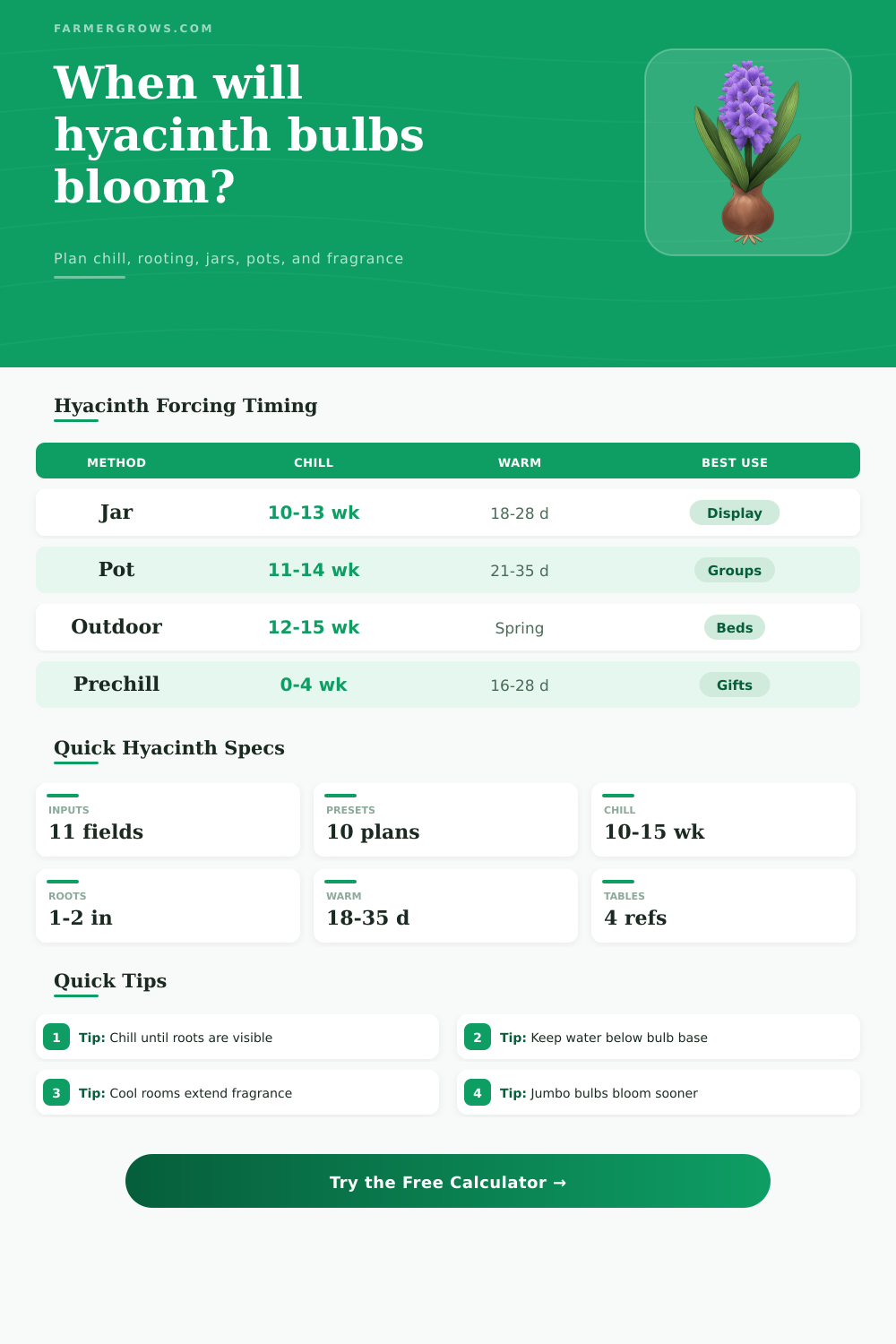
| Method | Cold Rooting Target | After Warmth | Hyacinth-Specific Note |
|---|---|---|---|
| Glass forcing jar | 10 to 13 weeks at 35 to 45°F | 18 to 28 days | Bulb should sit above water; roots reach into water before warmth. |
| Indoor soil pot | 11 to 14 weeks in cool dark storage | 21 to 35 days | Soil supports heavy spikes and keeps grouped bulbs steadier. |
| Outdoor container | 12 to 15 weeks of winter chill | Spring warmup dependent | Container roots need protection from freeze-thaw swings. |
| Outdoor bed | Natural winter chill after fall planting | Early to mid spring | Bloom shifts with soil thaw, exposure, and local spring speed. |
| Cold Range | Chill Credit | Rooting Effect | Use This Action |
|---|---|---|---|
| 35 to 45°F | Full credit | Best root growth and flower initiation | Keep bulbs dark, cool, and barely moist. |
| 46 to 50°F | Partial credit | Roots grow, but flower quality may lag | Add extra chill weeks before forcing. |
| 32 to 34°F | Slow credit | Roots form slowly if medium stays unfrozen | Allow more time before moving indoors. |
| Below 32°F | Risky | Frozen jars or pots can stall roots | Protect containers and inspect bulb firmness. |
| Bulb Grade | Warm Finish Adjustment | Fragrance Strength | Best Display |
|---|---|---|---|
| 14 to 15 cm | Add 3 to 5 days | Light to medium | Small jars or mixed bowls |
| 15 to 16 cm | Base timing | Medium | Windowsill pots and porch containers |
| 16 to 17 cm | Subtract 1 to 3 days | Strong | Holiday pots and fragrance bowls |
| 17 to 18+ cm | Subtract 3 to 5 days | Very strong | Single-bulb jars and show pots |
| Goal | Start Strategy | Move To Warmth | Display Control |
|---|---|---|---|
| Holiday fragrance | Start chill in late September or early October | Move rooted bulbs 2 to 4 weeks before the date | Use 60 to 65°F after buds color. |
| Late winter color | Start chill in November or use prechilled bulbs | Move when roots are dense and shoots are 2 inches tall | Bright cool rooms slow stretching. |
| Outdoor spring bed | Plant after soil cools in fall | No indoor move; wait for spring warmup | Mulch lightly where freeze-thaw heaves bulbs. |
| Staggered fragrance | Prepare multiple jars or pots together | Move batches 5 to 7 days apart | Keep later batches colder until needed. |
For jars: keep the water just below the basal plate, not touching the bulb. Hyacinths root into the water; a wet bulb base rots before the flower spike can finish.
For display dates: move rooted bulbs to a cool bright room first, then warmer display light after buds show color. That keeps stems shorter and fragrance lasting longer.
Start with what looks like a dirty onion, and end up with a strong perfume that scents the whole room. Magic, yes; but strictly biological magic. No matter what day of the week it happens to be, or whatever holiday, hyacinths don’t give a hoot. They need a cold storage time at just the right moment and a transition from one temperature to another.
If you skip the chill, there is no flowers, just leaves. If you rush the warmth, there are no flowers either, only weak, floppy stems that flop long before they scent the air. Use this tool, above, to plan exactly when in the process to begin the chill period, for those blooms to emerge just on the day you choose and not drift a few weeks earlier or later.
How to Grow Perfect Hyacinths
First things first: Soil pots aren’t like jars. Jars are elegant. But they’re not insulated. And they can’t hold up weight of a heavy flower spike. If you choose the jar approach on the calculator, you’re choosing greater reward with greater risk. Be sure to keep the water just beneath the basal plate. This keeps the bulb dry while allowing the roots to grow down into it.
A soil pot is more forgiving; it will hold up heavier stems better and the earth buffers change in moisture content. It also takes longer to root, since energy must be expended making a network instead of simply sending roots directly downward in water. Don’t fret about whether or not to add an additional day or two for forcing in soil vs. Forcing in water; the calculator accounts for these differences automatically.
Waiting around isn’t all there is to a chill week. There’s also a matter of breaking out of sleep on the cellular level. To do this, hyacinth has to be exposed to consistant cool temperatures. These temperatures tells him winter is here and spring is coming. A wild change from freezing one day to warm the next, as will happen in your garage, costs bigtime chill credit. See why a range of cool, like thirty-five to forty-five degrees, are best?
If it is warmer, the bulb thinks it is still fall and slows down. Colder than that, and the roots’ very tips may get damaged if they freeze while the rest of plant doesn’t. Consistent cool, not just occasional cold spikes, is what you’re after. Sounds easy…until you remember how impossible it can be to have some quiet spot in the house where it’s literaly always forty degrees for three months running.
Size of the bulb also affects timing (much more than novices anticipate). Generally speaking, the larger the bulb, the sooner it will finish. If you buy mixed sizes within a single pot, some will flower before others. The bigger bulbs will shove their spike up and out while those with less bulk remain only green-tipped. So, if you’re aiming for a co-ordinated display on a certain date, order only bulbs of similar size (grade). You can enter the bulb size into the calculator, too, so it can then adjust its end-bloom estimate to match.
This is another reason to purchase pre-forced bulbs from a nursery, since they have spared you the one or two-week wait in darkness. That is the tough part: the rooting up. After the bulb goes inside, light becomes an unexpected factor. “Brighter is better,” and “light makes things grow faster” is what many of us believe. True enough… But so does heat, which travels along with it.
What looks like an ideal growing spot (a sunny window) may actualy be cooking the roots because the glass holds on to some solar heat. A cool bright room is better than a hot sunny one. Stems stays strong and tight instead of getting all lanky and needing to be tied to sticks. Most tall, floppy-looking hyacinths has become that way from being rushed to warmth too fast or placed too close to a radiator. Another reason not to rush to blast them with heat: Cooler air also prolongs their fragrance.
You know what? The only way to promise yourself flowers on Valentine’s Day (or Christmas) is if you plan ahead. Once a bulb like a hyacinth has started growing, you can’t force it to speed up. It is better to be late than never, but using warmth to make it grow faster is harder then using cool to make it take longer. Which is why an early autumn start for the chill is key to getting a display of bulbs for winter.
When you carry them indoors to sit in bright light, their roots will have lengthened and turned white, that’s how you know they’re ready to push on into the growth-spurt phase. This tool lets you back-calculate from your desired date so you’ll know exactly where to place that bulb in the coat closet. You are not guessing anymore; you are just making a doable schedule you can follow.
There’s no magic here; it doesn’t take much skill, but it does require patience to get your hyacinths right. No green thumb required; all you need is a calendar and a thermometer. It pays off if you respect their biological clock instead of attempting to overrule it by taking any shortcuts. When that initial green shoot appears, after months of darkness indoors, you know why we repeat this cycle again and again each year as gardeners. It’s worth the wait, that jolt of scent and color.