Lily Bulb Bloom Time Calculator
Estimate first bloom window, chill fit, shoot timing, stem height, and bloom-group timing for Asiatic, LA, Oriental, and OT lily bulbs in pots or garden soil.
Choose a realistic lily bulb situation, then adjust the planting date, type, pot or ground setting, chill weeks, soil temperature, bulb size, and bloom group.
Your Lily Bloom Estimate
Enter lily bulb details to estimate first bloom timing.
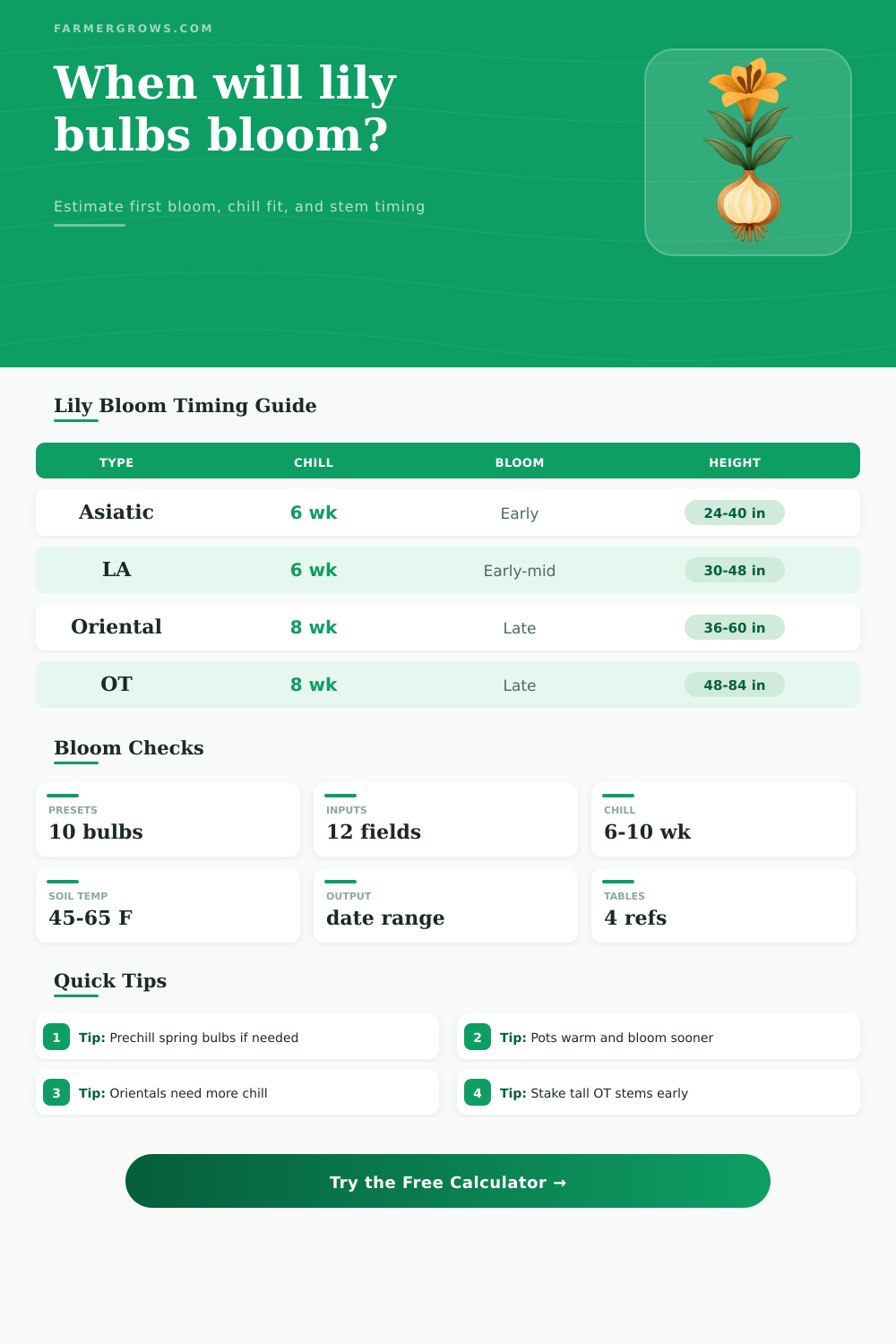
| Lily type | Typical first bloom pace | Minimum chill target | Bloom group cue | Usual stem height |
|---|---|---|---|---|
| Asiatic hybrid | 75-95 days after spring planting | 6 weeks | Early to early-mid | 24-40 in |
| LA hybrid | 80-100 days after spring planting | 6 weeks | Early-mid to mid | 30-48 in |
| Oriental hybrid | 100-125 days after spring planting | 8 weeks | Late, fragrant summer bloom | 36-60 in |
| OT / Orienpet hybrid | 110-140 days after spring planting | 8 weeks | Late to very late | 48-84 in |
| Trumpet / Aurelian | 95-120 days after spring planting | 7 weeks | Mid to late | 42-72 in |
| Setting | Timing effect | Best use | Watch point |
|---|---|---|---|
| Ground bed | Baseline timing | Perennial borders and cut rows | Cold wet soil can delay shoots |
| Raised bed | 2-5 days faster | Drained garden beds and cutting patches | Mulch to keep roots cool in heat |
| Outdoor pot | 5-10 days faster | Patio displays and movable color | Water swings can shorten stems |
| Greenhouse pot | 10-18 days faster | Forced pots and early crops | Warm nights can stretch stems |
| Soil temperature | Rooting and shoot effect | Timing adjustment | Practical note |
|---|---|---|---|
| Below 45 F | Dormant to very slow rooting | Add 10-18 days | Useful for chill, slow for bloom scheduling |
| 45-52 F | Cool rooting, slow emergence | Add 5-9 days | Common early spring garden soil |
| 53-62 F | Balanced rooting and shoots | Baseline | Reliable lily establishment range |
| 63-70 F | Fast shoots, shorter crop time | Subtract 4-8 days | Check moisture in pots and raised beds |
| Above 70 F | Fast top growth, warmer roots | Subtract 2-5 days | Shade pot walls and mulch root zone |
| Bulb or depth factor | Bloom effect | Stem effect | Calculator treatment |
|---|---|---|---|
| 12-14 cm bulb | Standard bloom on healthy stock | Moderate stems and bud count | Small positive or neutral stem score |
| 16-18 cm bulb | Strong first-season bloom | Taller stem and better bud count | Raises stem strength and confidence |
| 20 cm or larger | Best for showy stems | Heavy buds may need support | Adds stake cue for tall types |
| Shallow planting | Faster warm-up, weaker anchor | Can lean in wind or pots | Flags if depth is low for tall lilies |
| Deep planting | Delayed emergence | Better stem-root support | Adds days when over 7 inches |
This planner estimates normal garden and pot timing for true lilies. Weather swings, cultivar genetics, bulb storage quality, and wet soil can shift the real bloom window.
DID YOU DIG around in a garden bed and come up with nothing but earth, not even lily shoots? Don’t panic: It’s probably just a question of time, not a failure of your gardening skill. Unlike most perennials, true lilies is tough to cultivate. It is not that they don’t play by anyone’s rules but their own. Those rules depend more on how deep you planted them, the amount of chill hours they got, and soil temperatures from fall through spring different than on any calendar date.
Knowing approximately when they will bloom helps you plan instead of hoping. This involves estimating ahead of time. The calculator does all the arithmetic for you, but knowing where the numbers came from will make all the difference between a random display versus one you plotted.
Why Lilies Bloom When They Do
First, there’s the chill factor, which is a frequent misstep. To break their dormancy, Oriental and OT hybrids requires several weeks of cool weather. Plant too early (or live in a warm zone), and the bulb might go right back to sleep for the season. The tool calculates how many chill weeks your location provide compared to each variety’s requirements. You can easily make up for that shortfall by refrigerating the bulbs. Without those weeks of chill, even a big bulb won’t bloom.
Then think about where things are planted. What’s the setting? Do pots warm up faster (yes) or dry out faster (also yes)? Things will pop up and flower early in pots. Lilies in particular tend to do that which can make them less stable as well. You can set your pots or greenhouse option on the calculator, and it will adjust the timing accordingly. It will also factor in whether things is growing in raised beds, which warm up faster. Forget that variable and you’ll have your cut flowers ready a week or two ahead of when the rest of the garden are ready to go.
Depth is another factor. If planted too shallow, the stems will be weak and flop over when buds starts to swell. Too deep, and they’ll emerge later because there’s more soil to push up through. This took into account how tall you expect your plant to grow at time of planting, so it knows what depth equals stability for that height. For example, a tall OT tree lily need deeper planting than a compact Asiatic (which can manage with less dirt overhead).
The prediction is staking. How long can stems supports themselves against gravity? If you get it wrong the stems will break. The rest of the variables depend on soil temperature. Fifty-three- to sixty-two-degree Fahrenheit are ideal for root growth; anything colder causes stunted growth and anything warmer stresses them out. Using your estimate of soil temperature as input, the calculator adjust days to bloom. It’s a rough science, since weather changes from day to day, but it provides a realistic starting point.
Because you’re not forcing nature, you’re working with her… But working in concert. If you know how warmth, depth, and chill work together, you have biological machines… Lilies. That requires certain inputs, and you respond by treating them accordingly. And there you have it: a confidence level and a date range for your set-up.
You don’t even have to be an expert. But you would of have to understand the variables that control those big blooms. They save you from months of wondering what went wrong. The ones that tell you when to expect the flowers, because they’re going to show up like clockwork, on schedule and as heavy and luxurius as you’d imagined.
And that peace of mind? It’s worth taking the time to tweak the inputs.