Red Potato Growth Time Calculator
Estimate emergence, hilling timing, new red potato harvest, main crop harvest, and row yield from planted red seed potatoes.
Red potatoes are usually grown for early waxy new potatoes and modest-storage main crops. This calculator estimates field timing from seed pieces, soil temperature, planting depth, spacing, moisture, and red-skinned variety behavior.
📋Red Potato Field Presets
🥔Variety, Soil, and Storage Grid
⚙Seed Potato Timing Inputs
Red Potato Timeline Results
Dates are field estimates. Confirm with plant height, bloom, tuber size, skin set, and local weather before digging.
🌱Red Variety Timing Cards
📚Reference Tables
| Red potato variety | Typical maturity | New potato window | Best use | Timing note |
|---|---|---|---|---|
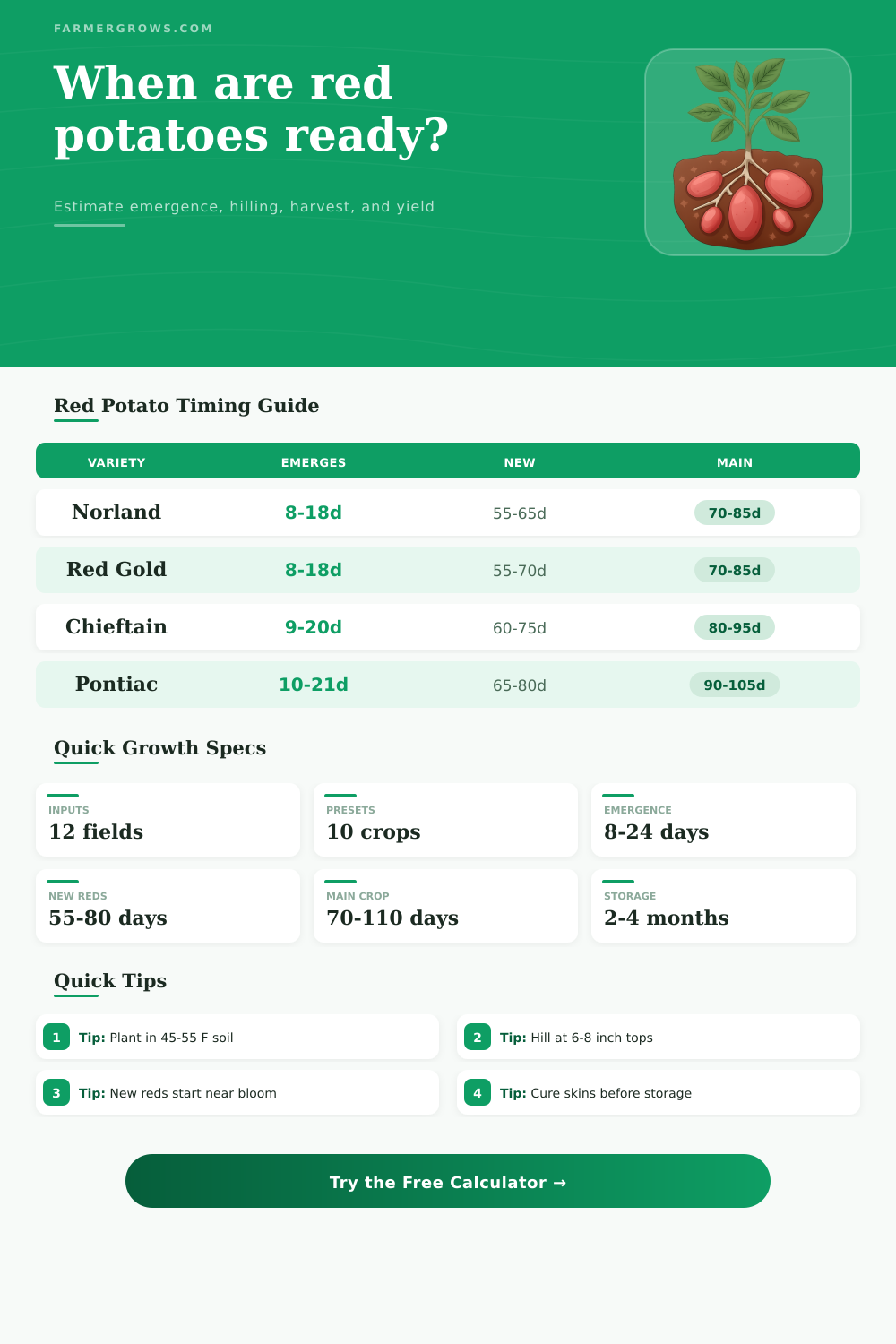
| Dark Red Norland | 70 to 85 days | 55 to 65 days | Early boiling reds, market bunches | Fast emergence from sprouted seed and good for short seasons |
| Red Gold | 70 to 85 days | 55 to 70 days | Early small reds with yellow flesh | Usually dug before long storage is the goal |
| Chieftain | 80 to 95 days | 60 to 75 days | Smooth red table potatoes | Let skins set for better handling after harvest |
| Red Pontiac | 90 to 105 days | 65 to 80 days | Larger main crop red potatoes | Needs more time than early reds for size |
| Red LaSoda | 90 to 110 days | 65 to 80 days | Warm-region red crops | Can handle warmer planting areas but still dislikes hot tuber set |
| Adirondack Red | 80 to 95 days | 60 to 75 days | Specialty red flesh potatoes | Harvest gently because colored flesh is often sold by appearance |
| Soil condition at planting | Emergence effect | Red potato risk | Calculator adjustment |
|---|---|---|---|
| 45 to 49°F, workable | Slow but acceptable | Seed pieces sit longer before shoots appear | Add 4 to 6 days |
| 50 to 60°F, moist and drained | Steady emergence | Best balance for early red planting | Base timing |
| 61 to 70°F, even moisture | Fast emergence | Good canopy start if soil does not dry out | Subtract 2 to 4 days |
| Cold wet clay | Delayed or uneven | Cut red seed pieces can decay before rooting | Add 6 to 10 days |
| Hot soil above 75°F | Shoots may emerge fast | Tuber initiation and yield may suffer | Add stress to harvest timing |
| Growth event | Common red potato cue | Typical days from planting | Field check |
|---|---|---|---|
| Emergence | First red potato shoots break soil | 8 to 24 days | Look along the row before disturbing seed pieces |
| First hilling | Plants reach 6 to 8 inches tall | 20 to 35 days | Cover lower stems without burying the growing tip |
| Second hilling | Canopy reaches 10 to 12 inches | 34 to 50 days | Finish ridge before stolons swell near the surface |
| New red potatoes | Bloom begins and small tubers size up | 55 to 80 days | Scratch a hill and harvest only what you need |
| Main harvest | Vines yellow, die back, and skins set | 70 to 110 days | Wait 10 to 14 days after vine kill for storage skins |
| Spacing choice | Expected tuber profile | Yield tendency | Use for red potatoes |
|---|---|---|---|
| 8 to 10 in in-row | More small potatoes | Moderate total weight | Good for bite-size new reds and early market harvest |
| 11 to 13 in in-row | Balanced count and size | Strong all-purpose yield | Default home garden red potato spacing |
| 14 to 16 in in-row | Fewer but larger tubers | Can improve size if water is steady | Useful for Red Pontiac and main crop reds |
| 30 to 36 in row spacing | Enough soil for hilling | Lower crowding stress | Standard spacing for ridge-grown red potatoes |
| Containers or bags | Smaller root zone | Lower yield per seed piece | Harvest young reds early and water consistently |
| Harvest goal | Skin condition | Curing target | Storage expectation |
|---|---|---|---|
| New red potatoes | Thin, easily rubbed skin | No storage cure needed | Eat within days for best quality |
| Fresh table reds | Mostly set but tender | Short dry-down in shade | A few weeks if cool and humid |
| Main crop reds | Skin does not slip under thumb pressure | 10 to 14 days near 50 to 60°F | Often 2 to 4 months by variety |
| Damaged or forked tubers | Cuts or bruises visible | Do not store long term | Use first to prevent rot spread |
💡Red Potato Timing Tips
For early new reds: Start with sprouted certified seed, plant into workable soil, and harvest gently around bloom. Red potatoes are often dug earlier than russets because waxy small tubers are the goal.
For storage reds: Stop digging by the calendar alone. Wait for vine dieback and skin set, then cure sound tubers before cool humid storage. Thin-skinned new reds do not keep like mature main crop potatoes.
The first time you pull a red potato out of the earth, there’s something about the moment: the thin, papery skin; the waxy, not-floury flesh. You won’t get that flavor from any of those spuds you buy at the store, not after they’ve spent their lives in the dark crates of delivery trucks traveling thousands of miles to reach you. It’s as though growing a crop of reds yourself is some kind of inside secret shared only between you and the earth.
Only the timing eludes most novice gardeners. One wrong guess (off by mere weeks), and even with all the right equipment (perfect dirt; certified seed stock), you could be left with nothing but empty, green tuber. Why? Knowing how long things take to grow is key to getting the timing right. Once you plug in your local conditions, the calculator above handles the heavy lifting.
Why Timing Is Important for Growing Red Potatoes
That’s because a variety’s maturity isn’t just about its own number, but how that number relate to the soil temperature. People tend to believe that planting date alone matters; it doesn’t. What really matters is what the temperature of the soil are on planting day, which determines how fast the seed piece will wake up and start sending roots around.
You might be planting into cold, wet clay. The calculator tacks on extra days to account for when the seed actualy wakes up and sends out roots, since they sits dormant longer. It’s a bummer to dig too soon and hope to find something when there is nothing there yet. Warm soil get things going faster at first. However, it can also stress tubers that don’t have enough moisture to keep up.
That’s what the tool factors in with an adjustment based off expected growing temperatures (and your irrigation status). It gives you a realistic window, not a best-case scenario.
Another important factor for your timeline is variety selection. Some varieties mature quickly and can absorbs as soon as they bloom, such as Dark Red Norland and Red Gold. If you crave fresh potatoes when others remains green shoots, these may be for you. Others take their sweet time. Chieftain and Red Pontiac falls into this group; they require more time to bulk up and develop thick skins for long-term storage. The contrast is made clear in the reference tables on the page which detail where various kinds of reds fit onto the season’s calendar.
Growing a late variety in a short season typically means tiny, underdeveloped tubers that also don’t hold very well even if you try. Better to select a crop whose timing align with yours rather than pursuing yield with a mismatched plant.
Another task to pay attention to early: hill your plants! After their stems get to six inches high, build up a mound of soil over them (and repeat just before they start sprawling all along the row). This keeps emerging tubers out of direct sun, which causes them to turn green and become bitter as they produce solanine. If you planted narrowly spaced rows, you may not have hilled properly; now those potatoes is exposed.
The calculator calculates when to do this, based on how deep you’ve planted, and how narrow your rows are. It helps keep you a little ahead of the game instead of behind the foliage.
There’s no one right way to harvest, though: It all depends on your use for the crop. If you want to enjoy new reds right away, be as gentle as possible and dig at bloom time when tubers reaches golf-ball size. No worries about waiting for the vine to die or even skin set. To store, plan to wait until the vine dies back and yellows naturaly. Tubers dug before then will have easy-to-tear thin skins that rot in short order in storage.
Curing the tubers for ten to fourteen days help harden the skin and heal minor wounds so they last longer in storage. Curing happens in a humid but cool location for a couple of weeks (10-14 days). This process heals any small wounds and toughens their skin, turning a summer snack item into a winter pantry staple.
With red potatoes, it’s not so much about the calendar, but learning the plant’s dance. You learn when the soil warms and what time the seed awakens. You learn when to hill to protect the fruit and when to be patient and wait for best results. It all makes sense once you learn how these elements play off one another; and stop guessing at what works, and get intentional about growing instead.
Those little details other people miss are often just what make the difference between a bucketful of perfect reds, or a handful of green scraps. You should of known that those small details matter more then anything else.