Bermuda Grass Seed Germination Time Calculator
Estimate Bermuda grass sprout timing from soil temperature, seed type, seedbed moisture, lawn area, and watering plan, then size seed and find the first-mow window.
Bermuda grass is a warm-season turf. For seeded lawns, soil temperature and surface moisture matter more than calendar date; this calculator treats hulled, unhulled, coated, and improved Bermuda seed differently.
Bermuda Germination Estimate
These estimates assume viable Bermuda seed, firm seed-to-soil contact, and shallow coverage. Cool soil, shade, deep burial, or dry seed can stretch the window.
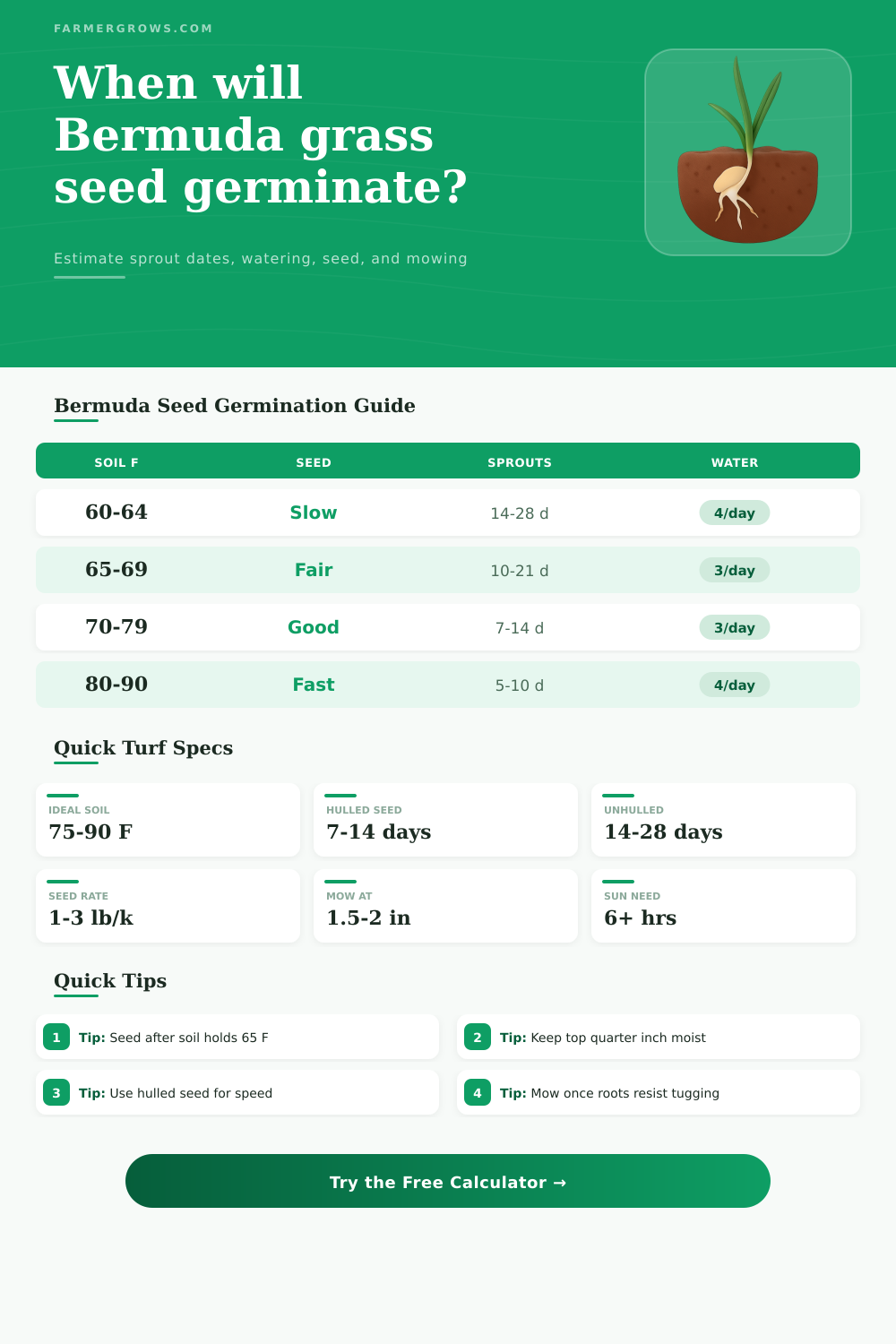
| Soil temperature at 2 in | Bermuda response | Typical germination window | Watering focus |
|---|---|---|---|
| Below 60°F | Too cool for reliable Bermuda seed | Delay or very uneven | Wait for warmer soil rather than soaking cold seed |
| 60 to 64°F | Marginal and slow | 14 to 28 days | Keep surface lightly moist, avoid crusting |
| 65 to 69°F | Acceptable start | 10 to 21 days | Short cycles, watch cool nights |
| 70 to 79°F | Good establishment range | 7 to 14 days | Moist top quarter inch until green haze appears |
| 80 to 90°F | Fast Bermuda germination | 5 to 10 days | More frequent light cycles in heat |
| Over 92°F | Fast but drying risk rises | 6 to 12 days if moist | Increase frequency, reduce puddling |
| Seed type or cultivar | Typical use | Clean seed rate | Germination behavior |
|---|---|---|---|
| Hulled common Bermuda | General warm-season lawns | 1 to 2 lb per 1,000 sq ft | Fastest common option in warm soil |
| Unhulled common Bermuda | Dormant or early shoulder seeding | 1 to 2 lb per 1,000 sq ft | Slower, more staggered sprouting |
| Princess 77 hulled | Finer-textured seeded turf | 1 to 2 lb per 1,000 sq ft | Fast when soil is consistently warm |
| Riviera hulled | Sports turf and transition areas | 1 to 3 lb per 1,000 sq ft | Good seedling vigor in warm weather |
| Yukon hulled | Transition-zone Bermuda lawns | 1 to 3 lb per 1,000 sq ft | Better cool tolerance, still needs warm soil |
| Coated Bermuda seed | Small lawns and easier spreading | Follow bulk label rate | Coating improves handling, not soil temperature |
| Germination stage | Days after seeding | Water target | Mowing or traffic note |
|---|---|---|---|
| Seed swelling | Day 0 to 3 | Top 1/4 in constantly damp | No traffic; seed can move before rooting |
| Sprout window | Day 5 to 21 | 2 to 4 short cycles per day | Keep seedlings from wilting during hot afternoons |
| Rooting begins | After visible green haze | Shift toward deeper, less frequent watering | Stay off saturated soil to avoid footprints |
| First mowing | About 3 to 6 weeks | Water deeply the day before, not right before mowing | Mow only when roots resist a gentle tug |
| Early turf fill-in | 45 to 60+ days | Deep irrigation as needed | Light use until runners thicken bare seams |
| Seedbed condition | Effect on Bermuda seed | Calculator adjustment | Field check |
|---|---|---|---|
| Lightly raked loam | Good seed contact and air | Neutral timing factor | Seed partly visible, soil firm underfoot |
| Sandy full sun | Warms fast but dries fast | More water cycles | Surface should darken after each light cycle |
| Clay or compacted soil | Crusting can slow emergence | Longer germination factor | Break crust gently if seedlings are trapped |
| Thin topdress | Protects seed and moisture | Slightly faster, steadier window | Keep cover thin enough for light to reach seed |
| Deep burial over 1/4 in | Small Bermuda seed may fail | Longer, risk warning | Rake high spots before watering heavily |
Moisture tip: Bermuda seed is shallow and small. During germination, short watering cycles are usually better than one heavy soak that moves seed into low spots.
Mowing tip: The first mow is a readiness check, not just a calendar date. Wait until seedlings stand at the target height and roots resist a gentle tug.
Don’t plant too early: Bermuda grass, a warm-season turf, depend more on soil temperature than calendar date or air temperature. Before sowing, test the soil by digging down two inches, your seed won’t sprout until there’s a steady range in the low sixties or higher for soil temperatures. You might sow when the air temperature is seventy but the soil remain cool.
You’re just stashing grain in the earth… Not getting things growing. This tool rely on real-time soil data to calculate your actual sprouting window (and help you stop guessing or using generic almanac-type tools). Depending on seed variety, timing of the crop’s emergence varies. Seed that has been hulled (meaning outside shell is off) will take up water more rapidy and pop through surface more quickly.
How to Plant Bermuda Grass
Unhulled seed still has its protective layer. This is good for long-term storage, but it is bad if you want fast results because seeds will emerge more unevenly and more slow. Many consumers buy seed by cost alone and don’t realize that they’ve swapped out longevity for speed. This tool will calculate adjusted expected emergence date based off your selection, so you’ll know what to expect: rapid development or a staggered emergence over several weeks time.
Bermuda seeds are so small and use up all their stored energy when they germinate. They would of die within 24 hours if the uppermost quarter-inch layer of soil dries out at any time. To grow them successfuly, you has to water very regularly, but lightly. Do not water once and thoroughly, which is a common error that kills seeds by washing them off or planting them too deeply. Instead, water several times a day, keeping surface moist but never wet.
The calculator takes into account your soil type: sand drains fast and you’ll have to check multiple times a day; clay retains water but can crust over in hot air. Knowing the quirks of your own yard, how it reacts to rain, keeps you from missing an area here or there, which can doom entire attempt.
Not all lawns are made equal in thickness, but that doesn’t mean you should just throw down more seed. If I throw down double number of seeds into any bare spots, I am unlikely to get double the thickness of grass because it will just be a tangle of seedling roots fighting over scarce nutrients. Generally, expect roughly one to two pounds per thousand square feet (depending on type) if using hulled seed; less if it is an improved variety (meaning better-quality control).
The estimator figure out required amount by multiplying the lawn area by a buffer for raggedy edges. It then divides that total by the number of bags and takes into account the germination percentage on bag label. This tells you exactly how many to purchase for first-time seeding and subsequent top-up.
To avoid killing your young plants by mowing them down while their roots is still tender (meaning they haven’t anchored), first mow at the right time. Wait until the foliage has grown as tall as length you will mow it to. Do not mow any earlier then when their roots have strengthened enough to hold up.
Do you have an established root? Test by trying to gently pull a seedling free; if it slides or tears easily, you’re too soon. The calculator use likely germination dates and average growing times to predict rooting. This tells you when those roots should be strong enough so you don’t accidentally cut them off too soon and rob the little guys of their ability to get along in this world.
It must have full sun (six hours daily or more); because Bermuda grows so fast it needs bright light to do that. Regardless of how carefully you water, seed will take longer to sprout with fewer hours of sunlight, and cover less area when finished. If the tool discovers you don’t get at least this much sun where you want to plant, it’ll let you know, and suggest that you lower your expectations.
Germinating Bermuda seeds takes time (as does everything else), and math figures out what it takes to make a good lawn, though outcome depends on conditions in the ground. Getting it properly warmed up, keeping top moist, and waiting till the roots grip are factors in success or failure here.