
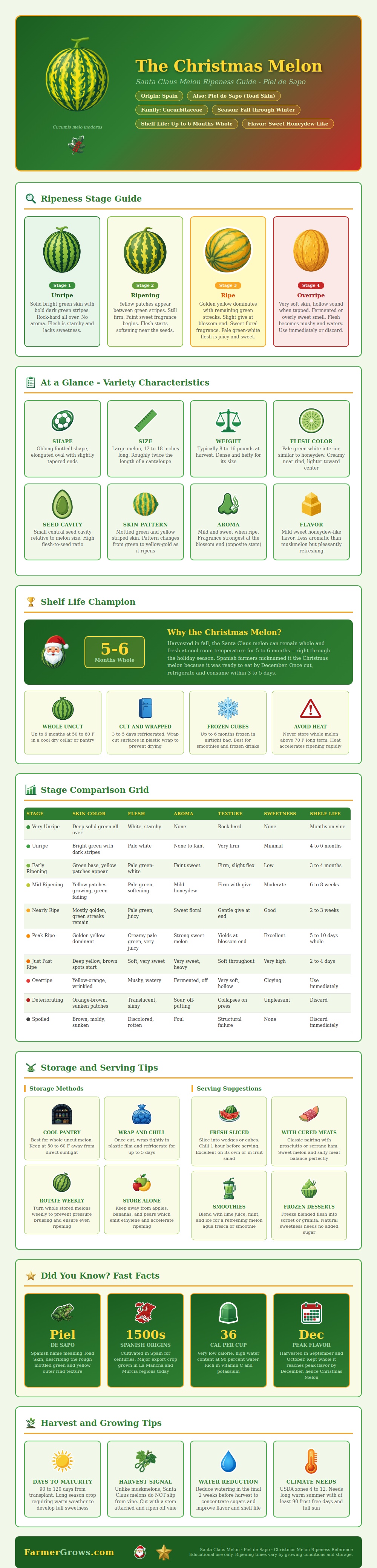
It gets better with age: That’s not how most fruit works. Within days of picking, berries mold and apples bruise. Not this one: A melon called Piel de Sapo; Toad Skin in Spanish, shows up at market with coarse yellow-green skin but paler, tastier flesh that actualy gets sweeter over time. You could pick it up in October and still have it for the Christmas holidays. It’s a melon designed for waiting.
If you want to know when it’s ready, the trick is knowing when to open it up. You will then be reward with sweetness or disappointed by starchiness. If you didn’t know what you were looking for, you wouldn’t notice much of visual change. Initially, skin is a bright green, marked with dark stripes. The fruit is rock hard and unscented. Inside, the flesh are starchy and white with no sugar.
How to Know When the Melon is Ready
With time, yellow spots emerge between the green stripe. That’s your cue that ripening has begun. The fruit remains firm but takes on the slightest hint of sweet smell around the blossom end. This is all good: It means you can stores these fruits for months to come, while waiting for the starches to convert into sugars. Rushing things won’t help.
When most of the skin color are a uniform golden yellow, they are truly ripe. Gently pressing on the blossom end (like an avocado) shows some give. If you tap it, it sounds hollow rather than solid and the flesh transforms into juicy interior that tastes like high-quality honeydew. At this point, there’s no beating the combination of flavor and texture, but go too long past this mark and you’re stuck with overripe fruit. It will soften, wrinkle up, and ferment so you won’t be able to enjoy it raw. Toss these fruits or cook them now.
Most of us go wrong here: We don’t store the entire melon in a cool dry place. A whole, uncut Santa Claus melon can last up to six months at room temperature. This explains why this long-lasting variety was called Christmas Melon in Spanish farming communities. There, growers picked it in late summer and it mellowed over winter. But after cutting into that festive fruit, time begins to run quick. The high water content makes it get soft quickly, so slice off what you’ll need now then refrigerate, and eat within three to five days. Tightly wrapping your slices will help. Unfortunately, nothing’s going to taste quite like fresh original.
Unlike most other cucurbits, melons take more care and a change in thinking about how to grow them. Unlike cantaloupes that slip off the vine at ripeness, melon fruits stays taut and attached right up until harvest. So you’ll cut them young but be sure that there’s plenty of time for them to develop (and don’t let them rot right on the stem!). Limiting water the last few weeks also concentrates the sugar content. This not only makes for longer-lasting storage, but also a sweeter fruit.
It is an act of faith; you’re harvesting an immature fruit hoping it will turn into something else. That’s what I like about the wait. Other fruit begs you now… But not the Santa Claus melon. In fact, it requires more care over time: patience pays off here as does waiting until the golden flesh has fully ripened and stopped being green. Slowly, slowly, the sweetness accumulate by the week, and the beauty is that it waits patiently all those weeks in your pantry. This is a bridge crop based off the end of the summer crops and the winter table. It’s been grown by generations of farmers for good reason. When you smell it and see its last bit of yellow on the rind, you’ll know.
It’s not a melon, really; it’s a promise fulfilled, one moment at a time.