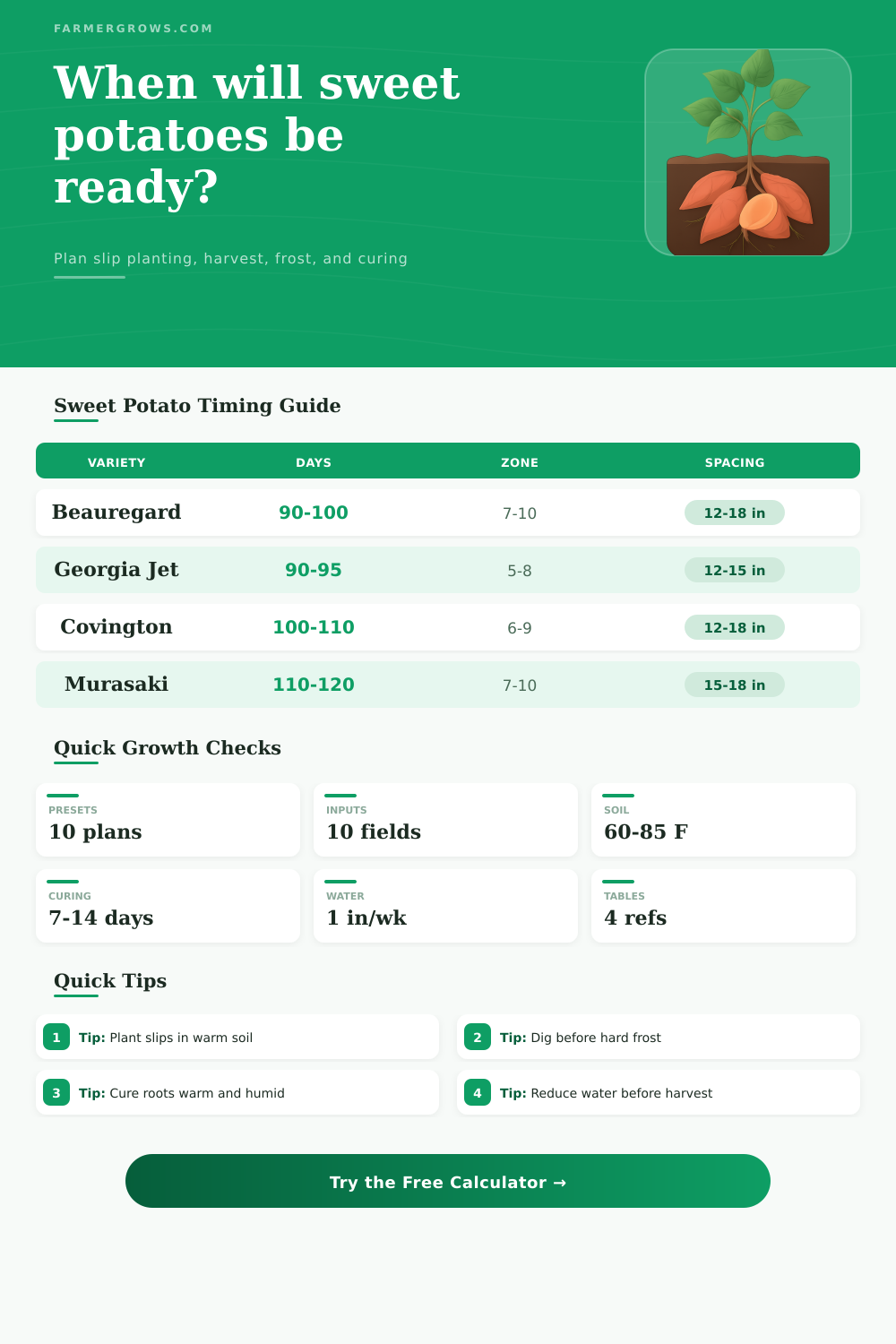
Sweet Potato Growth Time Calculator
Estimate slip establishment, harvest readiness, frost safety, curing finish date, row population, and water status from variety, planting date, soil warmth, spacing, maturity days, and irrigation.
Sweet potatoes are warm-season roots grown from slips, so the useful harvest date depends on more than the catalog maturity number. This planner adjusts the schedule for cool soil, zone pressure, vine spacing, and irrigation, then checks whether the crop can finish before frost and curing.
Georgia Jet and similar early types are the first choice when frost-free days are tight.
Beauregard, Jewel, and Centennial give broad garden reliability with flexible harvest timing.
Covington favors even roots and clean skin when spacing, water, and fertility stay steady.
Purple-flesh or Japanese-style roots usually need more warm days before sizing well.
Bushier types fit smaller gardens, but close spacing still needs water and open soil.
Sweet Potato Growth Plan
Your estimated planting-to-curing schedule will appear here.
| Variety | Typical days | Growth habit | Best use | Planning note |
|---|---|---|---|---|
| Beauregard | 90 to 100 | Vigorous orange standard | Fresh eating, storage, market | Reliable in many warm gardens and a good baseline preset. |
| Georgia Jet | 90 to 95 | Early orange, fast bulking | Short-season gardens | Often chosen where the frost-free window is limited. |
| Covington | 100 to 110 | Uniform orange market type | Consistent roots and clean skin | Steady water helps keep shape and sizing even. |
| Centennial | 95 to 105 | Classic orange garden vine | Fresh use and moderate storage | Works well when slips are planted after soil is truly warm. |
| Murasaki | 110 to 120 | Purple skin, pale flesh | Roasting and specialty sales | Give it extra warm days before judging root size. |
| Okinawan | 120 to 140 | Long-season purple flesh | Warm climates and specialty crops | Best in long seasons or protected warm sites. |
| Timing item | Common target | What to watch | Calculator effect | Field action |
|---|---|---|---|---|
| Slip planting | 2 to 4 weeks after last frost | Warm nights and warm ridges | Starts the maturity clock | Delay if soil is cold and wet. |
| Soil temperature | At least 60°F, better 65°F+ | 4-inch morning soil reading | Cool soil adds days | Use black mulch or wait for heat. |
| Establishment | 7 to 14 days after transplanting | New leaves and upright vines | Included in adjusted schedule | Keep slips evenly moist at first. |
| Root bulking | Mid to late season | Steady water, no deep cracking | Water and spacing shift final date | Stop heavy nitrogen after vines run. |
| Preharvest dry-down | 7 to 10 days before digging | Firm skin and workable soil | Shown in breakdown | Ease irrigation before harvest. |
| In-row spacing | Row style | Expected roots | Timing note | Best fit |
|---|---|---|---|---|
| 10 to 12 in | Tight bed or small roots | More roots, smaller average size | May finish small roots sooner | Baby roots and smaller gardens |
| 12 to 15 in | Standard garden row | Balanced count and size | Neutral timing baseline | Most orange varieties |
| 15 to 18 in | Market or storage row | Larger roots with room to bulk | May need a few extra warm days | Storage and uniform roots |
| 18 to 24 in | Long-vine specialty types | Fewer, larger roots | Long-season types benefit most | Purple and Japanese types |
| Rows 36 to 48 in | Field or wide garden | Better harvest access | Less disease pressure in humid sites | Vigorous vines and cultivation |
| Stage | Typical timing | Temperature target | Moisture target | Why it matters |
|---|---|---|---|---|
| Trial dig | 7 to 14 days before main harvest | Warm soil preferred | Avoid muddy digging | Checks root size before committing the row. |
| Main harvest | Before hard frost | Dig before chilling injury | Moderately dry soil | Bruised or chilled roots cure poorly. |
| Curing | 7 to 14 days | About 80 to 85°F | High humidity | Heals skin and improves sweetness. |
| Post-cure holding | 1 to 2 weeks after curing | Room temperature | Ventilated boxes | Lets flavors settle before storage. |
| Storage | After curing complete | About 55 to 60°F | Dry, not refrigerated | Cold storage can damage roots. |
Planting slips into cold soil can erase the advantage of an early calendar date. If the soil is under 60°F, wait, warm the ridge, or expect a slower start.
Sweet potato skins are tender at digging. Lift roots carefully, keep them out of cold rain, and move market or storage roots into warm, humid curing conditions quickly.
Growing sweet potatoes is not like growing other vegetable from seeds. Sweet potatoes is grown from slips, so you need to plan for them on your calendar. Once planted, each week counts because they needs warm days, which means there is usualy very little time between the last frost and planting time. The trick is to match up as best you can the slip variety with the weather report, and what your soil temp is telling you.
It is not just a catalog number. The maturity days listed on the slip label are what most folks use as their starting point. But it’s based off perfect conditions. A wide planting distance, cooler soil, shorter season: These will stretch the time frame. Steady water and a mild fall: It can shave days right off the same variety.
How to Plan for Growing Sweet Potatoes
Once you plug in those factors, the calculator up top do the math; and spares you from guessing at how far each one realy moves the needle. Soil temperature at planting is the quiet gatekeeper. If it’s under sixty degrees, slips grows a new root system gradually, and every day it lags compound throughout the entire season. Often just waiting until the ridge warms up to the mid-sixties save you more time than fussing with cold transplants.
It is the same with your frost date. You want a good buffer between the first hard freeze and harvest. This way, you don’t have to worry about chilling injury, which damage both storage life and flavor. Another tradeoff appears on the adjusted schedule: Spacing decisions determines yield (more rows = more roots) and size of tuber per plant.
Wider spacing leave tubers some room to bulk, for example, though it also might delay harvest. Closer spacing produces more roots per row but keeps individual tubers smaller, at the cost of limiting final size of any one tuber. Similarly, watering too much or too little either invites rot or stunts growth. It’s just where most varieties tend to land when vines starts running, which is why you see inch-per-week goal pop up on the inputs page.
Don’t treat curing like an afterthought, even though it’s the last phase of growing. Seven to 14 days of warm and moist conditions after digging will heal small wounds and convert starches into sugar. Rush it by forcing curing in cool air, or skip it entirely, and no amount of careful timing of your fieldwork would of produce the best-flavored roots.
This is where the page’s variety table comes in handy, listing those that will bear fruit and grow roots even if the season is shortened, and which require patient waiting for larger or flashier tubers. Some, such as the Georgia Jet types, will also ripen earlier in cooler climates compared to longer-season purple varieties; they’ll still be sizing up when frost hits. Fitting the correct vine to your climate frost window matter far more then eking out every extra possible day from the calendar.
The math’s done. Then comes the part that matters most: Does this plan sound realistic, for your own garden? Is the soil temperature looking marginal, and has the frost buffer narrowed down to a week? In those cases, it’s generally best to simply plant a bit earlier, maybe by covering the slips. You could also shift target date back a little on the schedule. Alternatively, you can live with an earlier but still perfectly good harvest instead of pushing the crop beyond its limits.
Make small changes now, while the slips remain out of the ground, and sweet potatoes will be forgiving.