
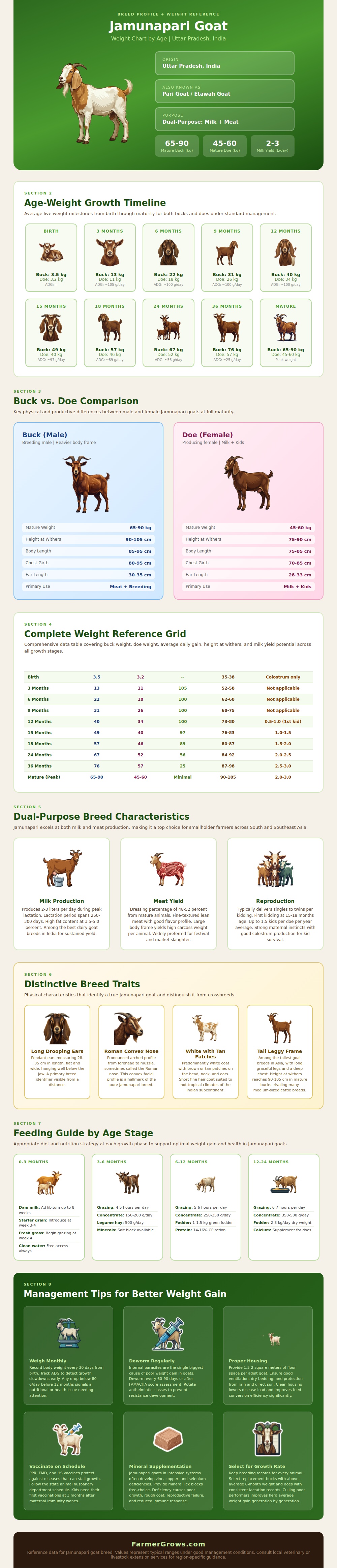
The Jamunapari goat is known for its growth rate, which are an important characteristic for those who breed and sell animals. The weights show how the animal progresses at various stages in life. Does it look like the kid is growing properly? Is the doe milking enough to maintain herself? Is the buck framed proper to be used for breeding?
The graph above display that progression well. This turns random notes into a plan of action. It’s no surprise that these long-eared, tall goats is called dual-purpose animals. They’ll give you some good milk, but also provide nice meat. For smallholders who can’t focus on only one type of product, that’s an attractive feature. But it also means mistakes are expensive.
How to Track Goat Weight and Growth
The kid that take longer to grow up now will be a smaller animal in adulthood, and the gap will widen over time. Early life counts the most: Growth is fast during first year (as indicated in the infographic) and then slows down after that. It’s naturaly. Growth problems in the first six months will be more severe then those that occur later. Stalled growth on the graph indicates something went wrong with the goat, either she didn’t get enough good milk from her mother or she got parasites. If you catch those stalling periods early, you can address the problem before it puts the animal too far back of the pack.
Sex differences becomes evident quickly and only increase with age of the goat. After about 3 months, bucks will outpace growth of does. Even though they aren’t full grown yet, this is the same size difference we see in adults. It’s obvious from looking at comparison portion in the infographic. If you’re sizing up young animals to use as breeders, knowing how much weight separation there should of be helps you decide if a doe weighing nearly the same as the buck is just an oddball. It also tells you if that weight difference is something to watch for in her kid.
As goats mature, their nutrition requirement also change and the chart can help you adjust those expectations to match what you feed them. For example, young goats will require more protein for rapid frame growth. Older does will need to maintain their body condition to support lactation and reproduction. The feeding guidelines in the infographic detail how this changes so that you don’t have to try to recieve exact amounts. Just know you are aiming for consistency (not perfection). On any given day.
Other factors is their housing and their overall health routine. Goats living in muddy conditions and lacking regular deworming every few months won’t reach the top of those weight ranges. When you weigh them each month, it becomes obvious which ones aren’t doing as well as they should. You can see this because there is less gain on chart than expected. That gives you something specific to look at instead of wondering.
At the end of the timeline are the mature weights, the outcome of all that earlier care. If a doe is in the upper half of her weight range, she’s likely to have maintained good milk production through several lactations. If a buck is on the heavy side, he’s generally got the bone strength and musculature needed for strong kids. This doesn’t just occur randomly. It’s the result of providing health care and nutrition that matches growth curve described in this chart.
Tracking weight by age transforms the process of raising Jamunapari goats from guesswork to something measurable. All you need to do is provide what’s necessary to maintain their progress along the path shown in the chart, which serves as a map.