Wet Brine Calculator
Size a weight-based wet brine for garden vegetables, olives, cheese, poultry, pork, fish, and smokehouse prep with salt purity, sugar, vinegar, and optional Cure #1 accounted for.
Choose a wet brine preset or enter your own batch. The calculator keeps liquid volume, food weight, percent basis, salt texture, and optional curing salt separate so you can see exactly what each choice changes.
★Wet brine presets
⚙Batch inputs
Formula breakdown
📊Salinity target cards
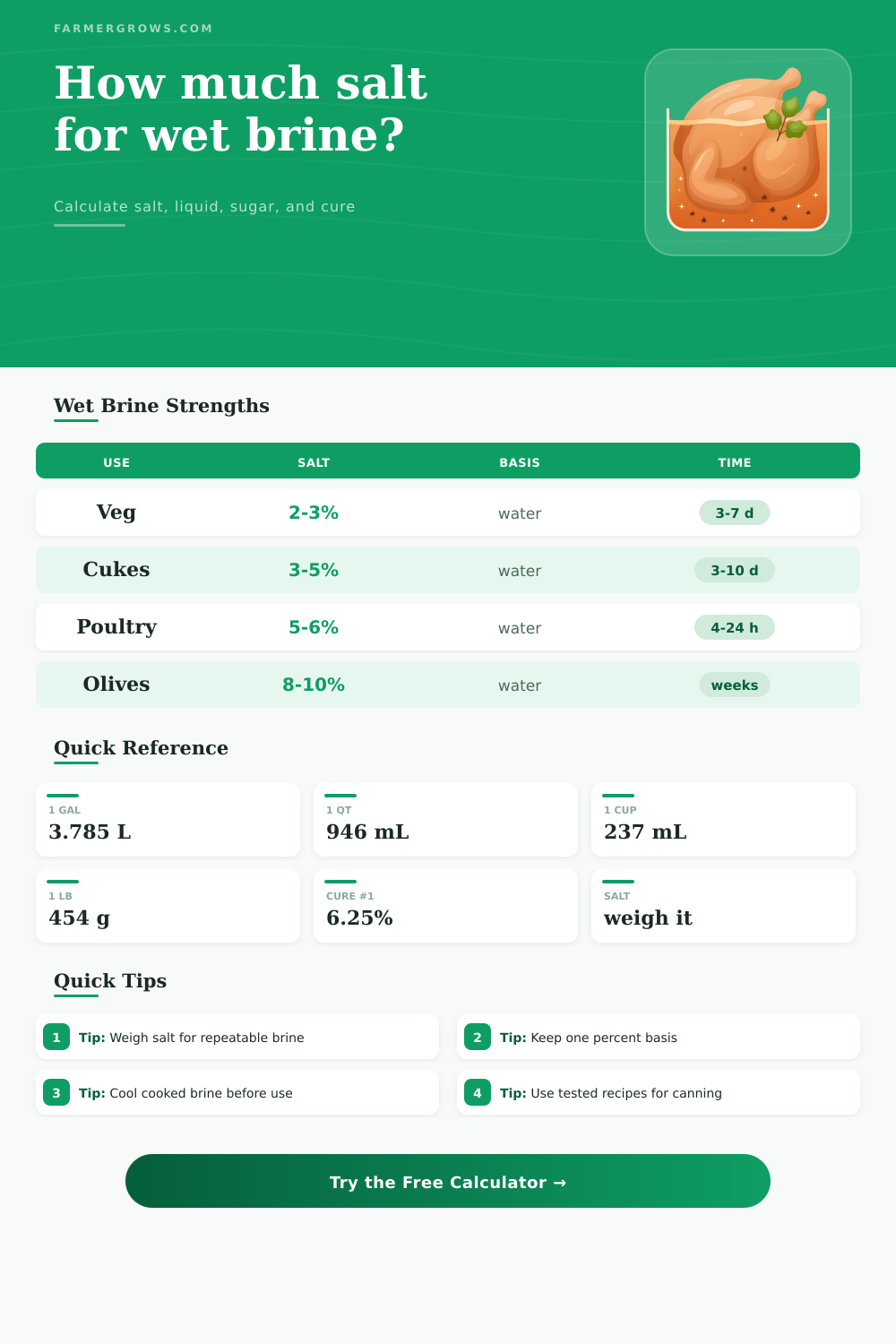
📋Wet brine strength reference
| Brine use | Typical salt range | Common basis | Notes |
|---|---|---|---|
| Mixed vegetable lacto brine | 2% to 3% | Liquid weight | Good for sliced carrots, beans, onions, and pepper rings. |
| Whole cucumber ferment | 3% to 5% | Liquid weight | Use the higher end for hot weather or large cucumbers. |
| Cheese or feta holding brine | 6% to 8% | Final solution | Match cheese style and chill brine before storage. |
| Green olive curing brine | 8% to 10% | Liquid weight | Long cures often step through changing brine strengths. |
| Poultry dinner brine | 5% to 6% | Liquid weight | Short brines are usually rinsed or patted dry before cooking. |
| Fish pre-smoke brine | 7% to 10% | Liquid weight | Often paired with sugar before drying to a pellicle. |
⚖Salt texture spoon estimates
| Salt texture | Approx grams per Tbsp | Best use | Repeatability note |
|---|---|---|---|
| Pickling or canning salt, fine | 19 g | Ferments and pickles | Dissolves cleanly and has little air space. |
| Table salt, fine | 18 g | Small kitchen batches | Iodized salt can darken some fermented vegetables. |
| Fine sea salt | 16 g | Vegetables and seafood | Mineral content varies by brand and source. |
| Morton kosher salt | 15 g | Meat brines | Denser than flake-style kosher salt. |
| Coarse sea salt | 14 g | Large brine pots | Stir until all crystals dissolve before measuring strength. |
| Diamond Crystal kosher salt | 8 g | Chef-style brines | Large flakes make spoon measures much lighter. |
🧪Basis and formula comparison
Salt equals brine liquid weight multiplied by target percent. This is the common quick method for vegetable ferments and meat brines.
Salt equals food plus liquid weight multiplied by target percent. This helps when the food absorbs salt during a longer rest.
Salt is solved so the finished saltwater solution reaches the target percent after salt is added.
📐Conversions for wet brines
| Measure | Metric equivalent | US equivalent | Calculator use |
|---|---|---|---|
| 1 gallon water | 3.785 L | 4 qt | Weighs about 3,785 g before salt. |
| 1 quart water | 946 mL | 4 cups | Convenient for poultry parts and jar batches. |
| 1 cup liquid | 236.6 mL | 8 fl oz | Useful for vinegar additions and small batches. |
| 1 pound food | 453.6 g | 16 oz | Used in equilibrium brine and Cure #1 math. |
| 1 ounce weight | 28.35 g | 0.0625 lb | Shown for salt and sugar output. |
🥧Common wet brine batches
| Batch | Liquid | Target | Salt to weigh |
|---|---|---|---|
| 1 quart pepper jar | 946 mL | 3.0% | 28 g salt |
| Half-gallon cucumber crock | 1.89 L | 3.5% | 66 g salt |
| 1 gallon poultry brine | 3.79 L | 5.5% | 208 g salt |
| 2 gallon olive brine | 7.57 L | 9.0% | 681 g salt |
| 2 quart fish brine | 1.89 L | 8.0% | 151 g salt |
ℹPractical brine notes
Using an brine calculator will allow you to accurately measure the amount of salt that you need to use in order to produce safe and flavorful brined foods. If you use too little salt, your brined foods may have undesirable texture characteristics. If you use too much salt, your brined foods may have an undesirable flavor.
If you use the wrong amount of salt in your meat products before roasting the meat products, the juiciness of the roasted meat products may be adversely affect. Many home cooks attempt to use measuring cup to determine the amount of salt to use in their brines. However, measuring cups are inaccurate because different type of salt have different weights.
Why Use a Brine Calculator
For these reasons, you should use a brine calculator to determine the amount of salt to add to your brined foods. The primary purpose of brining foods is to allow water and salt to diffuse into the foods until the concentration of salt inside the foods is the same than the concentration of salt outside the foods. When vegetables are brined, the vegetables give up some of their water and take up salt.
When meat is brined, the meat take up both water and salt. Because olives and feta cheese sit in their brines for many week or months, stability of the brine is important. A brine calculator considers the change of the brine; you may choose to measure the salt percentage of the brine against the weight of the liquid alone, or you may choose to measure the salt percentage against the combined weight of the food and the liquid.
Most recipes that call for brined vegetables instruct cooks to measure the salt percentage against the weight of the liquid alone, since the weight of the vegetables is small in comparison with the weight of the brine liquid. The salt that most brines use is not pure sodium chloride (salt). Most brand of salt contain varying amounts of water and minerals.
The salt may weigh differently if it is weighed as a volume of salt vs. The weight of the salt when it is packed in a jar. The weight of the salt should be used instead of volume measurement. The brine calculator will display the target weight of the salt first, since the weight of the salt is the most important measurement for brined foods.
The salinity of the water that is used in brining may also have an effect on the brined food. Hard water contains some dissolved salt. These dissolved salts will contribute to the salt level of the brine.
You can use the brine calculator to account for the salinity of the water so that you dont add too much salt to your brined foods. If you are using commercial vinegar to prepare a quick pickle, the salt calculator can also account for the salt that is contain in the vinegar. Sugar is an optional ingredient in most brines.
Sugar can be added to brines for fish in order to form a pellicle on the fish, or it can be used to balance the flavor of the brine if it is used to flavor meat. Sugar can also feed yeast if the brine temperature is too warm. Cure #1 is another optional ingredient.
Cure #1 contain nitrites that are used in the preparation of specific cured foods. The brine calculator accounts for the nitrite percentage in Cure #1 so that cooks dont have to account for this ingredient themselves. The brine calculator will warn cooks if the target nitrite level for the food to be brined is outside of a safe range.
However, the brine calculator does not account for food safety schedule that have been tested with the specific type of meat to be cured. The tested schedule accounts for the thickness of the meat to be cured and the temperature at which the meat will be cured. Brining requires that the salt be dissolve in the liquid.
Warm liquids dissolve salt faster than cold liquids. However, warm liquids encourage the growth of unwanted bacteria on the food. It is important to know the temperature of the brine prior to adding the food to be brined.
Most meat brines and brines for olives should be chilled below 40 degree F prior to adding the meat or olives to the brine. A table can be used to reference the salt percentages for different types of foods. For instance, a two-to-three percent brine may be used for sliced carrots, since the sliced carrots will take up the salt quick.
Brined whole cucumbers may require three-to-five percent salt in the brine, since the skin of the cucumbers will prevent the cucumbers from taking up salt as quickly as the sliced cucumbers would. Olives and feta cheese contain stronger brines since the olives and feta cheese will sit in the brines for many weeks or month. Many error occur when preparing brines.
For instance, one cup of kosher salt will not weigh the same as one cup of pickling salt. Furthermore, one jar will displace a different amount of liquid when filled with whole peppers than it will when filled with sliced peppers. These type of errors can be avoided by using a brine calculator to determine the amount of salt to use for the food to be brined and the amount of liquid to use for the brine.
A brine calculator can help cooks prepare brined foods, but it cannot ensure that the foods will be safe to eat. Ferments must remain in contact with the brine liquid to avoid bacterial growth. Canned foods must maintain a specific acidity level.
Cured meats must be cured to specific level of nitrites. The brine calculator may calculate the weight of a six-percent brine, for instance, but it will not indicate if the food prepared with that brine can be safely stored at room temperature. Brined foods should be prepared according to the validated recipes for those foods and according to the judgment of the cooks that prepare the foods.
The single most important habit to develop in the kitchen is to weigh your salt and to write down the percentage of salt that you used in the brine. If you write down the percentage of salt that you use, you will eventually find the salt percentage that produces the best result with each type of food that you wish to brine. The brine calculator will make it easier for cooks to write down the percentage of salt that they use when preparing their brined foods.