💧 Greenhouse Dehumidifier Calculator
Size moisture removal from greenhouse VPD, temperature, crop transpiration, and ventilation. The calculator compares current humidity to the target control point and turns the result into pints per day, runtime, and capacity margin.
Pick a real greenhouse humidity scenario. Each preset loads structure, climate, target VPD, crop moisture load, ventilation, and dehumidifier size so the calculator starts close to an actual job.
Humidity control snapshot
Enter the greenhouse conditions, then calculate the moisture load and the dehumidifier size needed to hold the target VPD.
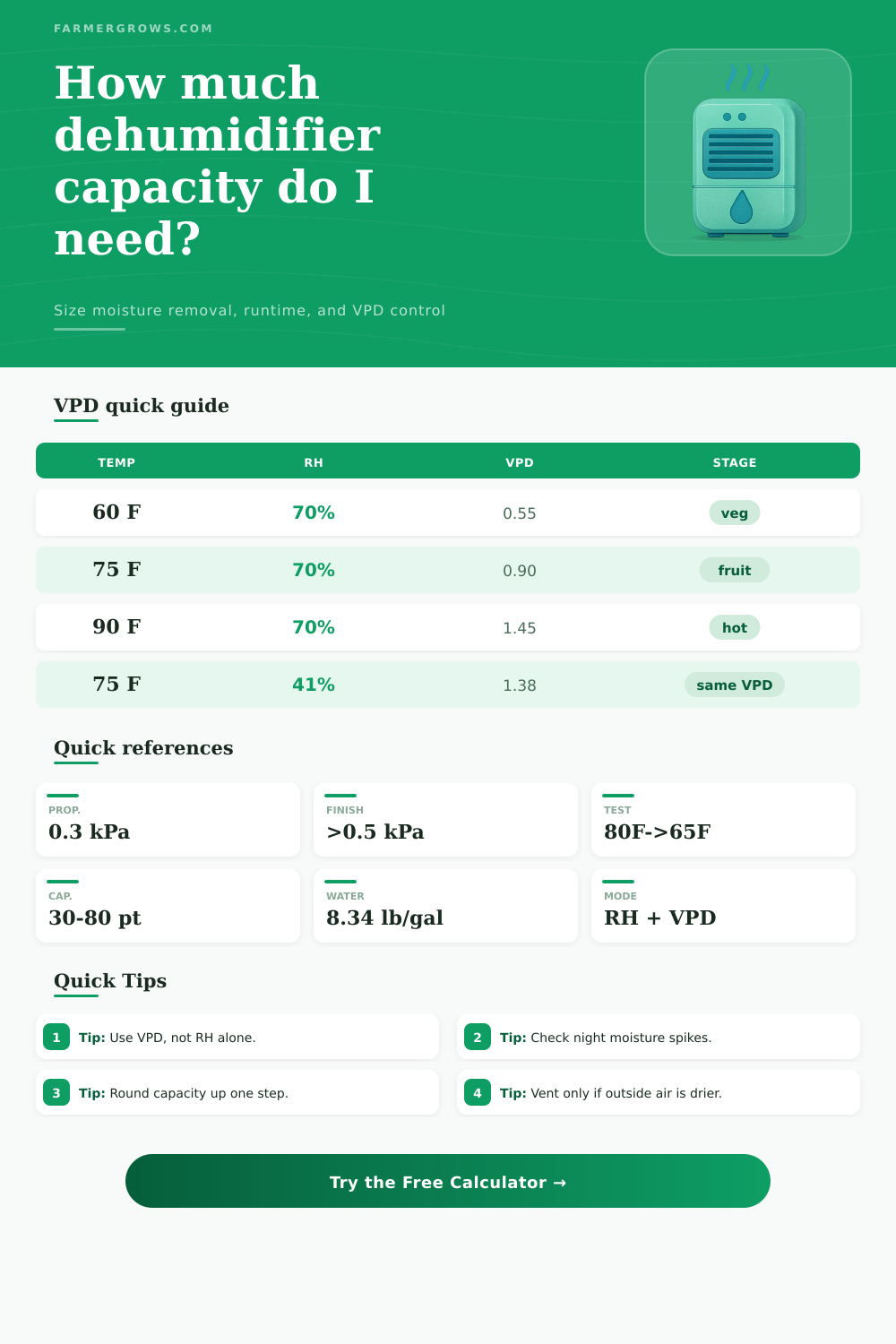
| Temp | RH | VPD | Note |
|---|---|---|---|
| 60 F | 70% | 0.55 kPa | Same RH |
| 75 F | 70% | 0.90 kPa | Same RH |
| 90 F | 70% | 1.45 kPa | Same RH |
| 75 F | 41% | 1.38 kPa | Same VPD |
| Stage | RH | VPD | Source |
|---|---|---|---|
| Propagation | Low RH | 0.3 kPa | MSU |
| Finishing veg | Moderate | >0.5 kPa | MSU |
| Tomato night | 65-75% | 0.5-0.8 | UTIA |
| Tomato day | 80-90% | 0.8 ideal | UTIA |
| Old rating | New approx. | IEF note | Test note |
|---|---|---|---|
| 30 pt/day | 20 pt/day | 1.35 L/kWh | 80F to 65F |
| 40 pt/day | 25 pt/day | 1.35 L/kWh | Cooler test |
| 60 pt/day | 35 pt/day | 1.50 L/kWh | Capacity shifts |
| 80 pt/day | 70 pt/day | 1.60-2.5 | Whole-home |
| Unit | Water mass | Volume | Use |
|---|---|---|---|
| 1 gal | 8.34 lb | 3.79 L | Water weight |
| 1 pint | 1.04 lb | 0.47 L | Per pint |
| 1 gal/day | 8 pints/day | 8.34 lb/day | Daily load |
| 1 pint/day | 0.125 gal | 0.47 L/day | Small unit |
This calculator uses MSU VPD guidance, UTIA tomato humidity ranges, DOE dehumidifier ratings, and a water-weight conversion anchored to 8.34 lb per gallon.
If you see moisture on the undersides of leaf in a greenhouse, you are seeing that the plants has ceased to breathe. If the stomata of the plants are closed, nutrients cannot be transport from the roots of the plants to the canopy of the plants. If the plants cannot transpire, they are unable to perform the process of pulling nutrients from the roots to the rest of the plant.
Thus, a plant may be surrounded by water, yet the plant cannot perform the biological processes necessary to breathe and exchange gas with the environment; it has become deficient in the nutrients required to perform these processes. Many grower pay attention to the relative humidity within greenhouses. While relative humidity is a valuable parameter for greenhouse management, it is not a complete metric of greenhouse moisture load because it does not account for air temperature.
How to Control Greenhouse Moisture so Plants Can Breathe
Instead, growers must pay attention to the Vapor Pressure Deficit (VPD) of the greenhouse environment. The VPD is a measure of how much moisture is in the air relative to the saturation point of that air at a specific temperature. VPD is also the force that dry the plants of the moisture necessary for transpiration.
If the VPD is too low, the air is too much humid for the plants to effectively breathe. If the VPD is too high, however, the plants will lose moisture faster then the roots can replace that moisture, leading to wilting plant. Thus, growers must find the target VPD that is appropriate for the plants that are to be grown.
The target VPD should be set to a value that ensures that the plants are stressed enough to effectively transport nutrients from the roots to the remainder of the plant, but not so stressed as to shut down the plants systems necessary for survival. Calculating the target VPD is a difficult scientific process. Various factors (air exchanges, crop load, greenhouse volume) influence the VPD that should be target for the greenhouse.
The calculator that is available on this page blends those variable together to calculate the number of pints of water that must be removed from the greenhouse environment each day to maintain the target VPD. The first mistake that many grower make is to base the sizing of the dehumidification equipment in the greenhouse based off the volume of the greenhouse. Growers must also account for the water that the plants themselves release.
An area with a dense growth of tomatoes will release more moisture into the greenhouse environment than a few seedling. If this moisture is ignored in the calculation of the needs of the greenhouse in relation to dehumidification, it is likely that the greenhouse will experience high levels of humidity and the development of mildew, regardless of the hours that the dehumidifier is operated. Ventilation can also introduce moisture into the greenhouse.
If vents are opened in the greenhouse when it is raining or foggy outside, moisture will enter the greenhouse, increasing the humidity. A tool is available on this page that allows the manager of the greenhouse to compare the absolute humidity outside the greenhouse to the absolute humidity inside the greenhouse. By understanding these two value, the grower can adjust the ventilation strategy for the greenhouse accordingly.
Once the total load of moisture that must be removed from the greenhouse is calculated, various hardware option must be considered. Options include refrigerant dehumidifiers and desiccant unit. Refrigerant dehumidifiers are typically used in greenhouses when the air temperature remain within a common range, but desiccant units may be better for cool greenhouses or high level of dryness within the growing environment.
In either case, the dehumidifier does not need to have a capacity that exactly match the moisture load of the greenhouse environment. A margin of capacity within the dehumidifier should be provided; it is better to purchase a dehumidifier with a capacity that has a margin of 15 or 20% over the calculated moisture load to account for unexpected moisture spike. Various factor that relate to the type of plants that are to be grown in the greenhouse are represented within the reference tables on this page.
For instance, propagation of plants typically requires low VPD value in order to prevent the plants from wilting, but finishing plants may be able to handle higher VPD value. A target VPD will eliminate the guesswork of how much moisture must be removed from the greenhouse in order to provide the right environment for the types of plant that will be grown. Within greenhouses, it is also important to pay attention to the dew point of the greenhouse environment.
The ability of the air within the greenhouse to hold water decreases as the temperature drop during the night. Condensation of the water vapor within the air can occur, and condensation is undesirable for the plants. Additionally, if the focus of greenhouse management is VPD and the amount of pints of water that must be removed from the greenhouse, the grower can control the greenhouse environment and manage the amount of moisture that is in the greenhouse, rather than allowing the greenhouse and its plants to be at the mercy of the weather.
Thus, by controlling the moisture load within the greenhouse, the plants can continue to breathe.