🌱 Cover Crop Mix Calculator
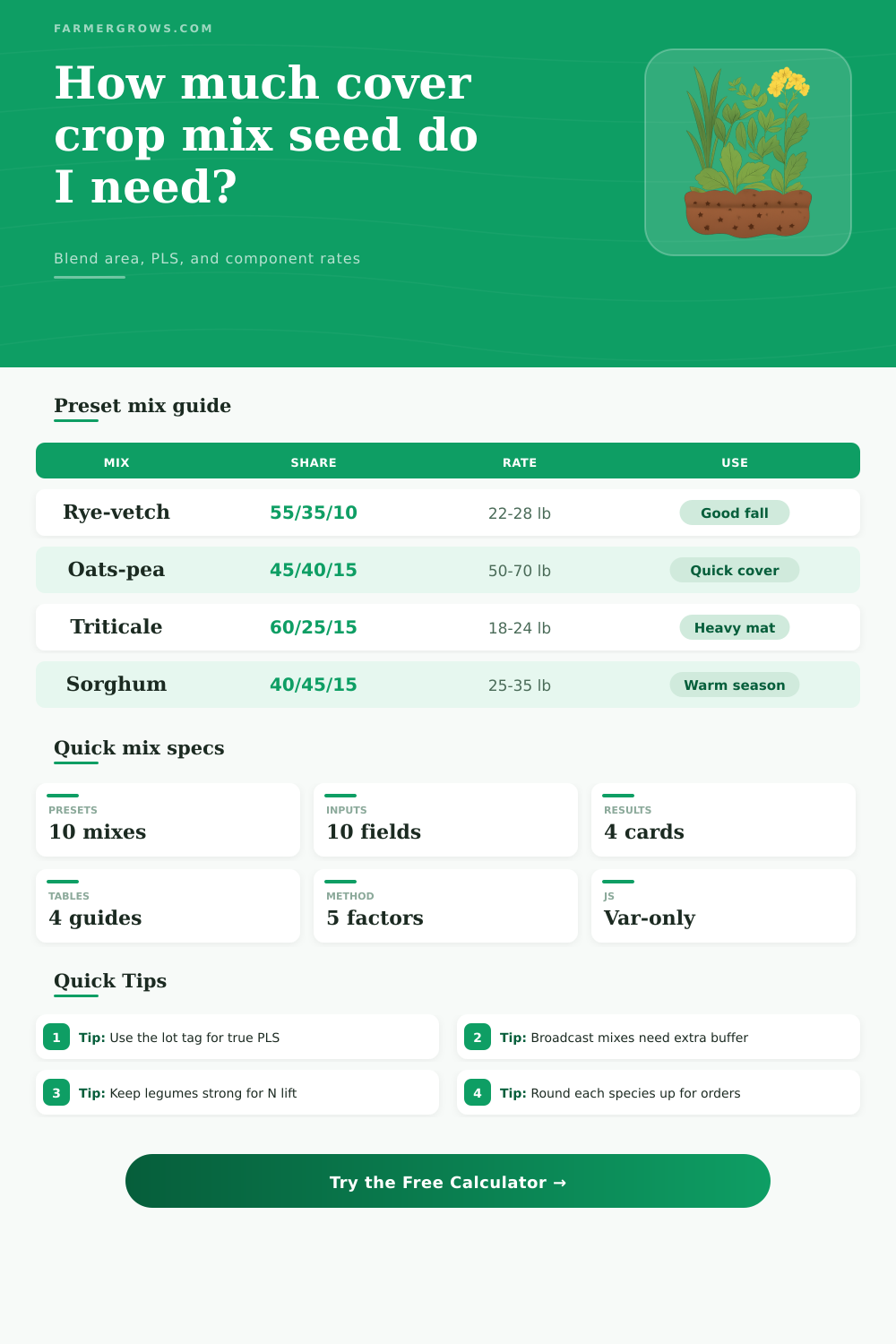
Size seed blends by area, PLS, method, and component rates. Compare real mix recipes, total seed weight, and bag counts in one layout.
Mix ready
Pick a preset or adjust the rates to see the field totals.
Drill
Best for cleaner placement, lower loss, and tighter seed count estimates.
Air seeder
Good when you want solid placement but a little more allowance than a drill.
Broadcast
Use for faster field work, then raise the buffer to cover uneven seed contact.
Overseed
Best for frost-seeding or cover-over-stand work where establishment is less certain.
| Mix | Rates | Use | Note |
|---|---|---|---|
| Rye + vetch + radish | 44 / 18 / 8 / 4 | Fall cover | Fast canopy |
| Oats + peas + radish | 32 / 28 / 10 / 6 | Spring cover | Quick lift |
| Triticale + clover | 38 / 22 / 10 / 4 | Grazing | Balanced mix |
| Sorghum + cowpea | 26 / 22 / 0 / 12 | Summer biomass | Warm window |
| Component | Common species | Imperial rate | Metric rate |
|---|---|---|---|
| Cereal | Rye, oats | 18-55 lb/ac | 20-62 kg/ha |
| Legume | Vetch, pea | 10-35 lb/ac | 11-39 kg/ha |
| Brassica | Radish, turnip | 4-12 lb/ac | 4-13 kg/ha |
| Broadleaf | Flax, chicory | 2-15 lb/ac | 2-17 kg/ha |
| Method | Factor | Best when | Tradeoff |
|---|---|---|---|
| Drill | 1.00x | Firm seedbed | Least waste |
| Air seeder | 1.05x | Even spread | Small cushion |
| Broadcast | 1.15x | Fast work | More buffer |
| Overseed | 1.20x | Frost seed | Most loss risk |
| Pack | Weight | Count | Note |
|---|---|---|---|
| 50-lb bag | 50 lb | 1.00 | Imperial pack |
| 25-kg bag | 55.1 lb | 1.10 | Metric pack |
| Bulk tote | 1000 lb | 20.00 | Large order |
| Mini lot | 25 lb | 0.50 | Sample seed |
Plan multi-species cover crop blends by area, seed rate, PLS, and establishment method. Compare preset mixes, review component totals, and size bags before you order seed.
Cover crop mixes are blends of several different plant species that is used to enhance the soil in fields that lie between crops that are to be grown. Cover crops help the soil in a variety of ways; they cycle nitrogen, they suppresses weeds, and they prevent soil erosion caused by the winter weather. In creating a cover crop mix, a person must select various plant categories and include each according to a specific percentage within the mix to ensure that each species in the mix work together for the benefit of the soil, and that no species dominate the others.
Cover crop mixes often include four different plant categories: cereals, legumes, brassicas, and broadleaves. Cereals, such as wheat or rye, are typically the primary components of a cover crop blend; cereals grow quick and generate a heavy biomass cover of the ground. The farmer typically sows cereals at a rate of 40 to 50% of the total mix.
How to Make and Plant a Cover Crop Mix
Legumes, like peas or vetch, contributes nitrogen to the soil, and are typically included at a rate of 20 to 30% of the total mix. Brassicas, such as radishes and turnips, help to break up the soil, and are typically included at 10 to 15% of the total mix. Lastly, plants like flax and chicory, which are known as broadleaves, help to aid in the development of pollinators in the field, as well as break crop disease cycles; these species are typically sown in amounts of less than 10% of the total mix.
The total seeding rate of the cover crop mix will vary with the time of year in which the cover crop is to be planted. For instance, fall planting rates may contain higher percentages of cereals to encourage the cover crop to establish prior to the winter season. Spring planting rates, in contrast, may contain higher percentages of legumes, since legumes adds nitrogen to the soil more quickly.
Additionally, the type of environment in which the cover crop will be planted will impact the type of species that is planted; species like sorghum and cowpea grows in warm soils, while other species may be required for colder soils. The method in which the cover crop seeds are to be planted will also impact the amount of seed that the farmer must purchase. If the farmer is to place the cover crop seeds into the ground with a seed drill, the manufacturer’s recommended base rate of the seeds may be used.
If the farmer is to be scattered the seeds across the field by broadcasting, however, 15% more seed is require by the farmer. Additionally, air seeders can be used to oversow cover crop seeds into fields that contain standing corn; in this case, the farmer requires even more seed due to the frost cycles that may thin the stands of corn in the fields. The third factor that the cover crop planning farmer must consider relates to the Pure Live Seed (PLS) percentage of the seed blend.
The PLS percentage refers to the amount of actual seed in a bag of seed; it is possible for this percentage to be lower than 100% due to the storage of the seeds. Thus, the target population of the fields divided by the fraction of the PLS will determine the amount of seed that the grower should order. Additionally, buffer rates can be incorporated into this calculation, as well.
For example, a 10% buffer can allow for spillage of seeds during transportation of the seeds, but a 20% buffer can account for any errors in planting the seeds in fields with challenging conditions. In order to calculate the total amount of seed that should be ordered, the base rate, method factor, stand factor, inverse of the PLS, and buffer factor should be multiplied. For instance, if a person plans to establish a cover crop blend in a 20-acre field at a base rate of 70 pounds of seed per acre, using a seed drill, adding a 10% buffer factor, and using seeds with a PLS percentage of 95%, the farmer will need to order 1,060 pounds of seed to cover the area.
If the method is to be changed to broadcasting seeds in a rough seedbed, however, 25% more seed will be required to establish the cover crop. Beyond the calculations associated with cover crop establishment, it is also important to consider in which crop rotation the cover crop will be used. For instance, cover crop blends can be used in both fall seasons and spring seasons.
Fall cover crops help to build the soil during the winter months, while spring cover crops help to suppress the weeds that may grow in the fields during the summer months. Fields that establish heavy amounts of cereal crops produce a heavy biomass of plant material, but contain little nitrogen for the soil. Therefore, it is best to use a cover crop blend that is balanced in its requirement for each type of species, as this type of blend will benefit the soil over many growing seasons.