🌽 Growing Degree Days Calculator — Corn
Track heat unit accumulation to monitor corn development stages accurately
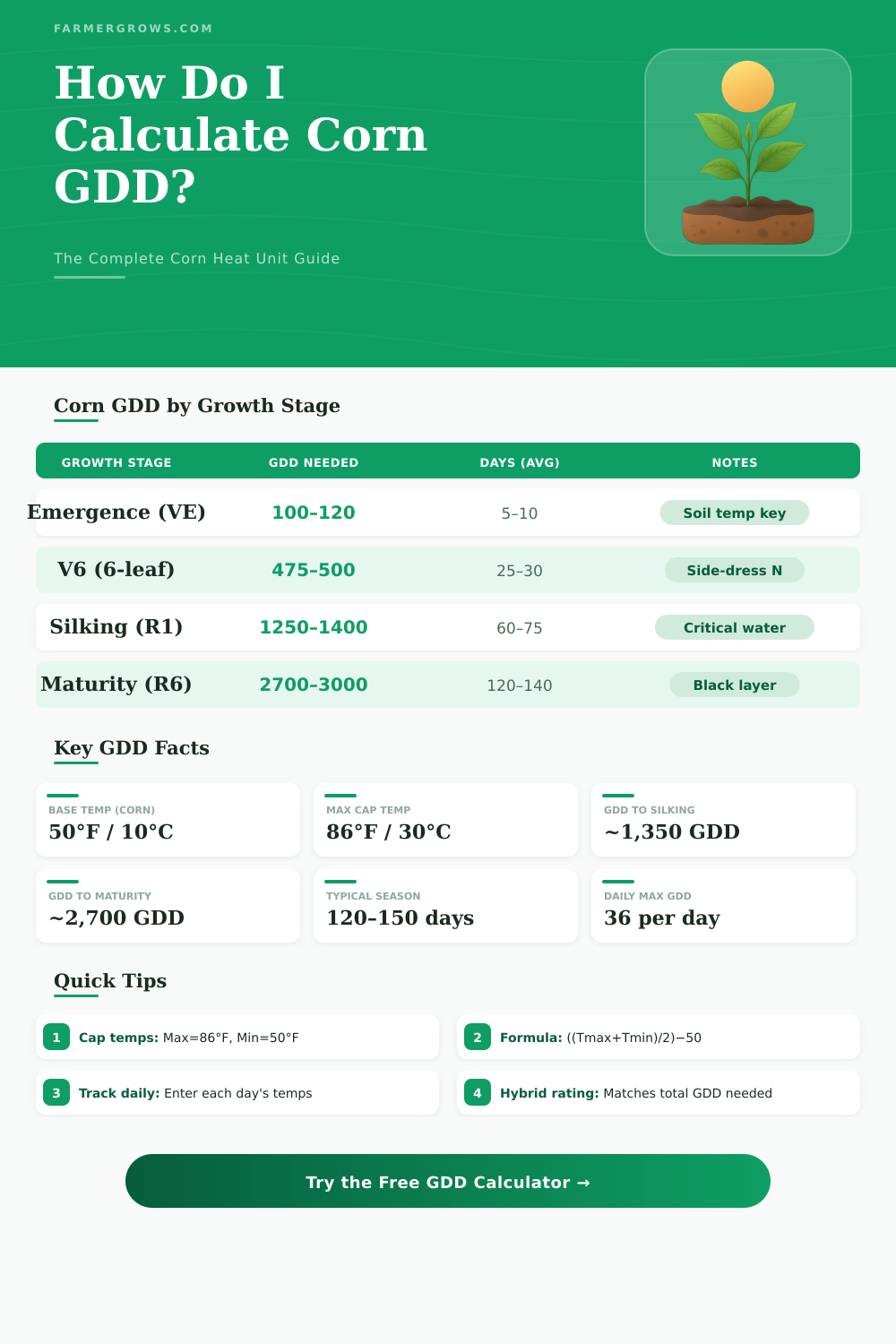
| Growth Stage | GDD Needed (°F base 50) | GDD (°C base 10) | Avg Days from Plant | Key Event |
|---|---|---|---|---|
| VE – Emergence | 100 – 120 | 56 – 67 | 5 – 10 | Seedling emerges |
| V3 – 3rd Leaf | 200 – 250 | 111 – 139 | 12 – 18 | Root system establishes |
| V6 – 6th Leaf | 475 – 500 | 264 – 278 | 25 – 32 | Growing point above soil |
| V10 – 10th Leaf | 750 – 800 | 417 – 444 | 38 – 45 | Ear shoot developing |
| VT – Tasseling | 1135 – 1150 | 631 – 639 | 55 – 65 | Tassel fully emerged |
| R1 – Silking | 1250 – 1400 | 694 – 778 | 60 – 75 | Silks visible, pollination |
| R2 – Blister | 1600 – 1700 | 889 – 944 | 80 – 88 | Kernels blister stage |
| R3 – Milk | 1800 – 1900 | 1000 – 1056 | 88 – 98 | Milky fluid in kernels |
| R4 – Dough | 1975 – 2100 | 1097 – 1167 | 95 – 108 | Starch accumulation |
| R5 – Dent | 2190 – 2350 | 1217 – 1306 | 108 – 120 | Kernel denting |
| R6 – Maturity | 2700 – 3000 | 1500 – 1667 | 120 – 145 | Black layer, max yield |
| T-Max (°F) | T-Min (°F) | GDD (°F base 50) | GDD (°C base 10) | Conditions |
|---|---|---|---|---|
| 95 | 70 | 28 | 15.6 | Very Hot Summer |
| 90 | 68 | 29 | 16.1 | Hot Summer |
| 86 | 65 | 25.5 | 14.2 | Warm Summer |
| 82 | 60 | 21 | 11.7 | Typical Summer |
| 78 | 55 | 16.5 | 9.2 | Mild Summer |
| 74 | 52 | 13 | 7.2 | Cool Summer |
| 70 | 50 | 10 | 5.6 | Minimum Growth Day |
| 65 | 48 | 6.5 | 3.6 | Near-threshold Day |
| 60 | 45 | 2.5 | 1.4 | Very Low GDD Day |
| 55 | 40 | 0 | 0 | No Accumulation |
| Maturity Class | GDD Required (°F) | GDD (°C) | Typical Days | Best Use Region |
|---|---|---|---|---|
| Very Early (70-75 day) | 2,200 – 2,400 | 1,222 – 1,333 | 70 – 80 | Northern Canada, short seasons |
| Early (80-85 day) | 2,400 – 2,600 | 1,333 – 1,444 | 80 – 90 | Northern US, Canada |
| Medium-Early (90 day) | 2,600 – 2,800 | 1,444 – 1,556 | 88 – 100 | Corn Belt north |
| Medium (100 day) | 2,700 – 2,900 | 1,500 – 1,611 | 95 – 110 | Central Corn Belt |
| Medium-Full (110 day) | 2,900 – 3,100 | 1,611 – 1,722 | 105 – 120 | Central to southern |
| Full Season (120+ day) | 3,100 – 3,400 | 1,722 – 1,889 | 115 – 135 | Southern US |
| From Stage | To Stage | GDD Span (°F) | Approx Days |
|---|---|---|---|
| Planting | Emergence (VE) | 100 – 120 | 5 – 10 |
| Emergence | V6 | ~380 | 15 – 22 |
| V6 | Tasseling (VT) | ~650 | 28 – 35 |
| Tasseling | Silking (R1) | ~150 | 5 – 8 |
| Silking | Milk (R3) | ~500 | 20 – 28 |
| Milk | Dent (R5) | ~400 | 18 – 25 |
| Dent | Maturity (R6) | ~450 | 18 – 25 |
| Planting | Maturity (R6) | ~2,700 | 100 – 120 |
Growing degree days, or GDD for short, are a method that is used to measure the growing degree days that is required by corn to grow. The plants require the use of heat in order to grow, and there are certain stage within the plant that require those degree days in order to complete such a task. As such, its impossible to rely on calendar days alone to determine the time that it will take for the corn to reach certain stages in its growth.
Growing degree days allow for farmers to understanding the progress of the corn plants by calculating the amount of degree days that the plants use to perform their growth tasks. To calculate the growing degree days for a given period of time, there is a specific mathematical formula that is used. Growing degree days for corn begin to accumulate when temperatures rise to 50 degrees Fahrenheit.
What Are Growing Degree Days for Corn
If the temperature dont reach 50 degrees during the time period that is calculated, there are 0 growing degree days for that period of time. Additionally, there is a limit to the amount of growing degree days for corn calculations; 86 degrees is the maximum temperature for growing degree days calculations for corn. If the temperature rise above 86 degrees, the growing degree day calculation will still use 86 degrees as the high temperature value for the period.
To calculate the growing degree days for a single day, the average of the high and low temperatures for that day must be calculated. That calculated average must then be subtracted by the base temperature of 50 degrees to determine the growing degree days for that single day of corn growth. Because growing degree days can help scientists and farmers to determine the growth stages of the corn plants, the stages of corn growth can be easily predicted.
For instance, the emergence of corn begins at around 100-120 growing degree days. Additionally, 475 growing degree days will lead to the corn reaching its V6 growth stage, at which time nitrogen fertilizer should be applied to the corn field. At 1,350 growing degree days, the corn begins to silk, another critical stage for corn growth.
Growing degree days continue to be tracked until the corn reaches physiological maturity at approximately 2,700 growing degree days. The type of corn hybrid that growers plant into the fields can be based off the total number of growing degree days that will be experienced within that region. If the number of growing degree days for that region is insufficient to supply the requirements of the selected hybrid, that corn will not reach maturity before the frost period.
For instance, the growers in the north may select corn hybrid with requirements of approximately 2,400 growing degree days, as the growing seasons in the northern regions are more short than those in other parts of the country. In contrast, the growers in the southern regions can use the additional heat of the region to grow corn varieties that require 3,200 growing degree days. Any attempts to plant corn varieties with requirements of growing degree days beyond what can be supplied to those fields will lead to the harvest of immature corn.
Various factors will impact the growing degree days for corn in a field. For instance, the soil temperature for the depth at which corn is planted will impact the emergence of corn from the soil. Additionally, the amount of cloud cover during the growing season will impact the growing degree days for corn; the more clouds that appear in the sky, the less growing degree days the corn plants will accumulate.
The amount of irrigation in the fields will also impact the growing degree days; irrigation will cool the corn fields and reduce the growing degree days that is allowed to accumulate by the plants. Furthermore, growing degree days must be tracked over time; counting the growing degree days for a single day will fail to reflect the total number of growing degree days that the corn has accumulated since emergence from the soil. Through the use of growing degree days for corn, farmers can plan for the harvest of the corn and the fertilizing of corn fields.
For instance, if it is determined that the corn plants will accumulate 500 more growing degree days before they reach maturity, and if 18 growing degree days are accumulated per day, then it is possible to calculate the amount of days that will pass before corn reaches maturity; in this example, there would be 28 days until maturity. Through the use of growing degree days, farmers can ensure that the fields are managed proper throughout the growing season.