Greenhouse Thermal Mass Calculator
Estimate how much heat storage your greenhouse can hold from water, stone, brick, or masonry mass. Size footprint, coverage, depth, and temperature swing before you place the load.
Pick a layout to seed the calculator. Each preset sets shape, footprint, mass type, coverage, depth, buffer, and temperature swing for a real greenhouse-style thermal mass plan.
Thermal Mass Output
Calculated from the greenhouse footprint, chosen material, and the storage target above.
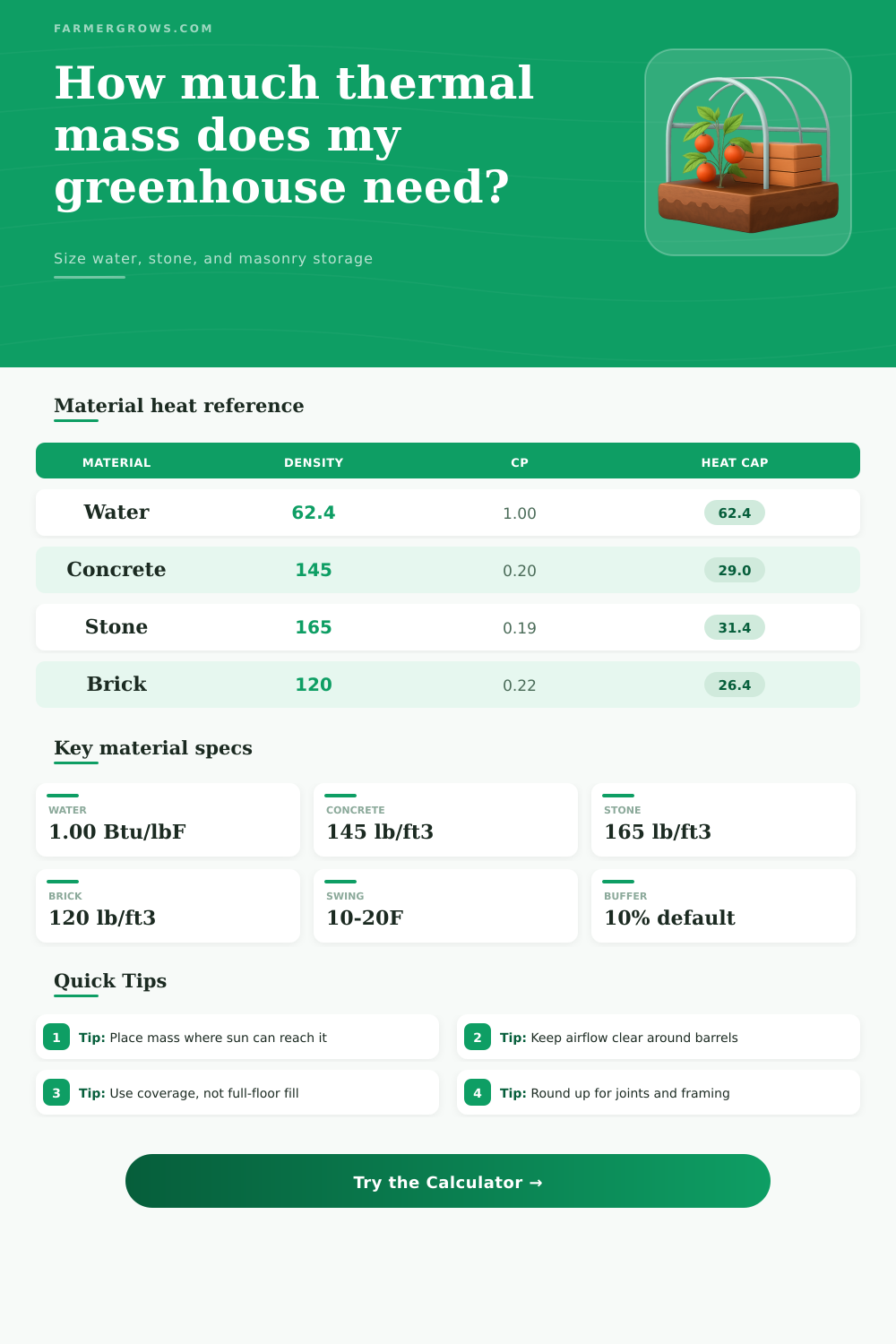
| Material | Density lb/ft3 | Specific heat Btu/lbF | Heat cap Btu/ft3F | Notes |
|---|---|---|---|---|
| Water | 62.4 | 1.00 | 62.4 | Highest sensible storage |
| Concrete | 145 | 0.20 | 29.0 | Heavy and steady |
| Stone | 165 | 0.19 | 31.4 | Dense and durable |
| Brick | 120 | 0.22 | 26.4 | Balanced thermal lag |
| Sand | 100 | 0.19 | 19.0 | Compact fill option |
| Gravel | 105 | 0.20 | 21.0 | Fast drain, moderate heat |
| Moist soil | 84 | 0.20 | 16.8 | Damp bank material |
| Clay tile | 118 | 0.21 | 24.8 | Thin and stackable |
| Depth | Volume per sq ft | Sq ft per yd3 | m2 per m3 | Use note |
|---|---|---|---|---|
| 2 in | 0.167 ft3 | 162.0 | 16.7 | Light fill or shelf tops |
| 4 in | 0.333 ft3 | 81.0 | 8.3 | Bench rows |
| 6 in | 0.500 ft3 | 54.0 | 5.6 | Shallow floor banks |
| 8 in | 0.667 ft3 | 40.5 | 4.2 | Common barrel zone |
| 12 in | 1.000 ft3 | 27.0 | 2.8 | Deep wall mass |
| 18 in | 1.500 ft3 | 18.0 | 1.9 | Serious storage layer |
| Greenhouse | Area | Example mass zone | 10F storage | Notes |
|---|---|---|---|---|
| 6x8 lean-to | 48 sq ft | 10 sq ft at 8 in | 0.10 kWh/ft2 | Small starter |
| 8x10 hoop | 80 sq ft | 18 sq ft at 8 in | 0.16 kWh/ft2 | Compact row house |
| 10x12 hobby | 120 sq ft | 25 sq ft at 8 in | 0.20 kWh/ft2 | Balanced layout |
| 12x16 bay | 192 sq ft | 38 sq ft at 8 in | 0.24 kWh/ft2 | Bench plus floor mix |
| 14x20 house | 280 sq ft | 56 sq ft at 8 in | 0.28 kWh/ft2 | Good water zone |
| 20x30 house | 600 sq ft | 120 sq ft at 8 in | 0.32 kWh/ft2 | Large floor bank |
| Container | Volume | Gallons | Thermal use | Footprint note |
|---|---|---|---|---|
| 55-gal barrel | 7.35 ft3 | 55.0 | Strong water mass | Round footprint |
| 20-gal tote | 2.67 ft3 | 20.0 | Portable and light | Easy bench fit |
| 5-gal pail | 0.67 ft3 | 5.0 | Small support unit | Limited storage |
| IBC tote | 47.5 ft3 | 355.0 | Large storage block | Needs heavy floor |
| Stone bed | 1 yd3 | 201.9 | Dense floor mass | Low moveability |
| Brick stack | 1 yd3 | 201.9 | Good wall lining | Uniform modules |
Thermal mass is another method that can be use to assist in the regulation of the temperatures within the greenhouse. Thermal mass works by absorbing the heat during the daytime and then releasing that heat during the night. By utilizing thermal mass within the greenhouse, the temperature will not experience as great of a swing between day and night temperatures, as the thermal mass will store energy during the daylight hours and release that energy into the greenhouse during the night temperatures.
If utilized correct, a greenhouse that include a thermal mass element will maintain an appropriate temperature for the plants that are cultivated within that greenhouse; however, if the size of the thermal mass elements is not correctly establish, the temperature may become too low during the night or too high within the greenhouse floor. Several different materials can be use as thermal mass elements; however, two of the most common materials that is utilized are water and stone. Water is an effective method of utilizing thermal mass due to the fact that water can absorb one British Thermal Unit (BTU) of heat per pound of water for every degree that the temperature of the water change.
Using Thermal Mass to Keep a Greenhouse Warm
Stone and concrete elements are also effective elements for incorporating into the greenhouse; however, stone and concrete elements absorb heat at a slower rate than water element. Despite the fact, however, that stone and concrete elements absorb heat at a slower rate than water, the materials are dense and can store a large amount of heat in a small area of the greenhouse. In incorporating thermal mass into the greenhouse, there are a few factor to consider, such as the footprint of the greenhouse and the depth of the thermal mass.
The thermal mass should not cover the entire floor of the greenhouse; some space will be necessary for the plants to grow within the greenhouse, as well as for the individuals to walk within the greenhouse. Twenty to thirty percent of the floor of the greenhouse should be covered by thermal mass, however. Additionally, the depth of the thermal mass elements is another factor to consider.
The deeper the thermal mass elements, the more heat that the greenhouse can store; however, deeper elements will also add more weight to the greenhouse floor. In calculating the amount of thermal mass that is required within the greenhouse, you can consider the temperature swing that is experienced within the greenhouse. The temperature swing is the difference between the highest daytime temperatures and the lowest nighttime temperatures.
For instance, if the temperature drop fifteen degrees from the daytime temperatures during the night, the thermal mass must be able to buffer a drop in temperature of fifteen degrees. To calculate the amount of thermal mass elements needed, you can multiply the area of the greenhouse by the percentage of the floor that will be covered by the thermal mass elements and the depth of the elements. The resulting number will represent the volume of the elements; multiplying the volume by the density of the elements is one way to calculate the total weight of the elements that are needed within the greenhouse for the necessary thermal mass.
The type of greenhouse that is to be used can change the way in which the thermal mass is to be incorporated into the greenhouse. For instance, hoop houses that are attached to the north wall of the greenhouse should incorporate thermal mass along the south edge of the greenhouse; the south edge will be exposed to the sun during the winter months. Lean-to greenhouses that are attached to a building may only require a shallow incorporation of thermal mass into the floor of the greenhouse; the floor may not be exposed to the sun for long period of time.
Finally, geodesic domes have a round footprint; in this case, the thermal mass should be incorporated along the edges of the dome shaped greenhouse. Incorrect incorporation of thermal mass into the greenhouse can lead to issues within the greenhouse. For instance, providing too much depth for the thermal mass elements can lead to cracking of the greenhouse floor.
Providing too much thermal mass to the floor can prevent the proper growth of the plant. Additionally, providing thermal mass to shaded areas of the greenhouse will prevent the thermal mass from charging with heat; the materials should be placed in areas of the greenhouse that are exposed to direct sunlight. 55 gallon drums are often used to incorporate thermal mass into greenhouses.
One benefit of utilizing 55 gallon drums is that the drums are often easy to move to different area of the greenhouse. In addition to this benefit, however, the 55 gallon drums can store a significant amount of water; this water can absorb the heat as part of the thermal mass. An alternative to using drums to incorporate thermal mass into the floor of the greenhouse is to place thermal mass elements, such as stone, under the benches upon which the plants are to be grown.
This prevents the stone from obstructing the movement of individuals within the greenhouse. Another alternative is to use brick element; bricks are often able to be stacked into the greenhouse to incorporate the thermal mass. Another means of determining if the thermal mass elements are effectively functioning within the greenhouse are to incorporate thermometers into the greenhouse.
These thermometers should be placed within the thermal mass elements and the temperature of the air within the greenhouse should be measured. If the temperature within the thermal mass elements is higher than the temperature of the air within the greenhouse, the thermal mass elements are effectively functioning. If the temperature swings within the greenhouse are too great, however, additional thermal mass elements can be incorporated into the greenhouse, or the greenhouse can be insulated on the north side of the greenhouse.