Frost Date Calculator
Convert average spring and fall frost dates into a safer planting plan. Use local frost windows, site exposure, risk buffers, and crop maturity to find the best time to sow, transplant, and finish the season.
Choose a common frost pattern to seed the fields. Each preset sets the zone, frost dates, exposure, buffer, maturity, transplant lead, soil warm-up, and planning mode.
Timing Summary
Adjusted for site exposure, buffer days, transplant lead time, and crop maturity.
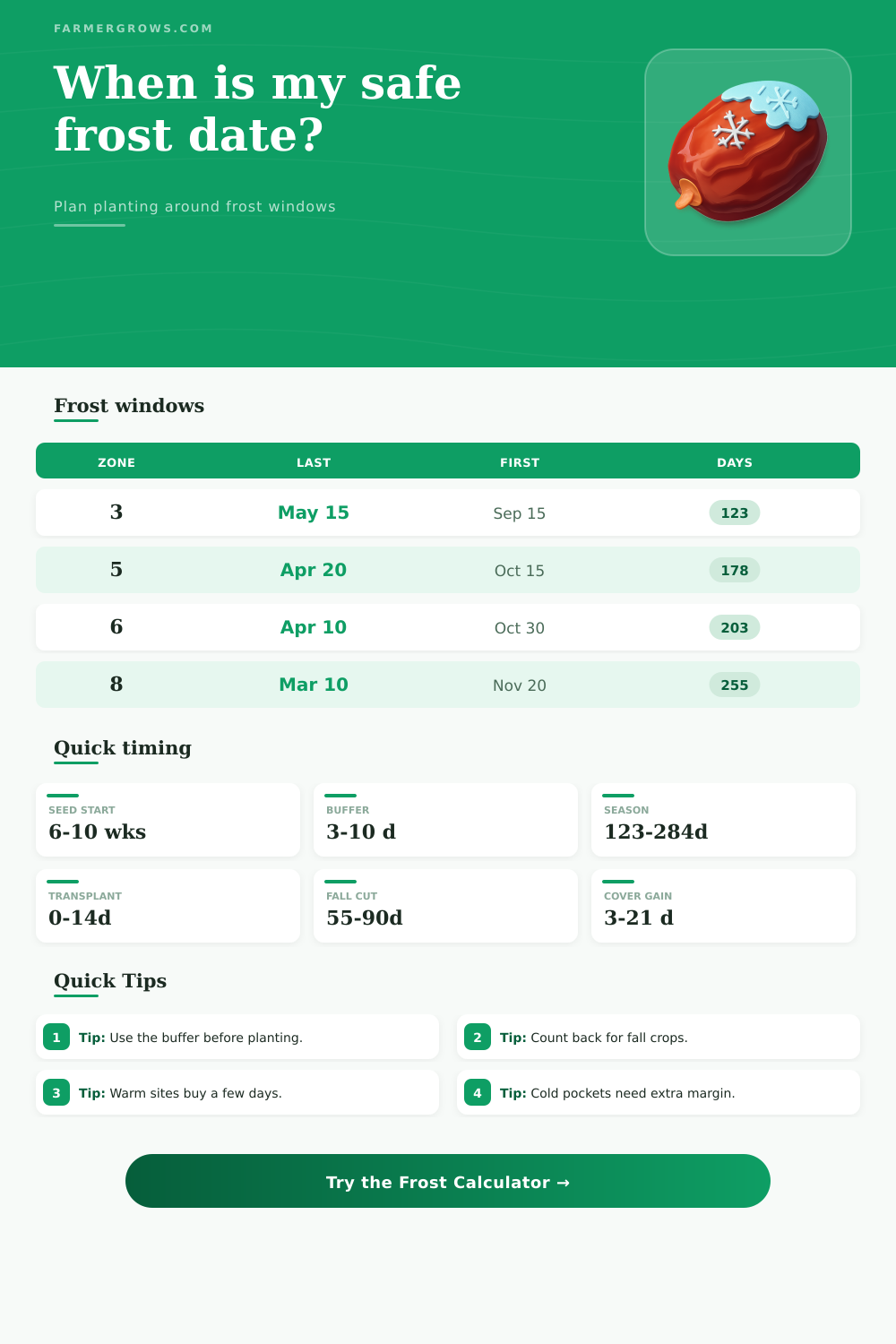
| Zone | Avg last frost | Avg first frost | Frost-free days | Notes |
|---|---|---|---|---|
| 3 | May 15 | Sep 15 | 123 | Short cool season |
| 4 | May 1 | Oct 1 | 153 | Late spring start |
| 5 | Apr 20 | Oct 15 | 178 | Balanced window |
| 6 | Apr 10 | Oct 30 | 203 | Longer finish |
| 7 | Mar 25 | Nov 10 | 230 | Warm shoulder seasons |
| 8 | Mar 10 | Nov 20 | 255 | Extended planting run |
| 9 | Feb 20 | Dec 1 | 284 | Mild frost pressure |
| Crop | Indoor start | Transplant window | Direct sow | Maturity |
|---|---|---|---|---|
| Tomato | 6-8 wks | 1-2 wks after | Rarely | 70-85 d |
| Pepper | 8-10 wks | 2-4 wks after | Rarely | 70-100 d |
| Cucumber | 3-4 wks | After frost | 1-2 wks after | 50-70 d |
| Bean | None | Not needed | 1-2 wks after | 45-60 d |
| Lettuce | 4-6 wks | 2-4 wks before | Early spring | 45-60 d |
| Broccoli | 4-6 wks | 2-4 wks before | Early spring | 55-80 d |
| Squash | 2-4 wks | After frost | 1-2 wks after | 50-70 d |
| Basil | 4-6 wks | 2 wks after | Warm soil only | 60-90 d |
| Site | Buffer | Why it matters | Plan effect |
|---|---|---|---|
| Open ridge | 0-3 d | Wind strips heat | Use the edge |
| Average yard | 4-6 d | Normal spring swing | Standard buffer |
| Sheltered bed | 6-8 d | Walls hold warmth | Earlier starts |
| Warm slope | 8-10 d | Sun drains cold air | More spring room |
| Low pocket | 10-14 d | Cold sinks at night | Add margin |
| Row cover | 3-7 d | Temp swings soften | Protected timing |
| Method | Extra days | Best use | Main caution |
|---|---|---|---|
| Mulch | 2-5 d | Slows soil swings | Spring soil warms slower |
| Row cover | 3-7 d | Soft frost shield | Vent on sunny days |
| Cold frame | 7-14 d | Hardening seedlings | Overheat fast |
| Low tunnel | 10-21 d | Early greens | Anchor in wind |
| Hoop house | 14-28 d | Spring and fall gain | Monitor moisture |
| Greenhouse | 21-30 d | Starts and tender crops | Heat management |
Frost planning is essential to determine the best time to plant your crops in a garden. Frost planning require that you account for temperature changes that could lead to the growth of plants in your garden getting frozen. A single frost could kill many of your plants, as well as ruin the growing season for your garden.
You must take note of the frost dates to determine when to plant your crops in your garden. Weather records in your area calculate average last frost dates and average first frost dates over many years. However, these dates are only averages, as they indicate the number of years that the temperature will be safe for the crops versus risky for the plants.
Plan for Frost in Your Garden
These average frost dates will change according to the location of your garden. Areas that can experience frost more often than others include frost pockets, which are low area in your garden that can cause the last frost date to occur later than the calculated last frost date for your area. South facing slopes will experience earlier last frost dates because the sun and the wind has an effect on the temperature in these area.
The exposure of your garden will have an effect on your garden’s microclimate, so you must adjust the average frost dates to account for the specific location of your garden. By adding buffer days to your average frost dates, you can avoid sudden freezes in your garden. Buffer days will provide insurance for your garden in the case of temperature drop.
By adding four to ten buffer days to your average frost dates, you can expect to avoid most freezes. The maturity dates of your crops will dictate when you should begin to plant them in your garden. For example, if a crop take 80 days to mature, you must count back 80 days from the first frost date to determine when to plant the seeds.
The temperature of the soil is also different than the air temperature in your garden. The soil will remain cold in your garden for three to seven day after the air temperature in your area becomes warm. This cold soil could cause the seeds that you plant to rot.
Fall planning for your garden also require you to work backward from the first frost date in your area. You will subtract the number of days that it takes for each crop to reach maturity from the first frost date, and then you will add buffer days to that calculation. Some crops, like broccoli and kale, can tolerate light frosts.
However, other crops, like pumpkins and beans, will not be able to tolerate frost. If you plan your fall garden correctly, you will be able to extend your growing season. However, if you plan your fall garden incorrectly, you will find yourself having to harvest your crops before they are yet mature.
There are a variety of tools and gardening guides that can assist you in frost planning for your garden. Reference guides will provide you with tables that show the number of days that your area is frost-free on average, as well as crop charts that will show you when to start your seeds indoors. You can also use row covers to extend your growing season.
Lightweight row covers will warm your soil or garden beds by four to six degrees, while heavier row covers can warm your plants and soil for up to two week. However, you must provide ventilation for your row covers so that the plants dont get too warm. Some of the most common mistake in frost planning are not taking into consideration the microclimates in your garden and not using buffer days to allow for the possibility of frost in your garden.
Many gardeners will make the mistake of trying to plant their gardens as early as possible. However, if they plant too early without buffer days, they will suffer a loss of the planted seeds. Many people also do not consider the fall planting season for their gardens.
If they did, they could grow some of the cool-season crops. By keeping track of the weather in your area for several years, you can better determine when to plant different types of crops in your garden. Accurate frost planning will ensure that your plants survives your growing season and that you can manage your garden effectiveley throughout the season.