🚧 Drainage Gradient Calculator
Check fall, grade, ratio, angle, and pipe capacity for farm drains, swales, and outlet lines with one practical calculator.
Drainage Result Summary
Enter the drain run and fall to see the grade, ratio, and capacity check.
| Application | Typical grade | Ratio | Use case |
|---|---|---|---|
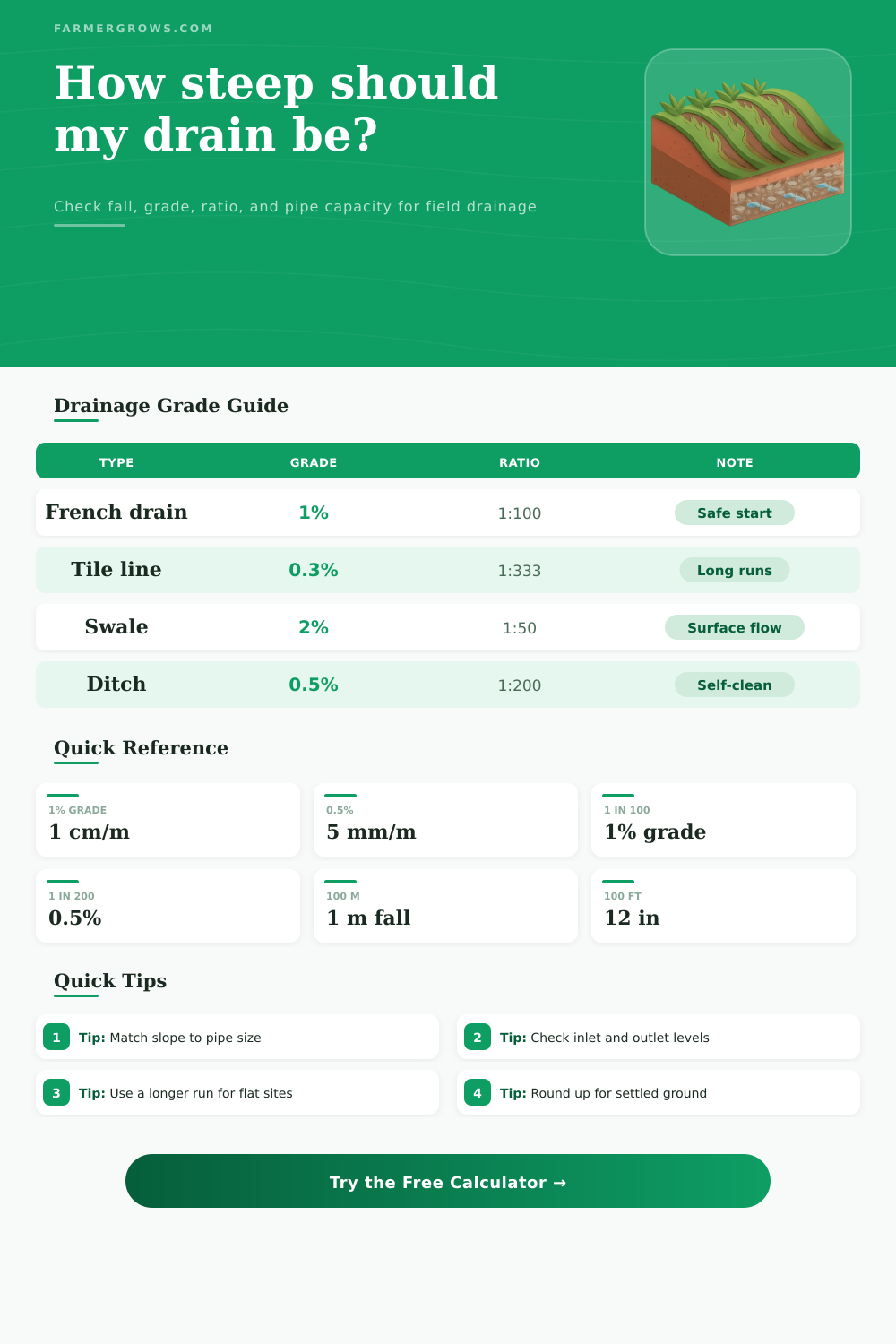
| Subsurface tile line | 0.1 to 0.3% | 1:1000 to 1:333 | Long collector lines |
| French drain | 0.5 to 1.0% | 1:200 to 1:100 | Perimeter and seepage control |
| Surface swale | 1.0 to 2.0% | 1:100 to 1:50 | Move runoff by gravity |
| Roadside ditch | 0.3 to 0.8% | 1:333 to 1:125 | Carry water without siltation |
| Grade | Drop per 10 m | Drop per 100 m | Drop per 100 ft |
|---|---|---|---|
| 0.1% | 10 mm | 100 mm | 1.20 in |
| 0.25% | 25 mm | 250 mm | 3.00 in |
| 0.5% | 50 mm | 500 mm | 6.00 in |
| 1.0% | 100 mm | 1000 mm | 12.00 in |
| Symptom | Likely cause | What to check | Fix |
|---|---|---|---|
| Ponding at inlet | Fall too low | Invert levels | Add more drop |
| Sediment build-up | Velocity too low | Pipe slope | Shorten run |
| Outlet splash | Too steep | End treatment | Add apron |
| Frequent blockages | Poor alignment | Survey line | Re-set inverts |
The drainage gradient is the tilt of the drainage line. The drainage gradient can be expressed as a percentage or a ratio. The drainage gradient will determines how the water move through the pipe or channel.
The drainage gradient will also prevents the water from pooling in a location where the water should not pool. Too flat of a gradient will cause the velocity of the water to drop to a level that will allow debris to accumulating in the pipe. Too steep of a gradient will cause the water to move to quick through the system, which could cause erosion at the outlet of the pipe or cause air binding in the system if the gradient is too steep over long runs of drainage pipe.
What Is Drainage Gradient and Why It Matters
To calculate the drainage gradient, you divide the vertical fall of the site by the horizontal run of the site. To calculate the vertical fall, survey the inverts (bottom edge of the pipe) of the site and subtract the inlet invert from the outlet invert. The result of the division of the vertical fall by the horizontal run are multiplied by 100 to express the gradient as a percentage.
For instance, a drainage gradient of 0.5% indicates that the site will drop 1 unit for every 200 units of horizontal distance. Drainage gradients can differ for different types of drainage systems. Subsurface tile lines typically have drainage gradients of 0.1% to 0.3% because these subsurface line can be very long.
A drainage gradient that is too steep within a long subsurface tile line can cause problems within that subsurface drainage line. French drain have drainage gradients of 0.5% to 1%. A steeper gradient than this can make it so that the gravel within the French drain gets wash out of the drainage system.
Swales have steeper drainage gradients of up to 2% because these swales is installed to allow the water to move over the land using gravity. Ditches typically have drainage gradients of around 0.5% so that debris can move through the ditch yet silt do not accumulate within the ditch. The type of material used to construct the drainage system can impact the capacity of the drainage system.
For instance, smooth PVC pipe will allow water to move through the pipe more easy than corrugated farm pipe. The smoothness of the PVC pipe will allow the water to move at a flatter gradient than if the pipe is make of corrugated polyethylene pipe. The corrugations on the pipe create drag that prevents smooth movement of the water through the pipe.
For these reasons, a steeper gradient will be required for corrugated pipe than for smooth pipe. In addition to the drainage gradient, you should consider the capacity of the pipe when constructing a drainage system. The capacity can be determined by calculating the number of liter of water that will pass through the pipe each second at peak flow.
The pipe should be large enough to allow for the volume of water that will pass through it, yet not so large as to waste the trench depth for the drainage system. For instance, a pipe with a 100-millimeter diameter and a 0.5% gradient of smooth plastic will move 2 liters per second. If the pipe is undersized relative to the amount of water that runs through it, there will be backup of water.
However, if the pipe is too large relative to the amount of water that runs through it, there will be unnecessary cost and depth for the trench. The settlement of the soil where the drainage system is to be constructed is another factor to consider. The soil may compact under the drainage system and flatten the gradient of the site after it is constructed.
Because the gradient may change after construction of the system, it is important to include some allowance for soil settlement. For instance, if the drainage gradient is too flat as a result of soil settling, the water will pond in the trench. In this situation, it will be necessary to re-level the inverts of the pipe so that the gradient are increased.
Finally, it is also important to consider the need to protect the outlet of the system if the gradient of the site is steep. High velocity of water exiting the pipe can erode the land at the outlet of the pipe. You can place an apron of rock at the outlet of the pipe to protect the land from erosion caused by the high velocity of the drainage systems water.
By managing the gradient of the land, drainage can be controlled to keep the fields dry while ensuring that the drainage system perform correctly over the long term. You should of also consider how the soil settles. Its important to make sure you’re drainage isnt blocked by silt.