🚜 Tractor Ground Pressure Calculator
Estimate axle load, contact area, and field pressure from tractor weight, ballast, tire setup, and soil condition.
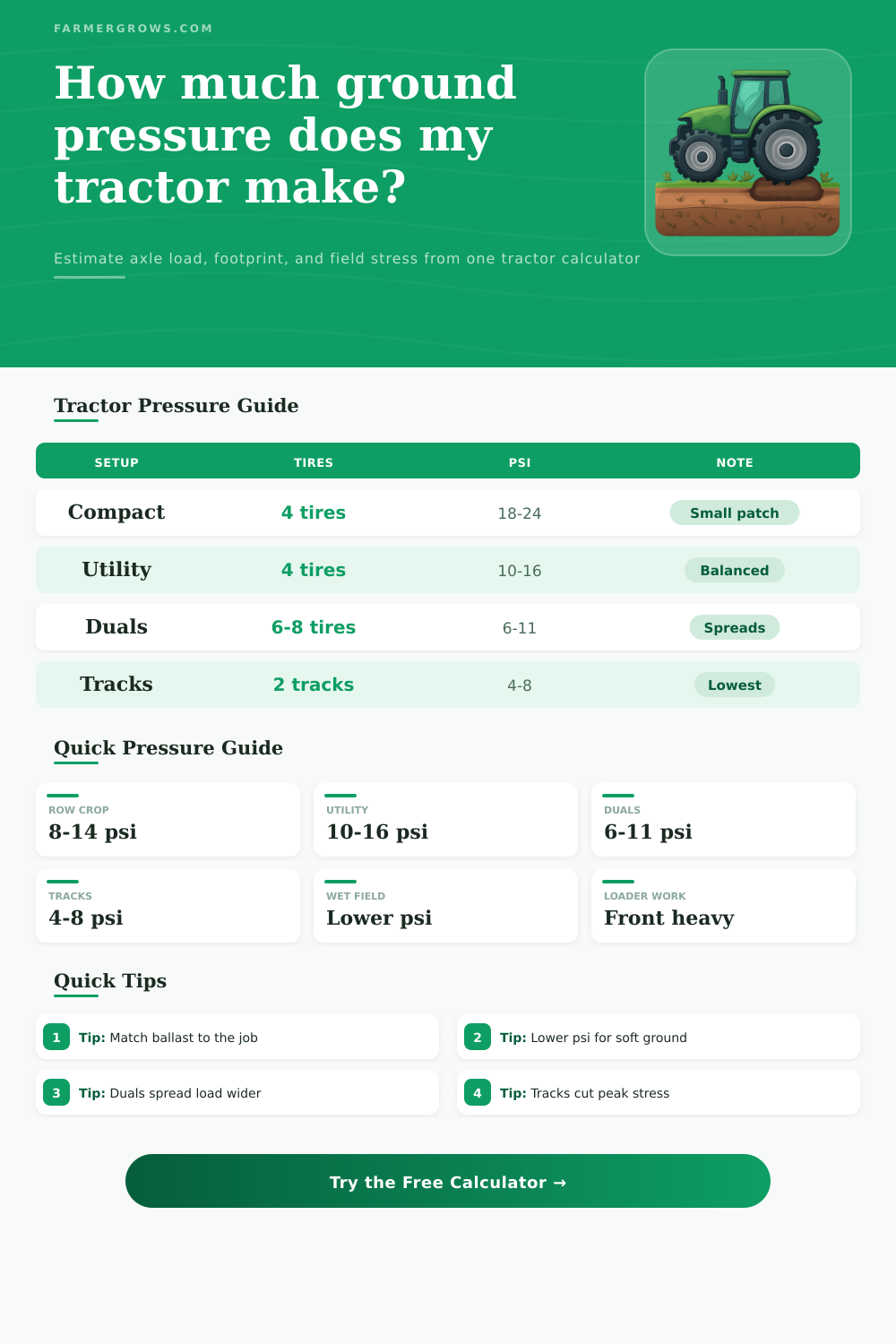
| Setup | Tire layout | Avg psi | Field note |
|---|---|---|---|
| Compact loader | 2 front / 2 rear | 18-24 | Small patch |
| Utility MFWD | 2 front / 2 rear | 10-16 | Balanced work |
| Row-crop MFWD | 2 front / 2 rear | 8-14 | Planting pass |
| Dual-wheel tillage | 2 front / 4 rear | 6-11 | Wide spread |
| Tracked tractor | 2 tracks | 4-8 | Lowest peak |
| Orchard tractor | 2 front / 2 rear | 12-20 | Narrow rows |
| Inflation | Area factor | Effect | Use case |
|---|---|---|---|
| 12 psi | 1.00 | Baseline patch | Field start |
| 18 psi | 0.90 | Tighter patch | Heavier work |
| 24 psi | 0.82 | Smaller patch | Road travel |
| 8 psi | 1.10 | Wider patch | Soft ground |
| 6 psi | 1.22 | Very wide | Duals / tracks |
| Condition | Multiplier | Soil state | Best move |
|---|---|---|---|
| Dry firm | 0.95 | Crumbly | Fast passes |
| Normal | 1.00 | Typical field | Baseline use |
| Soft | 1.10 | Deeper sink | Lower load |
| Wet | 1.22 | High risk | Delay if possible |
| Muddy | 1.32 | Severe sink | Avoid entry |
| Class | Weight range | Layout | Typical psi |
|---|---|---|---|
| Compact 25-45 hp | 3k-7k lb | 2 front / 2 rear | 16-24 |
| Utility 45-90 hp | 6k-12k lb | MFWD | 12-18 |
| Row crop 90-180 hp | 12k-20k lb | MFWD | 8-16 |
| Heavy tillage 180-300 hp | 20k-36k lb | Duals | 6-12 |
| Track tractor 200-500 hp | 25k-45k lb | Tracks | 4-8 |
Ground pressure is a force that a tractor exerts on the earth. The ground pressure for a tractor can determine whether the soils remains loose for the roots of the plants or if the soil becomes compacted and rutted. High ground pressure will damage the soil, which will lead to more lower yields of the crops that are planted in those fields.
A ground pressure calculator can help a farmer to understanding the ground pressure of his fields based off the type of tractor that is used on those farms. The formula for calculating the ground pressure of a tractor is based upon the weight of the tractor divided by the contact area of the tractors tire with the ground. However, the weight of the tractor are not distributed even throughout the tractor; there is a standard weight for tractors when the tractor is operating, but often ballast can be added to either the front or rear of the tractor.
Tractor Ground Pressure and How to Reduce It
By adding ballast to the front of the tractor, the weight of that front axle will increase. By adding ballast to the rear of the tractor, the weight of that rear axle will increase. Standard field tractors may have forty percent of the weight of the tractor distribute to the front of the tractor.
However, that distribution change with the addition of ballast to the tractor. The pressure of the tires of a tractor also changes the ground pressure of the tractor. By decreasing the tire pressure of a tractor, the area of the tire that is in contact with the ground increase.
By increasing the area of contact of the tractors tires with the ground, the ground pressure of the tractor will decrease. However, if the tire pressure is decreased too much, the tires may experience damage to the sidewalls of the tires. Additionally, decreasing the tire pressure of the tractor may lead to the tires wearing unevenly.
The width of the tractors tires also impacts the ground pressure; the wider the tires the more greater the area of contact between the tractor and the ground, leading to a decrease in ground pressure. Additionally, using dual wheels will increase the contact area of the tractor with the ground, leading to a decrease in ground pressure. The condition of the field also influences the effect of ground pressure upon the soil.
For instance, if the soil within a field is wet, then the soil is not as stable as dry soil. High ground pressure upon wet soil will lead to the tractor getting rutted into the soil. Therefore, if a tractor is to operate upon wet fields, it is necessary to use lower tire pressure or wider tires to reduce the ground pressure of the tractor upon the soil in those fields.
Ground pressure calculators allows for the field conditions to be entered to help calculate the ground pressure that will be exerted upon those fields. Another alternative to the tires for a tractor are tracks. Tracks are manufactured to have a tire pressure of four to eight psi.
Because the tracks have a large contact area with the ground, the ground pressure of a tractor with tracks will be much less than the ground pressure of a tractor with tires. Many heavy tillage machines has tracks on their implement so that they do not create deep ruts within the fields. Another tool that a tractor may use is ballast.
Ballast is used to add weight to the tractor. However, using ballast improperly can create high ground pressure on certain axle of the tractor. For instance, if the ballast added to the tractor is not sufficient to add to the rear of the tractor, the front of the tractor will dig into the ground.
Similarly, if too much ballast is added to the front of the tractor, the ground pressure on the front axle will be high, compacting the soil in the rows of the planted crops. Another problem that excessive ground pressure of a tractor upon the soil can create is soil compaction. Soil compaction is a problem that occurs when the ground pressure of a tractor is too high.
Soil compaction lead to issues with the ability of water to enter the soil. If the soil does not become wet with water, the plants roots will either starve for water or drown in the water that cant exit the soil. Additionally, excessive ground pressure can lead to yield losses of five percent or more of the crops that are grown in the field.
These yield losses are more common in clay soils than other types of soils. Clay soils hold ruts easily and become compacted by excessive ground pressure. The type of tractor that is being used may influence the tire pressure that should be set for that tractor.
For instance, utility tractors may have a tire pressure between ten and sixteen psi. However, if the fields become wet, the pressure may need to be changed. Compact tractors may have a tire pressure between eighteen and twenty-four psi; this is higher ground pressure.
If the tractor uses dual wheels, the tire pressure may be between six and eleven psi. Using the ground pressure calculator allow a farmer to understand the total weight of the tractor, the weight of each axle of the tractor, and the footprint of the tractors tires on the field.