🌱 Hectare to Square Meter Converter
Convert hectares to square meters, acres, and square plot lengths, or build the area from real land dimensions for field planning.
| Hectares | Square meters | Acres | Square feet |
|---|---|---|---|
| 0.01 | 100 | 0.02 | 1,076 |
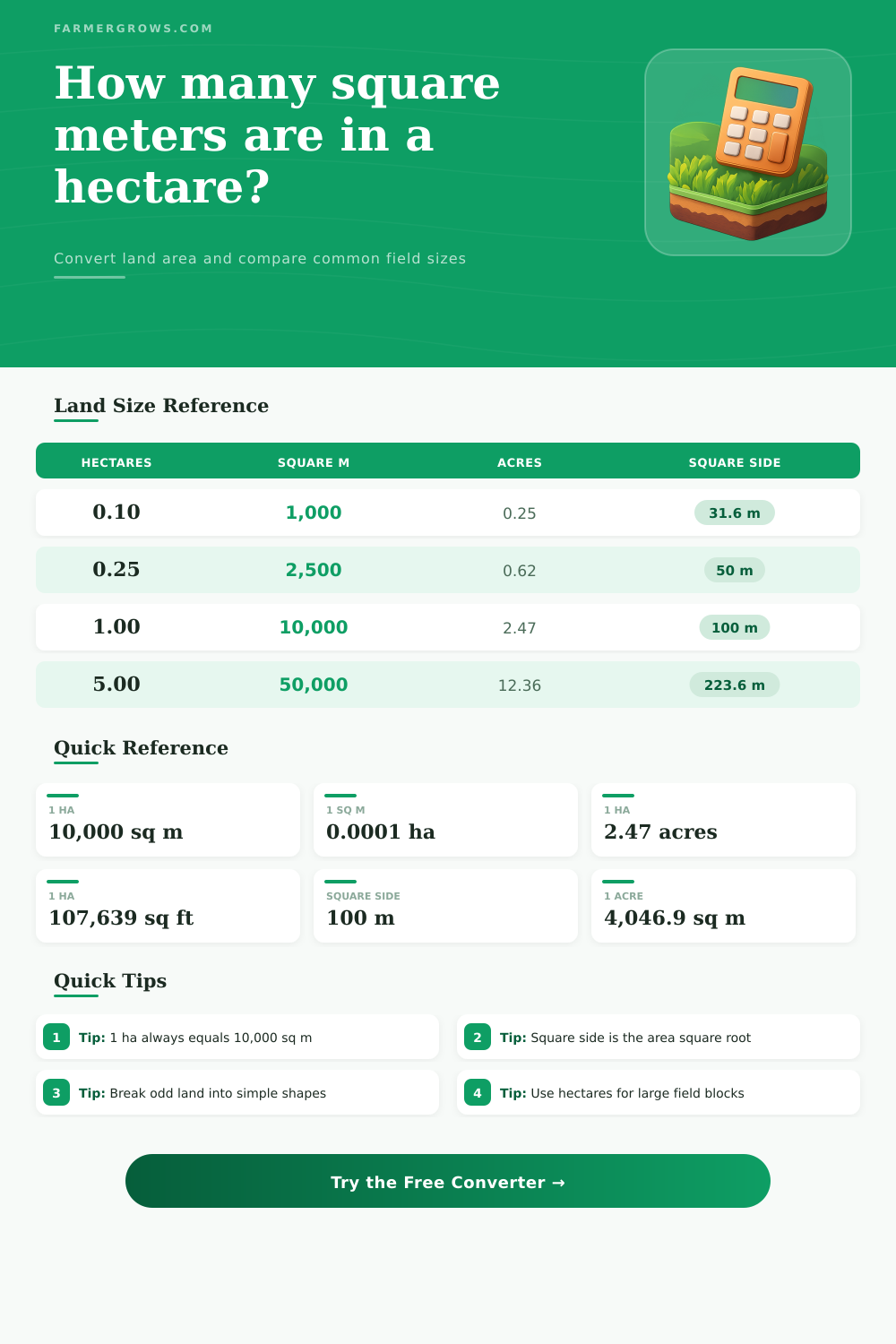
| 0.10 | 1,000 | 0.25 | 10,764 |
| 1.00 | 10,000 | 2.47 | 107,639 |
| 10.00 | 100,000 | 24.71 | 1,076,391 |
| Shape | Formula | Best for | Notes |
|---|---|---|---|
| Rectangle | length x width | Fields and blocks | Fastest survey shape |
| Square | side x side | Even parcels | Side = square root |
| Circle | pi x r x r | Ponds and circles | Use diameter for entry |
| Triangle | base x height / 2 | Corner sections | Split odd edges neatly |
| Common block | Area | Square meters | Square side |
|---|---|---|---|
| Garden bed | 0.05 ha | 500 | 22.4 m |
| Orchard block | 0.25 ha | 2,500 | 50 m |
| One hectare square | 1.00 ha | 10,000 | 100 m |
| Grazing block | 5.00 ha | 50,000 | 223.6 m |
| Hectares | Square meters | Acres | Side length |
|---|---|---|---|
| 0.25 | 2,500 | 0.62 | 50 m |
| 0.50 | 5,000 | 1.24 | 70.7 m |
| 1.00 | 10,000 | 2.47 | 100 m |
| 2.00 | 20,000 | 4.94 | 141.4 m |
A hectare are a unit of measurement that is used to measure the area of a piece of land. One hectare is equal to 10,000 square meter. Thus, one hectare is equivalent to a square that is measured as 100 meter on each of its sides and the other two sides.
A hectare is a unit within the metric system and is based upon the power of ten. Hectares are often used to measure the amount of land that is used for farming or pastures for livestocks. Where hectares is used, acres are used within the imperial system.
What is a hectare and how to measure land
One hectare contains 2.47 acres of land, meaning that one hectare is larger then one acre of land. Therefore, care must be taken when converting from acres to hectares (or hectares to acres). Should individuals incorrectly thought hectares as acres, they could order the wrong amount of seed to cover an area of land, or purchase fencing that is too short to contain the livestock on that hectare.
Land is rarely measured in perfect squares. Instead, parcels of land can be of any shape, such as a rectangle, triangle, or irregular shape. For rectangular land, one can measure the length of the rectangle and the width of the rectangle can be measured.
The length times the width of the rectangle will provide the area of the rectangular land in the unit of measurement (such as square meters). The area of a hectare can then be calculate. For parcels of land in the shape of a circle, one can measure the radius of the circle, and that measurement can be used with the mathematical constant pi to calculate the area of the circle.
For irregular shaped land, the area can be divided into several shapes (such as triangles and rectangles), the area of each of those shapes can be calculated, and the areas can be summed to determine the total area of the parcel of land. It is important for individuals to understand that area isnt the same as length. Length can be measured in one dimension; area is measured in two dimension.
For instance, a square with a side length of 100 meter will have a perimeter of 400 meter, but the area of that square will be one hectare. Thus, it is essential that the length of a plot of land is not treat as the area of that land. The shape of the land can have an impact upon how that land is to be used.
For instance, rectangular fields may be used for agricultural machinery or for establishing windbreak along the edges of the rectangular fields. Small amount of land (less than 0.1 hectares) may be used for testing plants. Large amount of land (such as five hectares) may be used for grazing livestock.
The size of the hectare will impact the amount of trees that can be planted within an orchard of that hectare, for instance, or the number of cows that can be grazed upon in a pasture. The topography of the land can also have an impact upon how that land is to be used for agriculture. While hectares are calculated based off the area of land that is flat, land with hills will have different slope than a flat plot of land, which may impact the total area of the hectare that is walkable or usable by farmers.
Other features of the hectare that may impact the use of that hectare for agricultural purposes may include the presence of wetlands or certain soil type. Thus, understanding how to convert hectares and measuring the land will help individuals to plan its use for agricultural purpose.