🌱 Compost Bin Size Calculator
Find the right compost volume, bin size, and bag quantities for any garden project
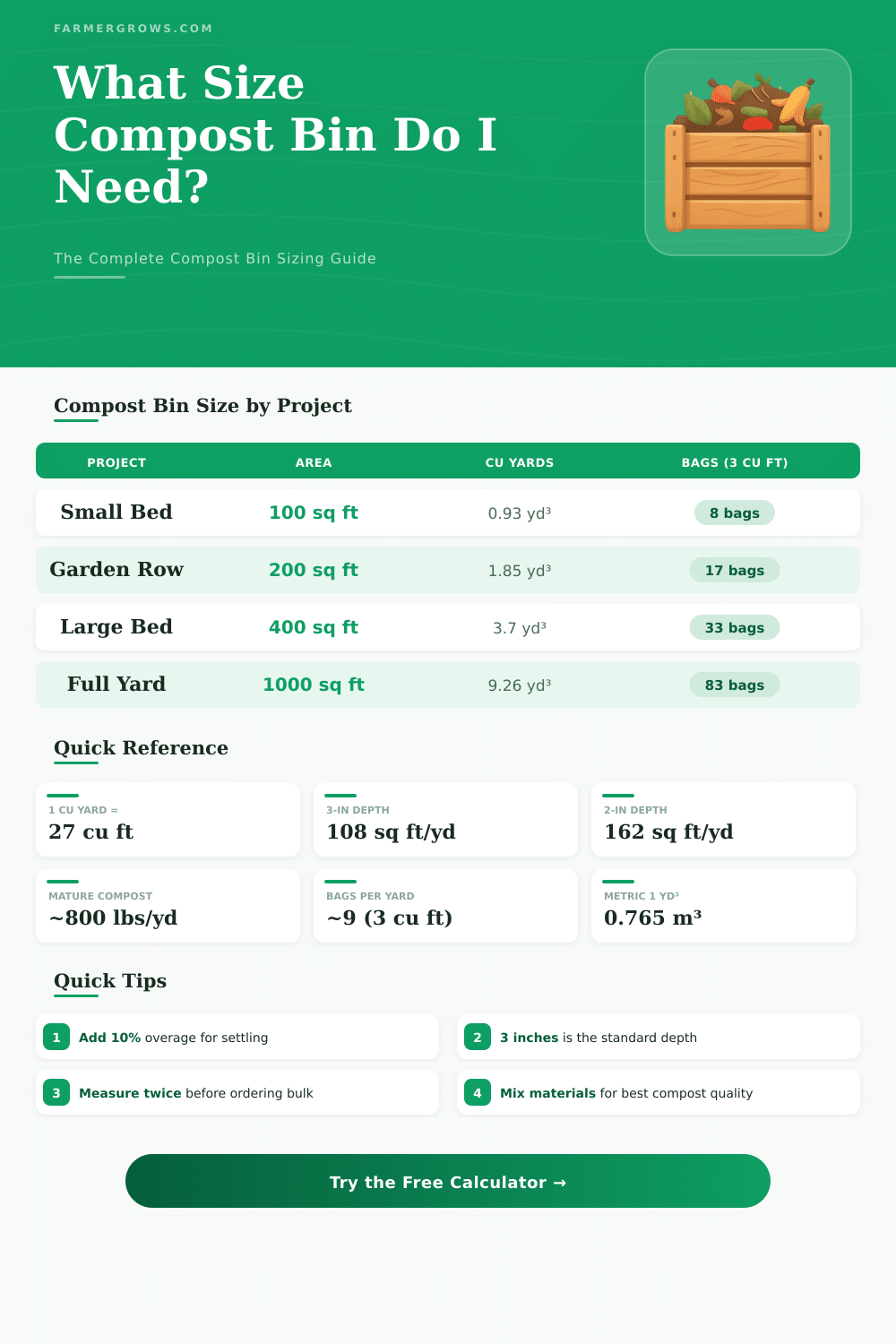
| Depth | Coverage (sq ft) | Coverage (m²) | Cubic Feet / Yard |
|---|---|---|---|
| 1 inch (2.5 cm) | 324 sq ft | 30.1 m² | 27 cu ft |
| 2 inches (5 cm) | 162 sq ft | 15.1 m² | 27 cu ft |
| 3 inches (7.5 cm) | 108 sq ft | 10.0 m² | 27 cu ft |
| 4 inches (10 cm) | 81 sq ft | 7.5 m² | 27 cu ft |
| 6 inches (15 cm) | 54 sq ft | 5.0 m² | 27 cu ft |
| Bag Size | Volume per Bag | Bags per Yard | Coverage @ 3 in |
|---|---|---|---|
| Small (1 cu ft) | 1 cu ft | 27 bags | 4 sq ft |
| Standard (2 cu ft) | 2 cu ft | 13.5 bags | 8 sq ft |
| Large (3 cu ft) | 3 cu ft | 9 bags | 12 sq ft |
| Super (5 cu ft) | 5 cu ft | 5.4 bags | 20 sq ft |
| Bulk (1 yard) | 27 cu ft | 1 yard | 108 sq ft |
| Project | Area | Cu Yards | Bags (3 cu ft) |
|---|---|---|---|
| Small Raised Bed | 40 sq ft | 0.37 yd³ | 4 bags |
| Standard Garden Bed | 100 sq ft | 0.93 yd³ | 9 bags |
| Tree Ring (6 ft dia.) | 28 sq ft | 0.26 yd³ | 3 bags |
| Veggie Patch | 200 sq ft | 1.85 yd³ | 17 bags |
| Large Bed | 400 sq ft | 3.70 yd³ | 34 bags |
| Half-Yard Garden | 600 sq ft | 5.56 yd³ | 50 bags |
| Full Small Yard | 1000 sq ft | 9.26 yd³ | 84 bags |
Choosing the right Compost bin size is more important than many folks believe. The size affects the speed that the organic waste breaks down, and if the piles reach high enough heat for good process. One cubic yard, so 3 feet on every side is enough so that the compost reaches the wanted heat and the killing of germs.
This size is commonly suggested as a good base to start. For warm composting the smallest right size usually is 3x3x3, or around one cubic yard.
How to Choose the Right Compost Bin Size
Although bigger bins commonly work better for warm composting in open or without cover. Ideal is a bin with around 4 feet of length, width and height. Home builds from old pallets commonly result in something near to 4×4 feet.
A common wooden plan requires 18 bits of 1×6 boards, cut to 48 inches, for a 4x4x4 bin. Even smaller 2x2x3 bins can give good results, if one turns them commonly.
The Compost bin size should have double the space compared to the wanted amount of finished compost. So, for 100 cubic feet of compost, the bin requires capacity of 200 cubic feet. Piles shrink during thier breakdown, hence in a setup with several bins the third can be half as big as the others.
Having two bins plus one extra is a reliable way, one for the warm process and another to add materials.
In smaller areas the situation adjusts. A bin of 17 gallons works for a small garden of 4×7 feet. Countertop bins take 2 to 3 gallons of compost bags and require regular emptying and washing.
For people in an apartment even a 30 cm cubic bin can serve. A 13-gallon bin works well for one- or two-family houses and gives space for four compost bags. In sum places the simple rule is 100 liters of bin capacity per family member, without counting garden waste.
The SoilSaver bin measures 28 inches in width, 28 inches in depth and 32 inches in height. It stores 11.4 cubic feet, around 85 gallons, and weighs 30 pounds. On the bigger end some outdoor bins offer 190 gallons of capacity to process big piles of garden and kitchen waste.
Wire net-cages also work, for instance one model has 51.5 inches of diameter and 40 inches of height.
Oxygen and temperature drive decay. A compost bin requires slits and holes for air flow. Without good airflow the pile breaks down slowly and becomes sticky, smelly chaos.
Multi-bin systems deserve attention, especially for families with many organic waste items. Rotary bins turn foodwaste into compost during short time. For those with a green area, a bin for continuous usage is a good idea, because most models requireground contact for drainage.