🌿 Lowe's Mulch Calculator
Calculate exactly how much mulch you need — bags or bulk — for any project size
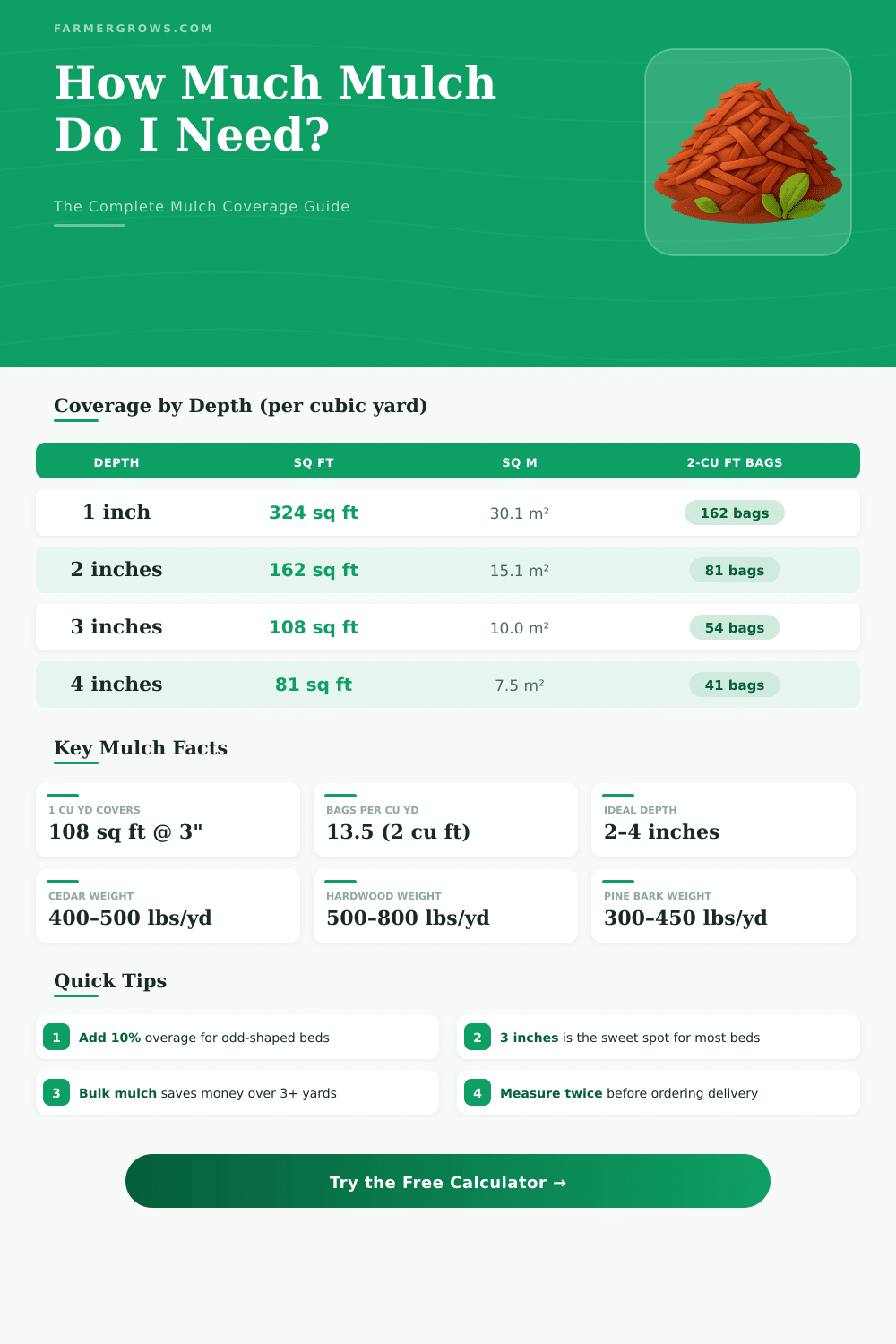
| Depth | Sq Ft Covered | Sq Meters | 2-cu ft Bags Needed | 3-cu ft Bags Needed |
|---|---|---|---|---|
| 1 inch (2.5 cm) | 324 sq ft | 30.1 m² | 162 bags | 108 bags |
| 2 inches (5 cm) | 162 sq ft | 15.1 m² | 81 bags | 54 bags |
| 3 inches (7.6 cm) | 108 sq ft | 10.0 m² | 54 bags | 36 bags |
| 4 inches (10 cm) | 81 sq ft | 7.5 m² | 41 bags | 27 bags |
| 6 inches (15 cm) | 54 sq ft | 5.0 m² | 27 bags | 18 bags |
| Bag Size | Volume per Bag | Bags per Cu Yd | Coverage @ 3" | Coverage @ 2" |
|---|---|---|---|---|
| 2 cu ft bag | 0.074 cu yd | 13.5 bags | 8 sq ft | 12 sq ft |
| 3 cu ft bag | 0.111 cu yd | 9 bags | 12 sq ft | 18 sq ft |
| 1 cu yd bulk | 27 cu ft | 1 delivery | 108 sq ft | 162 sq ft |
| 2 cu yd bulk | 54 cu ft | 2 deliveries | 216 sq ft | 324 sq ft |
| 5 cu yd bulk | 135 cu ft | 5 deliveries | 540 sq ft | 810 sq ft |
| Project | Area | Cu Yds @ 3" | 2-cu ft Bags | 3-cu ft Bags |
|---|---|---|---|---|
| Small flower bed | 50 sq ft | 0.46 yd³ | 7 bags | 5 bags |
| Tree ring (6 ft dia) | 28 sq ft | 0.26 yd³ | 4 bags | 3 bags |
| Medium garden bed | 200 sq ft | 1.85 yd³ | 25 bags | 17 bags |
| Large landscape bed | 500 sq ft | 4.63 yd³ | 63 bags | 42 bags |
| Front yard (avg) | 1000 sq ft | 9.26 yd³ | 125 bags | 84 bags |
| Playground area | 225 sq ft | 2.78 yd³ @ 4" | 38 bags | 25 bags |
| Backyard (avg) | 2500 sq ft | 23.1 yd³ | 313 bags | 209 bags |
Mulch is made up of material covering the surface of the ground. In gardening and landscaping it does several tasks. Main reasons for its use are keeping moisture in the soil, stopping growth of unwanted grasses, caring about good state of the ground and helping garden areas appear more neat.
Usually mulch is organic, although not always.
What Mulch Is and How to Use It
Organic types of mulch hold materials like cuttings of grasses, straw, bits of bark and more. There are also non-organic options. Wood types come from various trees, for instance pine, cedar and bark.
Between popular are well textured, dark brown mulch from almost whole hardwood bark. It ages to get a deep shade. Other types are finely ground wood from certain trees, that stays fully free of paints and keeps its natural wood color.
Landscape mulch tries to copy the forest floor. In woods twigs, leaves, branches and plant bits pile up on the soil and naturally protect it. For a yard or garden such organic covers must be laid by hand to protect the ground and hold the moisture.
The job of mulch changes according to the season. During winter it covers bare soil, stops erosion and protects plants. In spring it keeps moisture, stops unwanted grasses and feeds the ground.
Over time mulch breaks down and adds organic food to the soil. Moisture in mulched ground does not dry out as quickly, because the mulch acts as a sheild.
Before spreading mulch, you must remove unwanted grasses and trash from the area. With a rake you can spread it evenly, and a depth of 2 to 4 inches works well. Keeping it at around three inches thick works best.
Do not lay it right beside the base of a plant, because the roots need oxygen. If you lay mulch directly at a tree trunk, it can rot, so leave six inches of space… That is a wise rule for mulching around trees.
Too much mulch can create troubles. Piling it at plants or trunks is sometimes called volcano mulching, and it is the most common mistake. Right thickness and kind truly matters.
One way is to lay sheets of newspaper or flattened cardboard, overlapping the edges by two inches, then cover with mulch. That helps the block against unwanted grasses. On steep slopes mulch can slide or be blown away.
Ground cover from plants, like crawling species or dense bushes, works better in such places. They help to hold the mulch in place while they cover the spaces. Average black mulch keeps moisture well, controls unwanted grasses and warms the soil.
White or silver types help stop grasses. Buying mulch based on the size of your yard often costs much less thanbuying bags from stores.