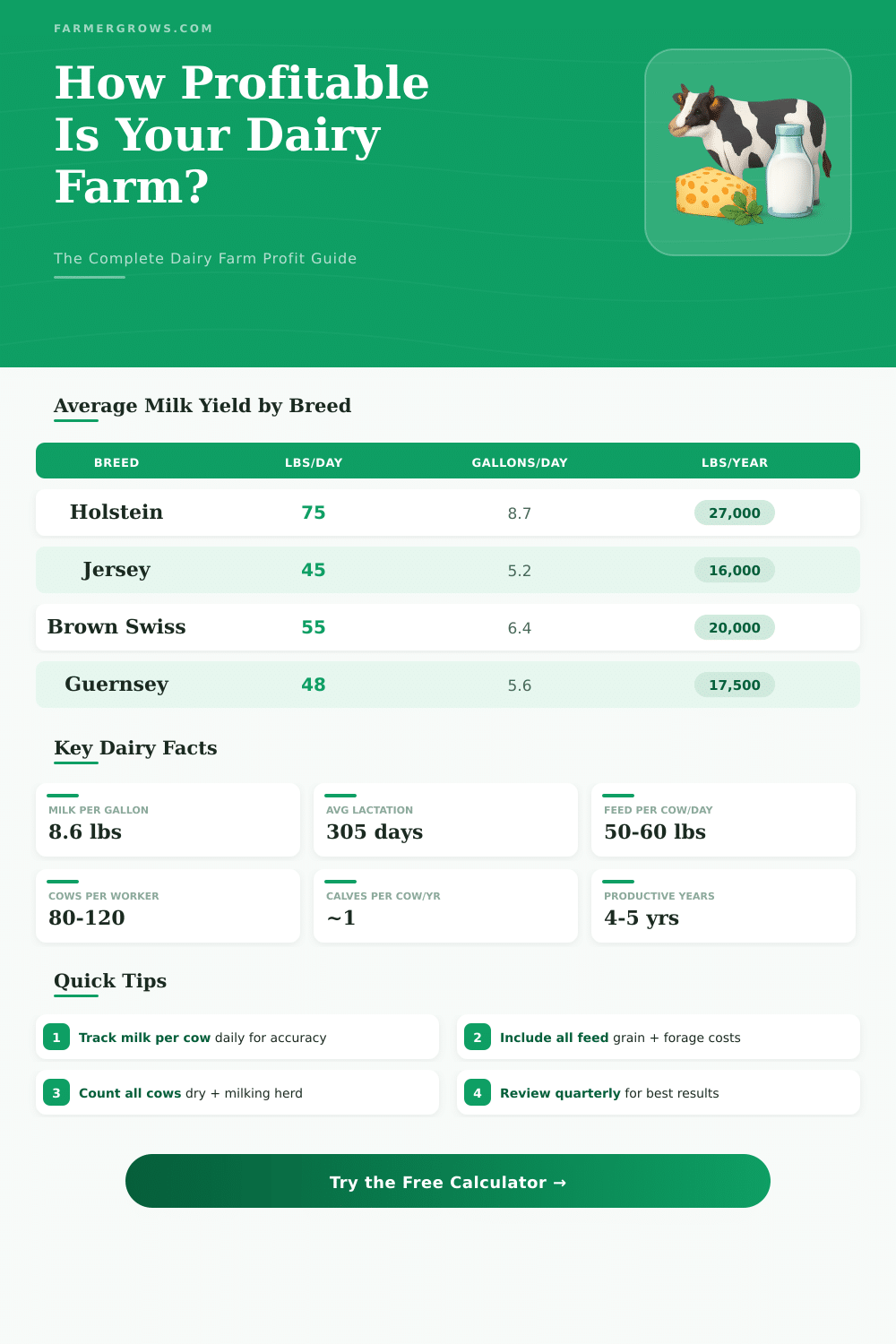
🐄 Dairy Farm Profit Calculator
Estimate annual milk revenue, feed expenses, and net profit for your dairy operation
| Herd Size | Holstein lbs/yr | Jersey lbs/yr | Gallons/yr (Holstein) | Metric Tons/yr |
|---|---|---|---|---|
| 10 cows | 228,750 | 137,250 | 26,600 | 103.8 |
| 25 cows | 571,875 | 343,125 | 66,500 | 259.5 |
| 50 cows | 1,143,750 | 686,250 | 133,000 | 519.0 |
| 100 cows | 2,287,500 | 1,372,500 | 266,000 | 1,038 |
| 250 cows | 5,718,750 | 3,431,250 | 665,000 | 2,595 |
| 500 cows | 11,437,500 | 6,862,500 | 1,330,000 | 5,190 |
| 1,000 cows | 22,875,000 | 13,725,000 | 2,660,000 | 10,380 |
| Cost Category | Low Estimate | Average | High Estimate | Unit |
|---|---|---|---|---|
| Total feed (grain + forage) | $5.00 | $8.50 | $13.00 | $/cow/day |
| Veterinary & health | $150 | $300 | $500 | $/cow/yr |
| Bedding & supplies | $100 | $250 | $400 | $/cow/yr |
| Labor (hired) | $300 | $700 | $1,200 | $/cow/yr |
| Replacement heifer | $1,500 | $2,200 | $3,500 | $/head |
| Overhead & utilities | $8,000 | $15,000 | $40,000 | $/farm/yr |
| Milk price (US avg) | $18.00 | $22.00 | $28.00 | $/cwt |
| Breed | Yield (lbs/yr) | @ $18/cwt | @ $22/cwt | @ $28/cwt |
|---|---|---|---|---|
| Holstein | 22,875 | $4,118 | $5,033 | $6,405 |
| Jersey | 13,725 | $2,471 | $3,020 | $3,843 |
| Brown Swiss | 16,775 | $3,020 | $3,691 | $4,697 |
| Guernsey | 14,640 | $2,635 | $3,221 | $4,099 |
| Ayrshire | 15,860 | $2,855 | $3,489 | $4,441 |
| Dairy Goat | 2,288 | $412 | $503 | $641 |
| Measurement | Imperial | Metric | Notes |
|---|---|---|---|
| 1 gallon milk | 8.6 lbs | 3.9 kg | Avg density |
| 1 cwt | 100 lbs | 45.36 kg | Hundredweight |
| 1 metric ton milk | 2,205 lbs | 1,000 kg | Standard |
| 1 liter milk | 2.2 lbs | 1.03 kg | Approx |
| 1 acre pasture | 43,560 sq ft | 0.405 ha | Land measure |
| Dry matter intake | 50–60 lbs/day | 22–27 kg/day | Per Holstein cow |
Dairy farms succeed because of many factors that affect the profit, however the size of the farm stays the most important element. Simple math shows that big farms lower the prices of milk for every unit. Looking at the period of 2011 until 2015, those farms with at least 1,000 dairy cows always reached the highest output regarding investment.
That result pushed continuous arrival of new cows and the production continuously grows year after year to bigger operations.
How Farm Size Affects Dairy Farm Profit
The data describe quite a clear history. In 2016, around 62 percent of the dairy farms with at least 2,000 cows managed to reach incomes that passed the total expenses. Compare that with farms having between 500 and 1,999 cows; only 43 to 44 percent of those passed that limit.
Move to plans for 2024, and the trend stays same. Big farms continuously get more hihgly Dairy farm profit each cow, during little groups under 250 cows struggle against financial storms.
Expenses for feed form the biggest burden for dairy farms. Usually they consume between 40 and 60 percent of the whole costs. Here is where the risks are.
Results of lack of rain, sudden increase of price of corn or lack of hay can quickly remove the margins. Regular checking of feed helps to control the situation. Really, start with hay as main feed resource is a wise idea, even if the farm does not grow other crops.
Location also affects the results. In 2022, the Northwest and Northeast showed the best profits, although more small farms in those areas did not reach so much gain. California and the whole Southwest?
They also have stable position, with average profits around 1,274 dollars each cow. Worth noting, that the Northwest commonly runs as bigger sets, what directly ties too those more good final accounts.
Milk is not the only source of income. Sale of healthy dairy livestock and backup young cows to other farms add extra coins. Genetic value actual amounts, especially if you have high producing Holsteins or good Jersey genes in your stock.
Some farms also earn through cheese making or other value added work.
Technology really changes the results. Automatic systems for milk and feeding means that fewer workers can care about much more big groups. That boost in speed directly helps Dairy farm profit in the numbers.
Groups between 200 and 500 cows commonly find the ideal balance. Enough size for good work without too few resources. Tracking the expenses is key.
When sales of milk, expenses and incomes sit in different lists split across various folders, one loses the fast overview. Gather everything in one clear board that shows entries, exits and staying amounts, does big difference. Because the milk market changes prices constantly, during good times last, dairy farms can pay everything andyet have money in pocket at the end of the month.