10-10-10 Fertilizer Per Plant Calculator
Estimate how much balanced 10-10-10 fertilizer to use per plant from plant type, nitrogen target, soil fertility, product density, safety factor, split timing, and plant count.
Load a common garden or landscape plant, then adjust the target, plant size, soil fertility, and split plan. Values are planning ranges for dry granular 10-10-10, not a replacement for a soil test or label limits.
10-10-10 Fertilizer Plan
Your per-plant fertilizer plan will appear here.
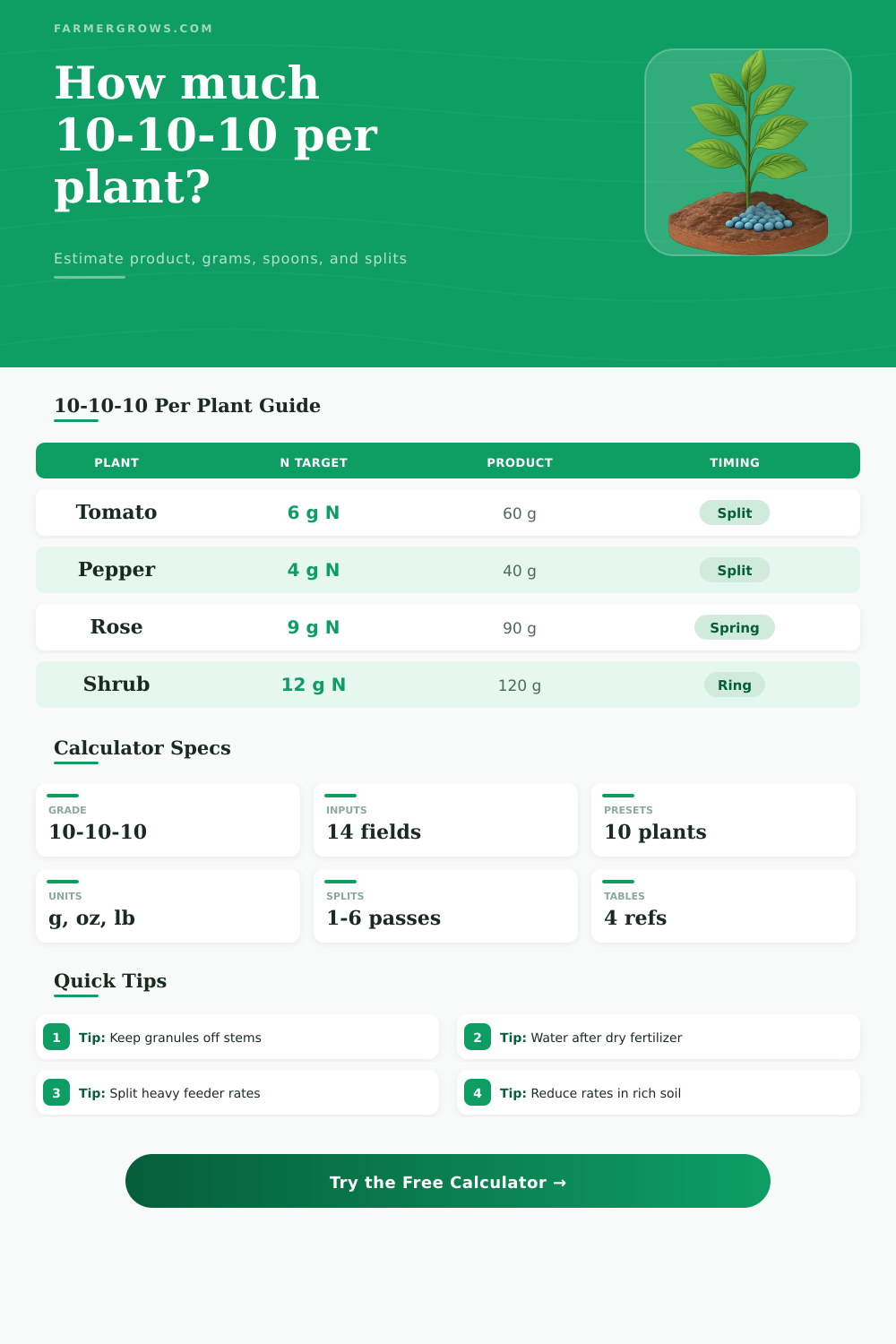
| Plant group | Planning N target | 10-10-10 per plant | Typical split | Field note |
|---|---|---|---|---|
| Tomato, eggplant | 4 to 8 g N | 40 to 80 g product | 2 to 3 feeds | Use lighter rates if compost or manure was added. |
| Peppers | 3 to 5 g N | 30 to 50 g product | 2 feeds | Avoid forcing too much leafy growth before fruiting. |
| Cucumbers, squash | 4 to 7 g N | 40 to 70 g product | 2 to 3 feeds | Side-dress as vines begin running and flowering. |
| Sweet corn | 2 to 4 g N | 20 to 40 g product | 2 feeds | Per-plant rates are small because plant density is high. |
| Roses and shrubs | 8 to 14 g N | 80 to 140 g product | 1 to 2 feeds | Spread in a ring, then water into the root zone. |
| Young fruit trees | 12 to 24 g N | 120 to 240 g product | 1 to 2 feeds | Keep granules well away from trunk bark. |
| Product amount | N supplied | P₂O₅ supplied | K₂O supplied | Kitchen measure at 14 g/tbsp |
|---|---|---|---|---|
| 10 g 10-10-10 | 1 g | 1 g | 1 g | 0.7 tbsp, about 2 tsp |
| 25 g 10-10-10 | 2.5 g | 2.5 g | 2.5 g | 1.8 tbsp |
| 50 g 10-10-10 | 5 g | 5 g | 5 g | 3.6 tbsp |
| 100 g 10-10-10 | 10 g | 10 g | 10 g | 7.1 tbsp, about 0.44 cup |
| 1 lb 10-10-10 | 45.4 g | 45.4 g | 45.4 g | about 32 tbsp |
| Density setting | Teaspoon weight | Tablespoon weight | Best use | Accuracy note |
|---|---|---|---|---|
| 12 g per tbsp | 4 g | 12 g | Light, coarse granules | Good for rough garden estimates. |
| 14 g per tbsp | 4.7 g | 14 g | Default dry blend | Common starting point for granular products. |
| 16 g per tbsp | 5.3 g | 16 g | Denser prills | Weigh one level tablespoon for better accuracy. |
| Custom weighed | density / 3 | your value | Best precision | Use a small scale and a level spoon. |
| Application style | Keep-away zone | Placement | Watering | Watch point |
|---|---|---|---|---|
| Vegetable side-dress | 4 to 6 inches | Band beside row, not on stem | Water after spreading | Keep granules off leaves and crowns. |
| Container top-dress | 2 to 4 inches | Outer pot surface | Water thoroughly | Use lower rates because salts build up. |
| Shrub ring | 8 to 12 inches | Ring under canopy edge | Soak root zone | Avoid piles near the crown. |
| Young tree dripline | 12 to 18 inches | Broad ring inside dripline | Deep watering | Do not place against trunk bark. |
Measure by weight when possible: Granule size changes spoon volume. If the dose matters, weigh one level tablespoon and enter that density.
Start conservative: 10-10-10 supplies equal N, P₂O₅, and K₂O. Rich soil or containers usually need a reduced per-plant dose.
Don’t guess about how much food to feed plant; calculate their precise need, so you apply just what’s needed (no more). Too much is never better; it stops plant growth (stunting them) and builds up salts in the soil. Instead of an easy “just add water” all-purpose blend (such as 10-10-10), think specificly about the nitrogen target.
The calculator figure out what each plant actualy needs based off its age and size. Only part of bag is actually nitrogen, so the calculator take that into account when figuring out how much of the package your plant requires.
Simple Tips for Feeding Your Plants
What about amendments? A good fertilizer routine takes into account whether you’ve amended your bed, since compost and other organic matter improves fertility of your soil. For example: In a quick-draining sandy soil, you’d want to give more supplemental feed then you would if your soil were heavily amended with compost or aged manure. Adjust accordingly on the tool; don’t overfeed what’s getting plenty of food otherwise, or it may suffer salt stress to its roots before you see any sign of yellowing in its foliage.
Don’t apply all fertilizer at once; break up the application into smaller doses. Applying all at once cause a spike, which may burn roots or wash away before they has time to do good. Breaking it up into two or three feedings ensures plant has food on hand. This helps when the plant really needs it during fast-growth periods like fruiting times. On the calculator, set how many splits there will be and tweak what percent is applied initially. Smaller, incremental amounts resemble how nature releases nutrients, rather than all at once like one giant gumball.
Fertilizer is measured by weight; the amount you use depend on what kind of granules are in it. Pellets can be denser then coarse granules and will weigh more per tablespoon. So number of tablespoons you add with a standard kitchen spoon will differ. (The example table shows the effect of changing the number of grams per tablespoon.) To get the remainder of calculations right, weigh out a single tablespoon of the exact brand and type of granules you have to establish that as your reference point.
Don’t feed near the trunks of plants; it’s bad for their health. Applying concentrated chemicals right next to a trunk (or stem) will inevitability cause chemical burns. Make sure to leave several inches between trunk/stem and any granular fertilizer. Water will wash it down and spread out the concentration so it doesn’t harm the plant, but instead feeds it safely in the root zone. For surface applications, proximity is key, not strength: A ring of several inches is ample around young trees and shrubs; with little annuals, you can place them closer.
Since there’s no place for salts to go in container plants, they needs even more care. In the absence of flushes with rain water, accumulation of residues will quickly build up in the soil mass within the pot where it can eventualy lock out nutrients rather than provide them. Again, reduce rates considerably for containers for the good of both the potting mix and the plant. Better to err slightly on the side of underfeeding and topdress later then to make the small volume of soil into a salty environment.
The fertilizer becomes active when watered on. Until it’s moistened, those dry granules don’t do a thing but wait to be blown around by wind or evaporate from the hot ground. The water soaks them in fast enough that they feeds the roots without baking the surface of the topsoil where they touch. Now you have a source of available nutrition to feed your plants instead of a bunch of inert chemicals still waiting to become something useful.
To maximize effectiveness of fertilizing, think of it more as medication prescribing than dumping (this stuff plus that stuff plus…). The goal is to apply the right amount at the correct time to the specific plant, such as a rose bush or tomato, not too much and not too little. The goal: the right amount applied at the correct time to the particular plant in question (rose bush or tomato), not too much and not too little. That’s the key.
Get the balance right and what was guesswork becomes a sure-fire system for healthy results season after season, there is no waste of product and no harm to the soil structure. You should of used this tool sooner.