Wood Stove Flue Size Calculator
Estimate round flue diameter, cross-sectional area, draft match, and chimney adjustments from collar size, heat output, height, fittings, altitude, and liner conditions.
📌Named flue presets
🔧Stove and chimney inputs
🧱Flue material comparison grid
📊Reference tables
Round flue diameter and area guide
| Round diameter | Area | Typical output range | Planning note |
|---|---|---|---|
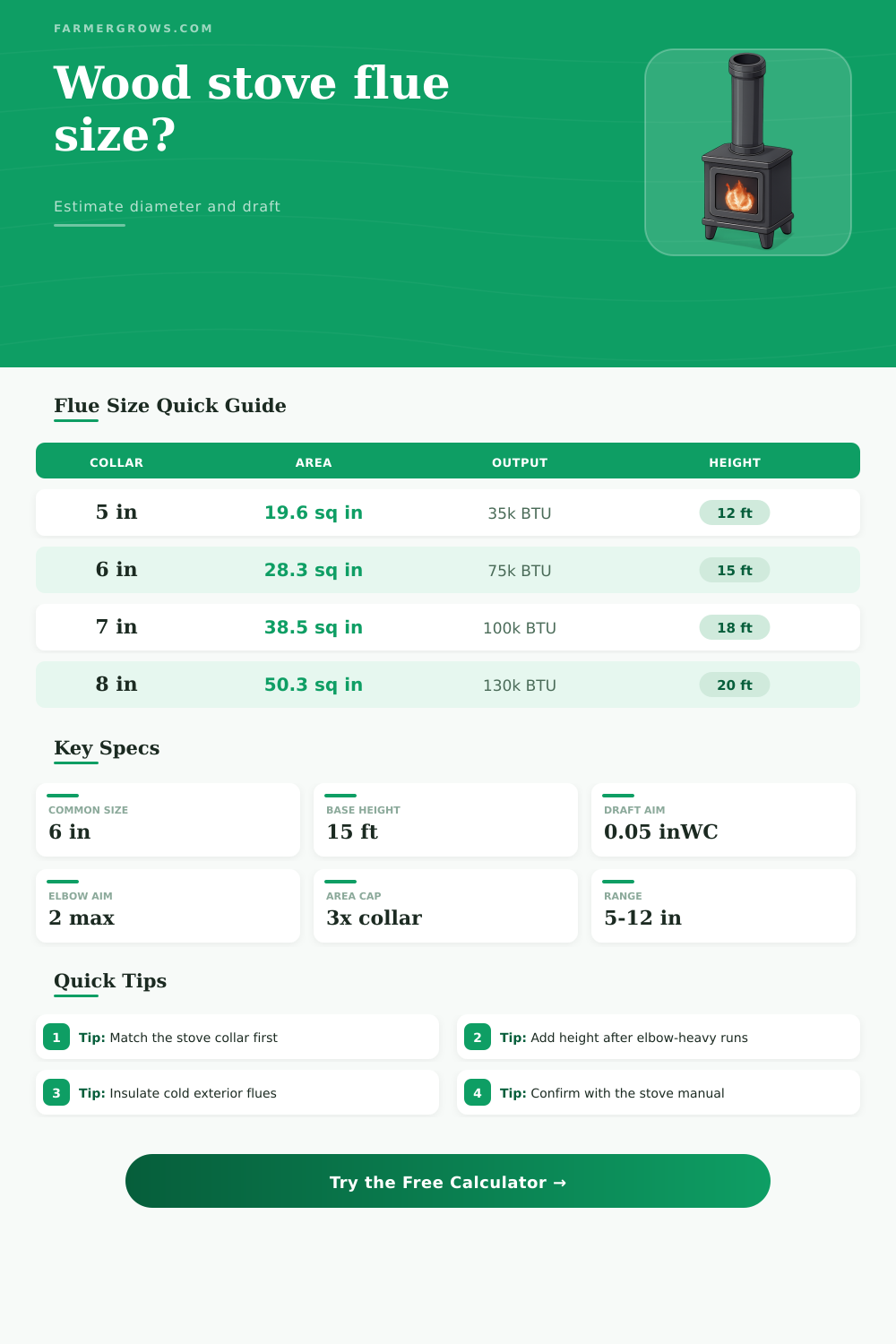
| 5 inches | 19.6 sq in | Up to about 45,000 BTU/hr | Small modern stoves only |
| 6 inches | 28.3 sq in | 45,000 to 85,000 BTU/hr | Most common modern wood stove size |
| 7 inches | 38.5 sq in | 85,000 to 110,000 BTU/hr | Large firebox or short stack cases |
| 8 inches | 50.3 sq in | 110,000 to 150,000 BTU/hr | Large stove, furnace, or older appliance |
| 10 inches | 78.5 sq in | Special appliance use | Often too large for standard room stoves |
Height and elbow allowance
| Chimney layout | Draft effect | Calculator action | Field check |
|---|---|---|---|
| Under 12 ft total height | Weak natural draft | Adds area demand and flags height | Confirm cap height and clearances |
| 12 to 18 ft with two elbows | Normal for many homes | Uses collar and BTU as main drivers | Keep connector run rising to chimney |
| More than three elbows | Higher flow resistance | Penalizes score and capacity | Reduce offsets where possible |
| Over 25 ft straight interior stack | Strong draft potential | May show over-draft warning | Check manual damper guidance |
Altitude correction guide
| Altitude | Air density effect | Draft adjustment | Common response |
|---|---|---|---|
| 0 to 2,000 ft | Minor | Standard sizing | Follow stove collar size |
| 2,000 to 5,000 ft | Moderate | Small score reduction | Favor warmer chimney routing |
| 5,000 to 8,000 ft | Noticeable | More height or insulation helps | Minimize elbows and long runs |
| Over 8,000 ft | High impact | Capacity is reduced | Use appliance manual high-altitude notes |
Draft target reference
| Appliance type | Common draft target | Flue temperature pattern | Sizing note |
|---|---|---|---|
| Modern EPA wood stove | 0.04 to 0.06 inWC | Moderate and controlled | Usually stays at collar diameter |
| Catalytic wood stove | 0.04 to 0.05 inWC | Lower during long burns | Warm, insulated flue helps stability |
| Fireplace insert | 0.04 to 0.06 inWC | Cooler at exterior chimney | Full insulated liner is often important |
| Wood furnace or boiler | 0.05 to 0.08 inWC | High output cycles | Manual and listing control final size |
💡Flue sizing tips
When choosing the size of the flue for a wood stove, it is important to ensure that the stove will function correct. If the flue size are incorrect, then the wood stove will emit smoke and have a poor draft. While many peoples think that the collar on the back of the wood stove is the only measurement that is important for stoves, the chimney must also match the wood stove.
If the chimney and wood stove is matched in their volume, the temperature of the smoke, and their resistance, the stove will burn more efficient and retain more heat for the house. The diameter of the collar will start the process of determining the size of the flue for the wood stove. For moddern wood stoves, the most common size of the collar is six inches.
How to Choose the Right Flue Size for a Wood Stove
This size of the collar is ideal for a modern EPA stoves because it allows enough airflow for the burn rates of the stove. If the diameter of the flue is larger then the diameter of the collar, the smoke will cool faster. If the smoke cools too quick, the draft will stall before it can exit the chimney.
The calculator will help ensure that this does not happen. The height of the chimney will also affect the performance of the flue. For chimneys that are too short, the wood stove may be able to expel smoke on a calm day but will struggle with high wind or low temperatures.
However, a tall chimney may also present a problem because the exterior chimney will lose heat quick. Any chimney that is taller than fifteen feet should of been insulated to retain the heat. Any number of elbow in the chimney will slow the smoke because each elbow presents a turn in which the smoke must make and provides an expansive area for the smoke to release heat.
Chimney configurations with two elbows are manageable but configurations with four may require adjustment to the height or size of the flue. The calculator will adjust for this because it will increase the demand for the area of the flue if a higher number of elbows is select. Another factor is the altitude of the area where the chimney will be installed.
The higher the altitude, the thinner the air. Thin air contain less oxygen for the smoke to create a draft. A stove that burns well at two thousand feet may not burn well at seven thousand feet.
The calculator will account for this in the altitude field. Lastly, the type of pipe that will be used in the chimney and the condition of the liner will impact how hot the smoke will remain and how much resistance is create for the draft of smoke. A single-wall chimney connector will lose heat quick.
Instead, insulated Class A pipe will retain the heat of the smoke better. However, retaining the heat of the smoke will impact the area that the flue can have. The material comparison will help determine if insulation are needed.
Using an oversized flue can also cause problem. If the flue is too large in relation to the stoves collar, the smoke will lose both velocity and heat as it exit the chimney. This loss of heat can stall the draft of smoke.
The calculator will warn of this possibility. The goal is to set the moddern wood stove’s draft to 0.5 inches of water column. This is the ideal draft for most stoves.
This draft will allow the fire to recieve enough oxygen to sustain itself without waste fuel or overheating the wood stove. The calculator will estimate the draft according to the chimney height, pipe type, liner condition, and wood stove profile. The calculator will provide a score to let the user know how close the measurement are to the ideal.
A higher score indicates more predictable behavior of the chimney. A low score indicates an adjustment is needed for the height, insulation of the chimney, or the number of elbows in the flue. The setup of the flue may not ever be perfect in relation to the ideal flue setup listed in the manual.
Many factor affect the performance of a wood stove flue. These factors may include the pitch of the roof, the number of trees, the direction of the wind, or other chimney in the area. The flue draft calculator provide an ideal starting point but measuring the draft will provide more accuratey information.
If the draft measurements are outside of the target, you can make adjustment to the installation. For instance, installing a flue cap or shortening a horizontal run may fix the problem. The goal is to have a flue that support the wood stove.
Any flue that can support a wood stove will allow it to light easy and burn the wood completely.