Wood Chip Mulch Calculator
Estimate wood chip mulch for garden beds, orchard tree rings, vegetable rows, farm paths, and play areas with chip type, moisture, settling, bags, bulk yards, and coverage built in.
Load a real wood chip job, then adjust dimensions, chip type, target depth, existing layer, settling, moisture, bag size, and overage.
Wood Chip Mulch Estimate
Enter a project and calculate to see bulk yards, bags, coverage, and weight.
Wood chips are not one uniform material. Fresh arborist loads may include leaves, twigs, bark, and mixed particle sizes, while bagged decorative chips are more consistent.
Often free or local, but pile volume, moisture, leaf content, and decomposition speed vary by load.
Knits together well on beds and slopes, with higher weight per yard than coarse bark or cedar.
Useful where lower load weight matters, though lightweight chips can move more on exposed paths.
Designed for play surfaces. Use local safety depth guidance, edge containment, and maintenance topping.
| Settled depth | Coverage per cubic yard | Coverage per 2 cu ft bag | Coverage per 3 cu ft bag |
|---|---|---|---|
| 1 inch top-up | 324 sq ft (30.1 sq m) | 24 sq ft | 36 sq ft |
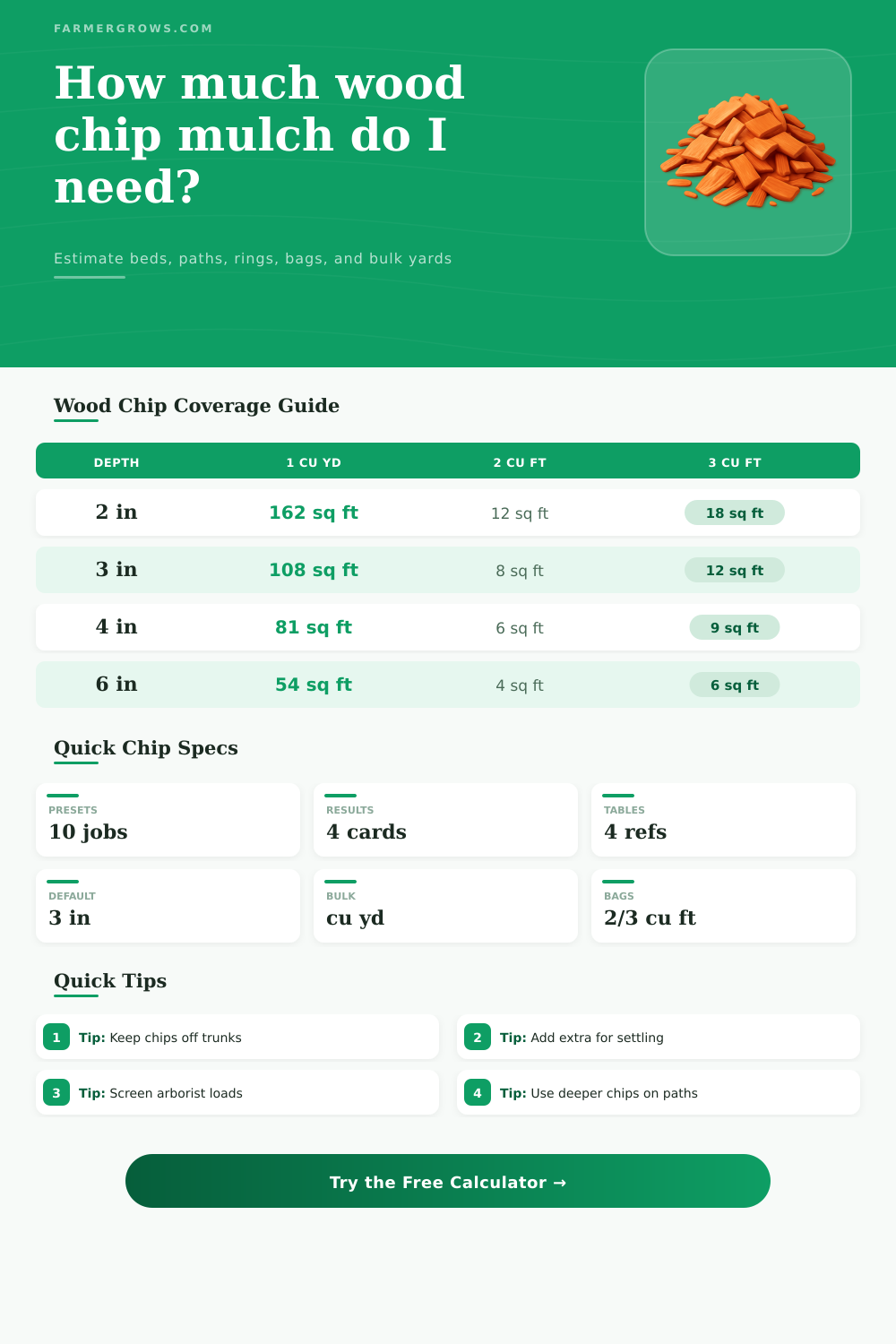
| 2 inch refresh | 162 sq ft (15.1 sq m) | 12 sq ft | 18 sq ft |
| 3 inch bed layer | 108 sq ft (10.0 sq m) | 8 sq ft | 12 sq ft |
| 4 inch weed layer | 81 sq ft (7.5 sq m) | 6 sq ft | 9 sq ft |
| 6 inch path layer | 54 sq ft (5.0 sq m) | 4 sq ft | 6 sq ft |
| 9 inch play layer | 36 sq ft (3.3 sq m) | 2.7 sq ft | 4 sq ft |
| Buying unit | Volume | Units per cubic yard | Best use |
|---|---|---|---|
| 2 cu ft bag | 0.074 cu yd | 13.5 bags | Small beds, touch-ups, precise color matching |
| 3 cu ft bag | 0.111 cu yd | 9 bags | Medium beds where bags are easier than delivery |
| Bulk cubic yard | 27 cu ft | 1 yard | Large beds, orchards, paths, and farm lanes |
| 5 cu yd load | 135 cu ft | 5 yards | Common small dump trailer or local delivery size |
| Project | Area | Typical depth | Bulk volume before overage |
|---|---|---|---|
| Small perennial bed 10 x 20 | 200 sq ft | 3 in | 1.85 cu yd |
| Single 6 ft tree ring with trunk gap | 26 sq ft | 3 in | 0.24 cu yd |
| Market garden path 3 x 100 | 300 sq ft | 6 in | 5.56 cu yd |
| Play area 15 x 15 | 225 sq ft | 9 in | 6.25 cu yd |
| Orchard row rings, 12 trees | 310 sq ft | 4 in | 3.83 cu yd |
| Condition | Weight effect | Volume behavior | Planning note |
|---|---|---|---|
| Dry stored chips | About 15% lighter | More fluffy, easier to spread | Good for hand spreading and bag estimates |
| Typical damp delivery | Baseline estimate | Normal settling after rain | Use for most bulk yard planning |
| Wet fresh chips | About 25% heavier | Settles faster after spreading | Check trailer and driveway load limits |
| Rain-soaked pile | About 45% heavier | Can mat or compact in place | Order by volume, but handle by weight |
| Mixed arborist load | Wide density range | Leafy or twiggy loads shrink more | Add overage and screen out large sticks |
For trees, build a wide donut instead of a volcano. Keep chips pulled back from trunks so bark can dry and root flare remains visible.
Loose chips settle after spreading, especially fresh arborist chips. A 10% to 25% allowance keeps the finished layer closer to the depth you intended.
Calculating an correct volume of mulch for your landscaping project are a necessary step. If you dont calculate the correct amount of mulch needed for your projects, you will have to make extra trips to your local hardware store to purchase the remaining mulch needed to complete your landscaping project. There is two main reasons that people fail to properly calculate the volume of wood chip mulch that they need for there landscaping project.
Most people do not account for the settling of the mulch into the ground. Additionally, people do not account for how the moisture level of the mulch will change the weight of the mulch. In order to calculate the area that will recieve the mulch, you will have to consider the area of the garden bed in which you will place the mulch, as the shape of the garden bed will determines the volume of the mulch that is required.
How to Calculate the Right Amount of Mulch
For instance, if the garden bed is rectangular in shape, it is easy to calculate the total square footage of that garden bed. However, if the garden bed is triangular in shape or circular in shape, it is more difficult to calculate the total square footage of the bed. In either of these scenarios, you may find that the garden bed contains certain objects (such as other tree or rocks) that take up some of the total area of the garden bed.
In this case, you must also subtract the area of those objects from the total area of the garden bed. Additionally, if the garden bed already contains mulch, it is important to consider that you will reuse the layer of mulch already in the garden bed and, therefore, the amount of mulch that you will order will not have to account for that existing layer of mulch. The depth of the mulch will change the function of the mulch in the garden bed, and it will also change the amount of mulch that must be purchase.
For example, mulch applied to a garden bed at a depth of two inches will provide a light weed barrier. A depth of three inches of mulch is often a common middle ground for many garden bed. A depth of four inches will help to suppress any weeds that may grow within the garden bed.
A depth of six inches is suitable to apply to garden paths so that the mulch will remain firmly under the feet of those who walk on the path. Play area often require a depth of nine inches of mulch. However, since mulch will compact when placed in the ground, the calculator account for this by adding a settling allowance to the depth of the mulch.
The type of mulch that is used can impact how much of that mulch will settle into the ground, as well as how much that mulch will weigh once it is placed into the ground. For instance, arborist chips may contain leaves and twigs that shrink at ground more then shredded hardwood chips. Thus, arborist chips will require a larger overage of mulch to account for the settling than other types of mulch.
Shredded hardwood and cedar chips are more easily predicted than arborist chips. However, another factor that can change the weight of the mulch is the moisture level of the mulch. Mulch that contains more moisture will weigh more than mulch that is dry.
Thus, it is important to know the weight of the mulch when the mulch is damp, particulary if you will transport the mulch on a trailer. Finally, there are different types of mulch that are used for different purposes in certain locations. For instance, dense hardwood mulch will remain in place on slopes because the mulch knits together, while lighter cedar mulch will not remain in place on these slopes.
Additionally, engineered wood fiber is used for play area and requires a different form of maintenance than landscape chip. Thus, it is important to ensure that you choose the specific type of mulch for the project in which it will be used. By using this calculator to take into account the area to be covered, the depth of the mulch, the type of mulch that will be used, and the settling of the mulch in the ground, you can ensure that you will order the correct volume of mulch for your landscaping project.