Wind Turbine RPM Calculator
Estimate rotor RPM, blade tip speed, generator RPM after pulley ratio and load slip, and blade-pass rate from wind speed, rotor diameter, target TSR, blade count, and cut-in speed.
Pick a starting rotor style, then adjust the wind, diameter, TSR, blade count, cut-in speed, pulley ratio, and load slip for your tower or bench test.
Wind Turbine Speed Results
RPM is calculated from target TSR, wind speed, and rotor circumference. Generator RPM then applies pulley ratio and load slip.
This grid holds your wind speed and rotor diameter constant, then compares rotor RPM at common target TSR values.
| Quantity | Formula | Inputs used | Planning note |
|---|---|---|---|
| Rotor circumference | π × diameter | Rotor diameter | Larger rotors spin slower at the same TSR |
| Rotor RPM | TSR × wind speed × 60 / circumference | Wind, diameter, TSR | Main wind turbine RPM calculation |
| Tip speed | TSR × wind speed | Wind speed, TSR | Useful for noise and blade stress checks |
| Generator RPM | Rotor RPM × pulley ratio × (1 - slip) | Rotor RPM, ratio, slip | Compare to alternator cut-in and safe RPM |
| Blade-pass rate | Rotor RPM × blades / 60 | RPM, blade count | Shows pulses per second at the tower |
| Rotor type | Typical TSR | Blade count | Speed behavior |
|---|---|---|---|
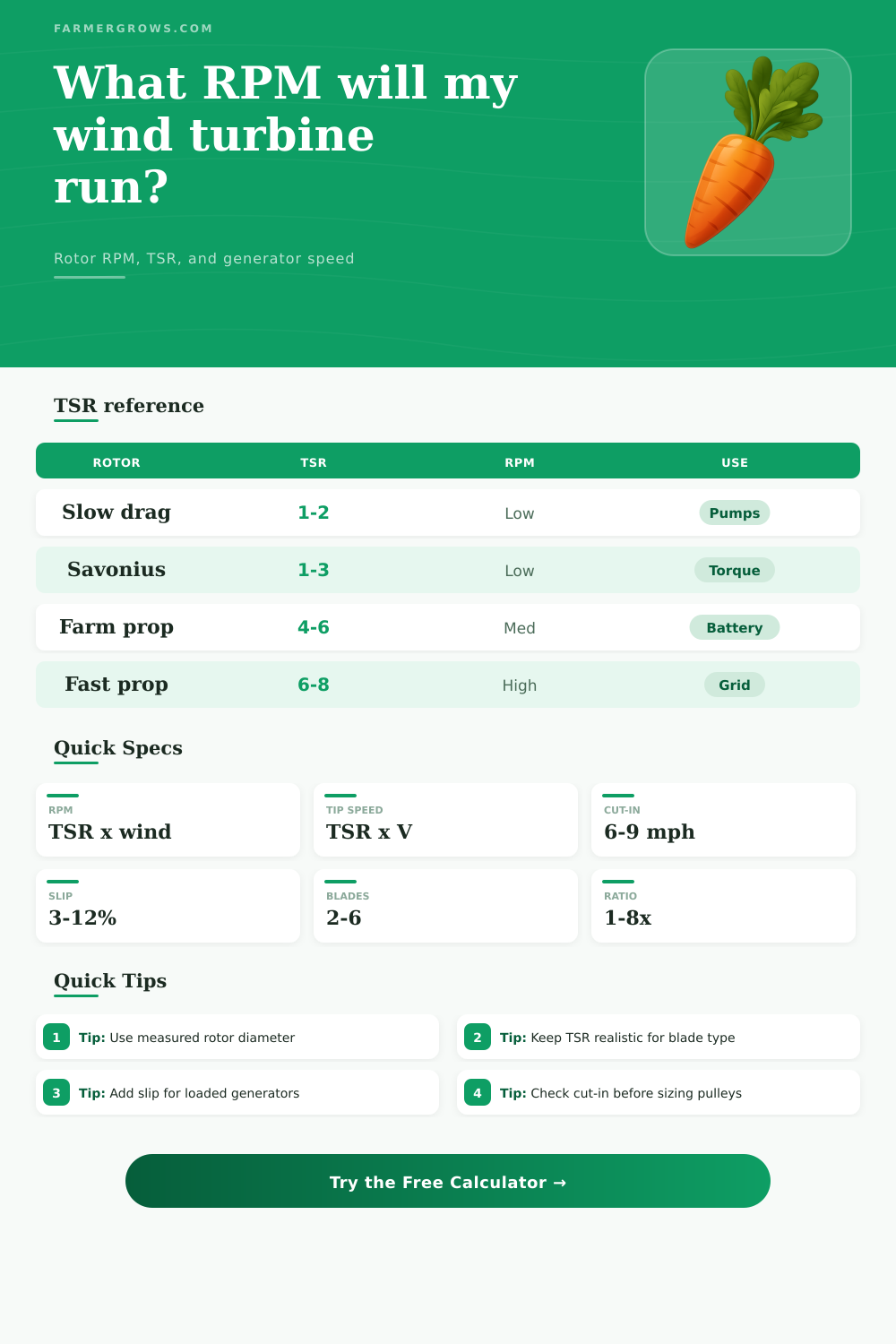
| Savonius drag rotor | 0.8 to 1.8 | 2 scoops or more | High starting torque, low RPM |
| Multi-blade water pumper | 1.0 to 3.0 | 6 to 18 blades | Slow rotor for mechanical loads |
| Small 3-blade battery turbine | 4.0 to 7.0 | 3 blades | Balanced speed and starting behavior |
| Two-blade fast rotor | 6.0 to 9.0 | 2 blades | Higher RPM and lower solidity |
| Darrieus vertical-axis rotor | 3.0 to 6.0 | 2 to 4 blades | May need help at low wind speeds |
| Drive setup | Ratio range | Slip allowance | Use case |
|---|---|---|---|
| Direct-drive axial alternator | 1.0x | 0% to 4% | Simple small turbine with low-speed alternator |
| Single belt step-up | 2x to 5x | 3% to 10% | Battery charging with compact generator |
| Two-stage belt drive | 5x to 12x | 6% to 15% | High generator RPM from slow rotors |
| Chain or timing belt | 1.5x to 8x | 1% to 6% | Better ratio control with more alignment care |
| Loaded permanent magnet generator | Any ratio | 3% to 12% | Electrical loading can slow the rotor under charge |
| Wind condition | mph | m/s | RPM planning note |
|---|---|---|---|
| Light breeze | 5 | 2.24 | Often below cut-in for small generators |
| Common cut-in target | 7 | 3.13 | Rotor may begin useful charging |
| Steady small-turbine wind | 12 | 5.36 | Good reference speed for RPM estimates |
| Fresh breeze | 18 | 8.05 | RPM and tip speed rise directly with wind |
| Strong operating wind | 25 | 11.18 | Check furling, braking, and safe RPM limits |
The wind speed at the hub of a small wind turbine will rarely be constant. However, the small wind turbine itself must turn at a speed that is equal to the wind speed and the generator speed. The relationship between these two speeds are crucial to understanding if the machine will be able to charge batteries, if the blades of the machine will be within safe speed limits, and if the machine require a brake system to engage on gusty days.
The individual that plan to construct the machine must understand each of these variables to ensure that it is constructed in accordance with those variables. The diameter of the rotor of the machine will determine the circumference that the tips of the blades travel. If the rotor has a wide diameter, the blades will travel more distance with less rotational speed.
Wind Speed and Rotor Speed in Small Wind Turbines
Conversely, a smaller diameter will make the blades reach the cut-in speed for rotation of the blades more easy. The diameter will impact the rotational speeds of the machine once the wind begins to turn the blades. The tip-speed ratio of the machine will impact the rotational speeds of the machine.
For instance, machines with drag blade designs, like Savonius machines, have tip-speed ratios of around one or two. However, three blade propellers for farm uses have tip-speed ratios between four and seven. Higher tip-speed ratios mean that more energy can be extracted from the wind, but also require blades that can better handle the rotational speeds.
Additionally, higher tip-speed ratios indicate that the machine will create more noise. Another important factor to consider is the drive system for the machine. This system will multiply the speeds of the rotor to match those of the generator.
For instance, people often use a belt system that provides a step-up of four to one in battery charger systems, as the compact generators require higher rotational speeds. However, slip may occur within this system if the loads on the machine is high. Another factor to consider is the blade-pass rate of the machine.
The blade-pass rate is the number of times that the blade passes the tower each second. High RPMs or an excessive number of blades will result in a high blade-pass rate, which can be felt within the tower. The blade-pass rate can be calculated from the RPM of the machine and the number of blades that it has.
The cut-in wind speed of the machine will indicate the speed at which the generator will begin to produce current. At speeds lower than the cut-in speed, the generator will produce no current. This value can help to determine if the area will provide enough wind to enable the turbine to function.
Small wind turbines usually have cut-in speeds of around six or seven miles per hour. The actual wind that is present will not be a constant. Factors like turbulence from structures around the machine will impact the true speed of the wind that is hit by the blades.
Additionally, gusts of wind will increase the tip speed of the blades. Thus, the calculated wind speed is only an approximation of the actual speed that the blades will achieve, and is not an exact value. However, if the calculated tip speed is near the upper limit for the blade material, gusts will increase the tip speed beyond that calculated value.
Another factor to consider are the alignment and tension of the pulleys within the drive system. For instance, if the belt within the drive system is too loose, it may not provide slip losses for the rotor when there are no loads on the machine. However, if the belt is also too loose, it will slip when the machine is fully loaded.
If the belt is too tight, there will be less slip losses, but the machine will create friction in its components. Small wind turbines are often constructed based off the rotor that the individual that is constructing the machine owns. After determining the tip-speed ratio of the blades of the rotor, the individual can determine the size of the pulleys that should be used to enable the machine to function appropriately.
However, if the rotor is slow compared to the generator speeds, it will spend most of its time outside of its efficient range of speeds. Conversely, if the rotor is fast but the wind speeds at the site are low, it will spend most of its time outside of the cut-in speed of the rotor. The blades of the rotor create noise.
When the tip speed of the blades reaches roughly 120 mph, the amount of noise that the machine creates begins to rise rapid. Two blade machines may create more noise than three blade machines due to the “smoothing” effect of the third blade. Thus, the tip speed of the blades should be evaluated against the wind records within the area where the machine will be constructed to protect both the machine and the neighboring residents.
The overspeed protection of a machine is provided outside of the calculations of the speed at which the generator should reach. Factors like furling tails, pitch blades, and braking systems will engage within the machine prior to the blades reaching speeds that could potentially damage the machine. Thus, the calculated speeds will help to determine the overspeed protection requirements for the machine; if the calculated overspeed is near the upper limit of the alternator, overspeed protection should be considered for the design of the machine.
By calculating each of these factors, an understanding can be gained of the relationship between each factor and the performance of the small wind turbine. Each factor will help to determine whether or not the small wind turbine will effectively charge batteries, and if it will do so within safe limits. Small changes in any of these factors can be made prior to construction of the machine, but large alterations to any of these factors will indicate necessary changes in the cost of the construction of the small wind turbine.