🚧 Welded Wire Fence Calculator
Calculate the exact amount of fencing, posts, and hardware clips needed for your project
| Perimeter | 6 ft Spacing | 8 ft Spacing | 10 ft Spacing | 12 ft Spacing | Perimeter (m) |
|---|---|---|---|---|---|
| 40 ft | 8 posts | 6 posts | 5 posts | 4 posts | 12.2 m |
| 80 ft | 14 posts | 11 posts | 9 posts | 8 posts | 24.4 m |
| 120 ft | 21 posts | 16 posts | 13 posts | 11 posts | 36.6 m |
| 200 ft | 34 posts | 26 posts | 21 posts | 18 posts | 61.0 m |
| 300 ft | 51 posts | 38 posts | 31 posts | 26 posts | 91.4 m |
| 400 ft | 68 posts | 51 posts | 41 posts | 35 posts | 121.9 m |
| 600 ft | 101 posts | 76 posts | 61 posts | 51 posts | 182.9 m |
| Roll Length | 2 ft Height | 4 ft Height | 6 ft Height | 8 ft Height | Roll (m) |
|---|---|---|---|---|---|
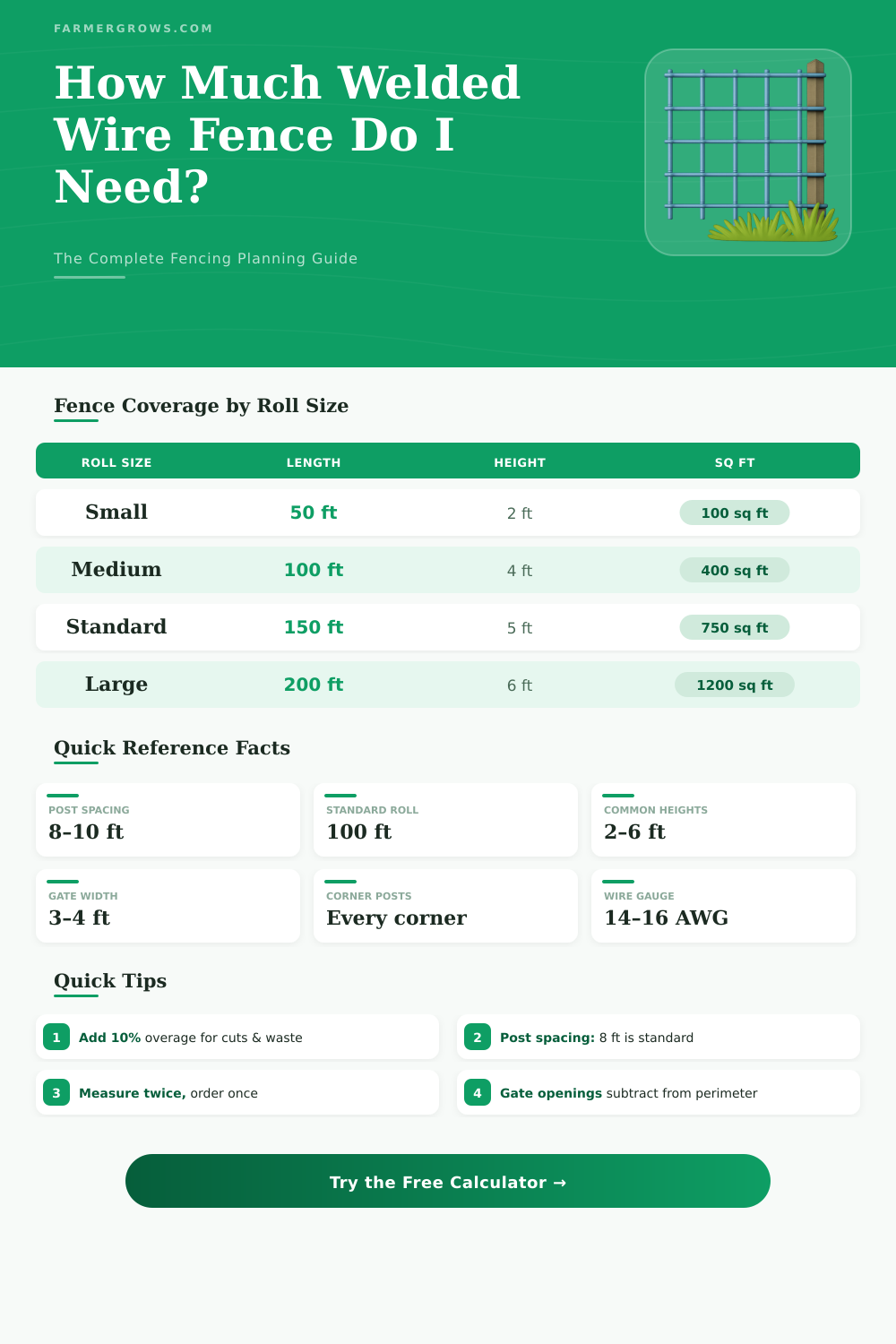
| 50 ft roll | 100 sq ft | 200 sq ft | 300 sq ft | 400 sq ft | 15.2 m |
| 100 ft roll | 200 sq ft | 400 sq ft | 600 sq ft | 800 sq ft | 30.5 m |
| 150 ft roll | 300 sq ft | 600 sq ft | 900 sq ft | 1,200 sq ft | 45.7 m |
| 200 ft roll | 400 sq ft | 800 sq ft | 1,200 sq ft | 1,600 sq ft | 61.0 m |
| Project | Dimensions | Perimeter | Fence Needed | Posts (8ft) | Rolls (100ft) |
|---|---|---|---|---|---|
| Small Garden | 10 x 10 ft | 40 ft | 44 ft (+10%) | 6 | 1 |
| Raised Bed Area | 20 x 20 ft | 80 ft | 88 ft (+10%) | 11 | 1 |
| Chicken Run | 30 x 15 ft | 90 ft | 99 ft (+10%) | 13 | 1 |
| Dog Kennel | 40 x 20 ft | 120 ft | 132 ft (+10%) | 16 | 2 |
| Backyard | 50 x 50 ft | 200 ft | 220 ft (+10%) | 26 | 3 |
| Orchard | 60 x 60 ft | 240 ft | 264 ft (+10%) | 31 | 3 |
| Deer Perimeter | 100 x 60 ft | 320 ft | 352 ft (+10%) | 41 | 4 |
| Large Property | 200 x 100 ft | 600 ft | 660 ft (+10%) | 76 | 7 |
To determine the amount of welded wire needed for a project, you must first determine the perimeter of an area to be fenced in. The perimeter of an area is the distance around the outside edge of the area. To find the perimeter of an area, you must calculate the perimeter of the area rather than the square footage of the area.
If you calculate the square footage of the area, you wont have enough welded wire to complete the fence. For example, if the garden are 20 feet long and 20 feet wide, the area of the garden is 400 square feet, but the perimeter of the garden is 80 feet. In this example, you must buy 80 feet of welded wire to complete the fence for the garden.
How Much Welded Wire Do You Need for a Fence
The shape of the area to be fenced in will dictate the method used to calculate the perimeter. If the area is in the shape of a rectangle, you will need to calculate the length and the width of the area and multiply that number by two. If the area to be fenced in is in the shape of a circle, you must calculate the circumference of the circle because the circumference is the perimeter of a circle.
If the area to be fenced in is of an irregular shape, such as a triangle or an area that will go around a tree, you must measure each side of that area and add each measurement to find the total perimeter of that area. Once you have calculated the total perimeter of the area to be fenced in, you must subtract the width of any gate that you will construct in that fence because welded wire does not cover the gate openings. The height of the welded wire fence is another critical measurement to determine how much wire you need to purchase.
If the fence is to be taller, you will need more welded wire because the total surface area of a taller roll of welded wire is more greater than a fence that is shorter in height. For example, if you have to fence in a perimeter of 100 feet, a roll of welded wire that is four feet in height will provide 400 square feet of fencing coverage, but a roll of eight feet in height will provide 800 square feet of fencing coverage. The height of the welded wire fence will depend on the type of animal you wish to keep out of your fence.
A fence that is only two feet in height may keep small weeds from entering your garden, but a fence that is six or eight feet in height are necessary to keep deer from entering your garden. Another factor that will play a role in determining the amount of welded wire to purchase is the gauge of the welded wire. The gauge of the wire is the thickness of that wire.
If the gauge is lower, it means the welded wire is thicker. If the fence is for light tasks, such as poultry fencing, you can purchase 16 gauge welded wire. If the fence is for heavy animals, such as goats or pigs, you should make the fence of 12 gauge welded wire.
Since welded wire that is of a higher gauge is thicker, it will weigh more. Therefore, you must consider the weight of the welded wire when purchasing it for your project. When planning your fence with welded wire, you also need to plan for the fence posts.
Fence posts should be equally spaced. For fences with welded wire, the standard distance between fence posts is eight feet. However, fence posts is necessary at every corner and gate.
Additionally, you should bury the corner and gate posts deeper into the ground than the fence posts in the middle of the fence. Fence clips are necessary to attach the welded wire to the fence posts. Approximately two fence clips is needed for each foot of fence.
It is also helpful to purchase extra welded wire for your fence. If you buy extra welded wire, you will have enough to account for any mistake that might occur while building the fence. Additionally, buying extra wire will provide you with extra wire to wrap around the corners of the fence.
If you do not purchase extra welded wire, you may run out of wire before you have completed the fence. Finally, another factor to consider when building your fence using welded wire is the terrain and the environment where you will build the fence. If the terrain is sloped, you may need more welded wire to reach the ground.
If the area where you will build your fence is wet, you should purchase galvanized welded wire because the galvanized coating will protect the fence posts from rusting. If the fence is for chickens, you may need to bury the bottom of the welded wire into the ground because chicken predators will dig under the fence. By using these factors to determine how much welded wire you need to purchase, you can be sure that you have the correct amount of wire for your fence project.