🍉 Watermelon Spacing Calculator
Calculate exactly how much space your watermelon plants need based on variety, growing method, and garden dimensions
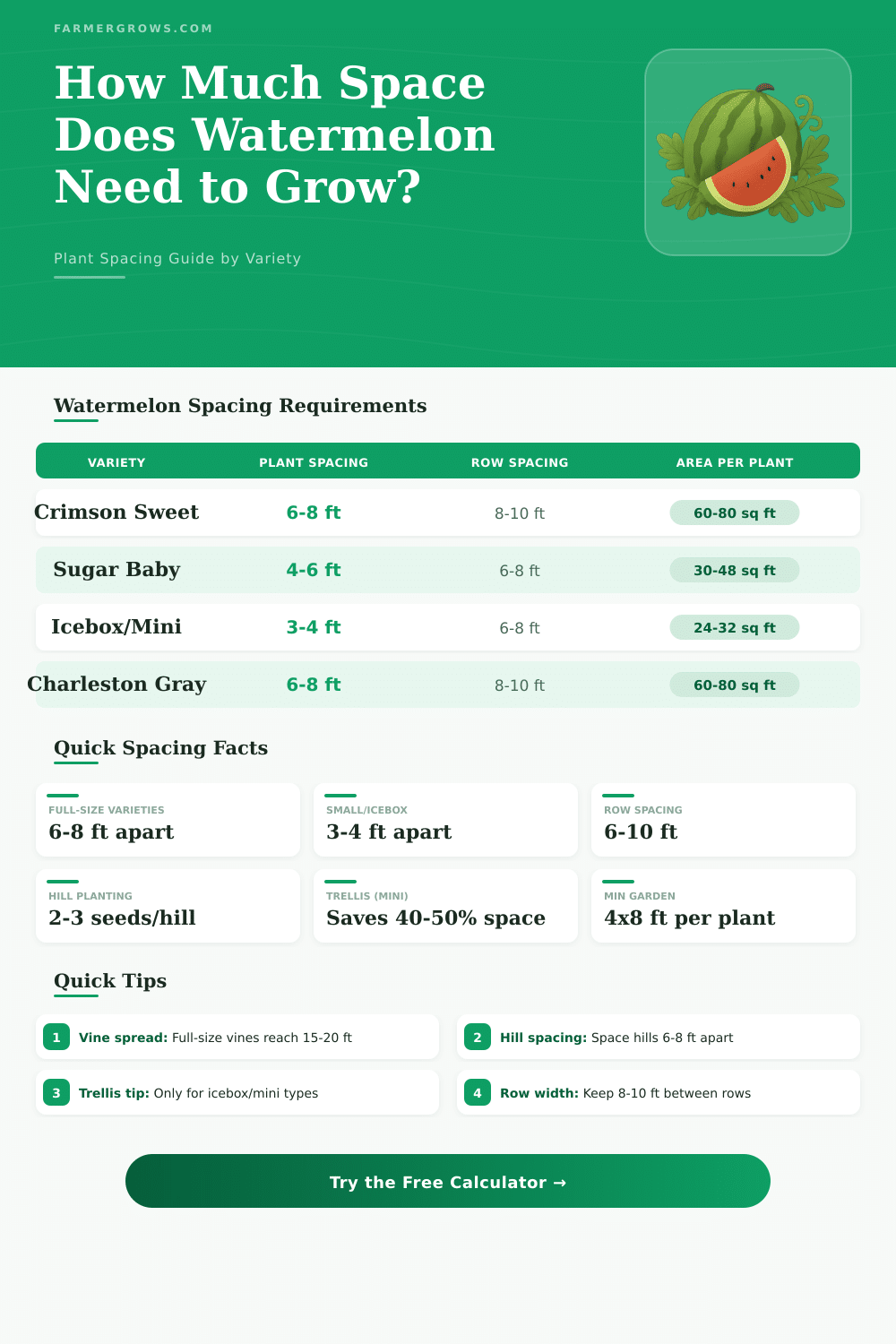
| Variety | Plant Spacing | Row Spacing | Area Per Plant | Vine Spread |
|---|---|---|---|---|
| Crimson Sweet | 6–8 ft (1.8–2.4 m) | 8–10 ft (2.4–3 m) | 60–80 ft² | 15–20 ft |
| Sugar Baby | 4–6 ft (1.2–1.8 m) | 6–8 ft (1.8–2.4 m) | 30–48 ft² | 8–12 ft |
| Charleston Gray | 6–8 ft (1.8–2.4 m) | 8–10 ft (2.4–3 m) | 60–80 ft² | 15–20 ft |
| Jubilee | 6–8 ft (1.8–2.4 m) | 8–10 ft (2.4–3 m) | 60–80 ft² | 15–20 ft |
| Yellow Flesh | 5–6 ft (1.5–1.8 m) | 6–8 ft (1.8–2.4 m) | 36–48 ft² | 10–15 ft |
| Seedless | 5–6 ft (1.5–1.8 m) | 6–8 ft (1.8–2.4 m) | 36–48 ft² | 10–15 ft |
| Icebox / Mini | 3–4 ft (0.9–1.2 m) | 6–8 ft (1.8–2.4 m) | 24–32 ft² | 6–10 ft |
| Moon and Stars | 6–8 ft (1.8–2.4 m) | 8–10 ft (2.4–3 m) | 60–80 ft² | 15–20 ft |
| Method | Best For | Space Savings | Notes |
|---|---|---|---|
| Ground Sprawl | All varieties | Standard | Traditional spacing, vines spread freely across open ground |
| Raised Bed | Sugar Baby, Icebox | 10–20% denser | Rich soil allows slightly closer spacing; train vines over edges |
| Trellis / Vertical | Icebox, Sugar Baby only | 40–50% savings | Use slings to support fruit; not for full-size melons over 15 lbs |
| Bed Size | Icebox / Mini | Sugar Baby | Full-Size Varieties |
|---|---|---|---|
| 4 × 4 ft (1.2 × 1.2 m) | 1 plant | 1 plant | Not recommended |
| 4 × 8 ft (1.2 × 2.4 m) | 2 plants | 1–2 plants | 1 plant (vines trail out) |
| 4 × 12 ft (1.2 × 3.7 m) | 3 plants | 2–3 plants | 1–2 plants |
| 6 × 10 ft (1.8 × 3 m) | 4–5 plants | 3–4 plants | 1–2 plants |
| 8 × 12 ft (2.4 × 3.7 m) | 6–8 plants | 4–6 plants | 2–3 plants |
| Variety | Yield Per Plant | Avg Fruit Weight | Days to Harvest |
|---|---|---|---|
| Crimson Sweet | 25–35 lbs (11–16 kg) | 20–25 lbs | 80–90 days |
| Sugar Baby | 8–12 lbs (3.6–5.4 kg) | 8–10 lbs | 75–85 days |
| Charleston Gray | 28–35 lbs (13–16 kg) | 25–35 lbs | 85–95 days |
| Jubilee | 25–40 lbs (11–18 kg) | 25–40 lbs | 90–100 days |
| Yellow Flesh | 15–25 lbs (6.8–11 kg) | 15–20 lbs | 80–90 days |
| Seedless | 15–20 lbs (6.8–9 kg) | 12–18 lbs | 85–95 days |
| Icebox / Mini | 5–10 lbs (2.3–4.5 kg) | 5–8 lbs | 70–80 days |
| Moon and Stars | 20–30 lbs (9–14 kg) | 20–30 lbs | 90–100 days |
| Garden Size | Max Plants (Full-Size) | Max Plants (Small/Icebox) | Expected Total Yield |
|---|---|---|---|
| 10 × 10 ft (3 × 3 m) | 1 | 2–3 | 25–35 lbs |
| 15 × 15 ft (4.6 × 4.6 m) | 2–3 | 4–6 | 50–100 lbs |
| 20 × 20 ft (6 × 6 m) | 4–5 | 8–12 | 100–175 lbs |
| 30 × 30 ft (9 × 9 m) | 9–12 | 18–28 | 225–420 lbs |
| 50 × 50 ft (15 × 15 m) | 25–35 | 50–80 | 625–1,200 lbs |
Watermelon vines are famous Space eaters. They spread in all directions, and when the fruits grow, they become really heavy. One single vine can cover up to 20 square feet of garden area.
Really more well address Watermelon vine as independent plant, it will take whole raised bed or take whole corner of your yard.
How to Space Watermelon Vines
Is excellent reason for Space them correctly. The air must flow freely between the vines, sunlight needs to reach the leaves, and bugs need access to do their task. If you press them too closely one to the other, that is like locking a pig in a little studio.
Simply it does not work, though you try as hard as you can.
Space Watermelon seeds in 3 to 5 feet one from the other for get good results. The ground should be rich in nutrients and well draining, with pH between 6.0 and 6.8. Wait until the ground temperature reaches 70 degrees or more, what commonly means to plant after the last spring frosts or at the start of summer.
Plant seeds at one inch depth.
Raised beds work for growing those vines well. Place six to eight seeds in every bed and Space the beds at around 4 feet. Or try the mound method: do 12-inch hills from ground, scattered at least 6 feet, plant six to eight seeds each hill, later thin to three or four vines.
For contest areas, keep the vines in 5 to 6 feet of neighbours. Interesting fact: using seedlings instead of direct sowing, you can harvest too weeks sooner.
Big species, as Crimson Sweet, really need 5 to 6 feet of Space. Those big melons weigh up to 40 pounds and can reach more than 4 feet of length. A normal 6×6 raised bed works for around 2 to 4 adult vines.
Commercial growers Space them at 8 to 12 feet in raised rows of 4 to 12 inches high.
Little species are less demanding. Mini-melons do fine with 13 or 14 square feet each vine. Small species need only 3 feet of distance, while big spreaders can need up to 12 feet.
For fruits under 8 pounds, Space the vines at 1 to 2 feet in rows (that works well).
Try also a trellis plan… Those spreading vines cover a lot of ground, and the fruits themselves need Space to rest. Trellising of Watermelon saves ground Space dramatically.
Attaching them to a greenhouse roof almost does not coverground. Use slings to hold heavy fruits, if that worries you. The roots go around 3 feet deep, so giving them enough depth does make a big difference.