Vine Spacing Calculator
Estimate vineyard, berry, and garden vine plant count from row length or acreage, then plan row spacing, headlands, trellis posts, end assemblies, drip emitters, and training-system materials.
Use this as a field layout estimate before staking rows. Final spacing should still account for slope, tractor width, cultivar vigor, disease pressure, harvest method, and local extension guidance.
Calculated Vine Layout
Plant count, usable row length, trellis hardware, and drip quantities are calculated from your spacing, headland, vigor, and training system choices.
| Crop or vine | Typical row spacing | Typical vine spacing | Common system | Planning note |
|---|---|---|---|---|
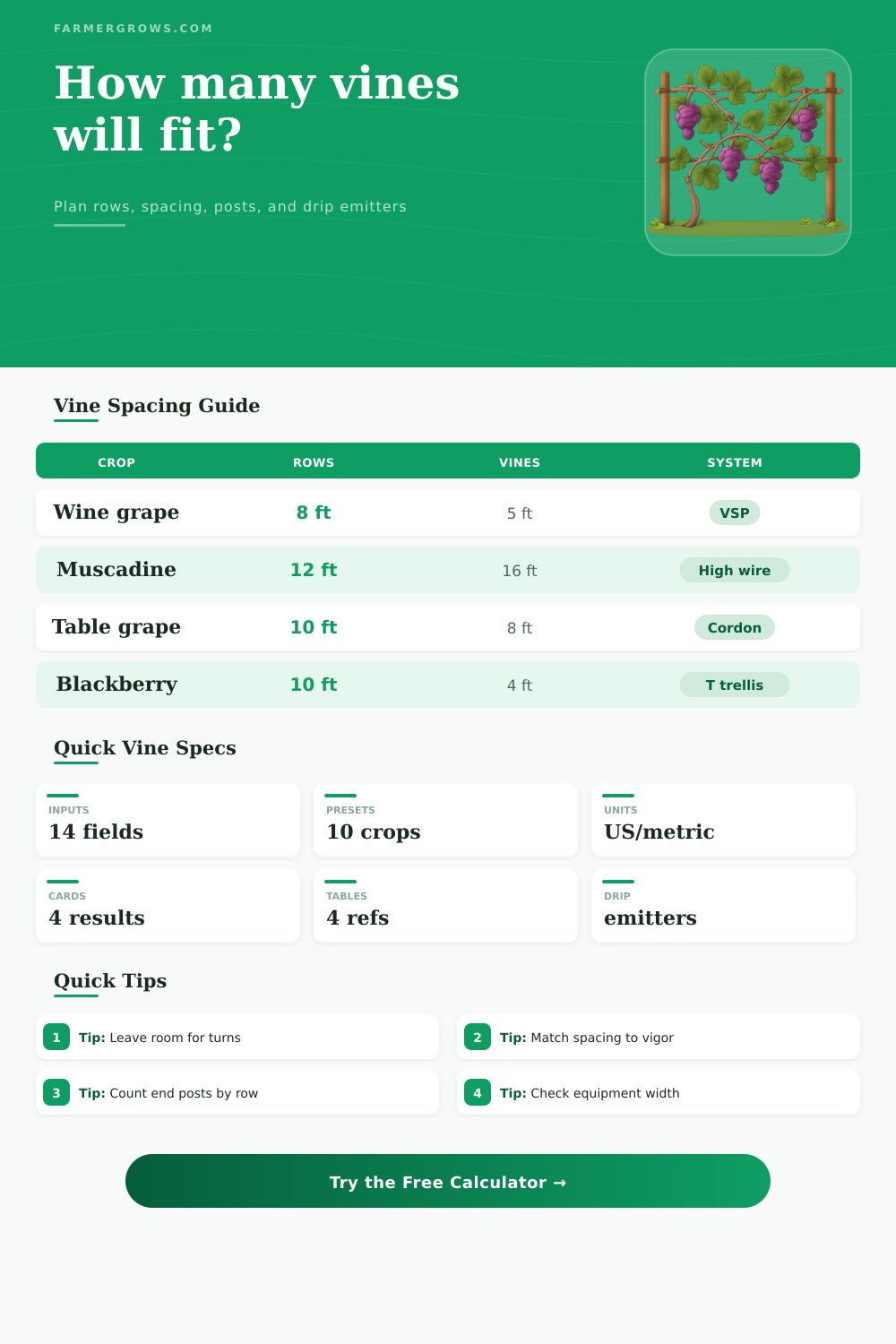
| Wine grape, balanced vigor | 7 to 10 ft | 4 to 6 ft | VSP or cordon | Closer spacing raises vine count and canopy density. |
| Table grape | 9 to 12 ft | 6 to 10 ft | Cordon or arbor | More vine space helps clusters hang and air out. |
| Muscadine | 10 to 12 ft | 14 to 20 ft | High wire cordon | Very vigorous vines usually need wide in-row spacing. |
| Blackberry | 9 to 12 ft | 3 to 5 ft | T trellis | Leave enough row width for picking and pruning. |
| Raspberry | 8 to 10 ft | 2 to 3 ft | Hedgerow wire | Canes fill the row after establishment. |
| Hardy kiwi | 12 to 16 ft | 12 to 18 ft | Pergola | Strong growth needs room and heavy support. |
| Training system | Useful row width | Wire count used | End load | Best fit |
|---|---|---|---|---|
| Vertical shoot positioned | 7 to 10 ft | 5 | Medium | Wine grapes with upright shoot positioning. |
| Single wire cordon | 8 to 12 ft | 2 | Light to medium | Garden grapes, simple cordon rows, trials. |
| High wire cordon | 10 to 12 ft | 2 | Medium | Muscadines and trailing grape canopies. |
| Geneva double curtain | 11 to 13 ft | 4 | Heavy | High vigor sites needing split curtains. |
| T trellis berry | 9 to 12 ft | 4 | Medium | Blackberry and raspberry cane support. |
| Pergola or arbor | 12 to 16 ft | 6 | Heavy | Table grapes, kiwi, shaded garden structures. |
| Trellis item | Calculator method | Typical spacing | Quantity driver | Field check |
|---|---|---|---|---|
| Line posts | Planted row length divided by post spacing | 20 to 28 ft | Rows and row length | Shorten spacing on slopes, curves, and heavy canopies. |
| End assemblies | Two assemblies per trellised row | Every row end | Row count | End strength matters most where wire tension is high. |
| End posts | Assembly count times end style posts | 1 to 3 posts | End style | H braces and double H braces add post count quickly. |
| Trellis wire | Rows times planted length times wire count | 2 to 6 wires | Training system | Add allowance for end wraps, splices, and tensioners. |
| Anchors | Assembly count times anchor factor | 0 to 1 each | End style | Match anchors to soil, end post lean, and pull load. |
| Drip layout | Emitter plan | Tubing plan | Common use | Planning note |
|---|---|---|---|---|
| One line per row | 1 to 2 per vine | One planted row length | Most young grape rows | Place emitters near the root zone as vines establish. |
| Two lines per row | 2 to 4 per vine | Double planted row length | Wide beds and sandy soil | Use when wetting width matters more than simplicity. |
| Berry hedgerow | Spacing by cane zone | One or two drip lines | Raspberries and blackberries | Emitter count can be higher than plant count in filled rows. |
| Pergola vines | 2 to 4 per vine | Main rows plus laterals | Kiwi and table grapes | Add branch lines if trunks are not centered on rows. |
| Garden trial | 1 to 2 per vine | Short rows | Backyard vines | Keep a few spare emitters for replacements and plugs. |
Before staking: Mark headlands, driveway edges, and equipment turning radius first. A row that fits on paper can still be frustrating if the tractor cannot turn squarely.
Before ordering plants: Treat vigor as a spacing warning. If a site is fertile, wet, or naturally vigorous, wider vine spacing can prevent crowded canopies later.
Row and vine spacing for grapevines is a critical component of vineyard management because vine spacing influence many aspects of managing a vineyard for many years. The distance between the rows of grapevines will impact the number of grapevines that a tractor can move through the rows, the amount of sunlight that the grape plants will receive, and the number of disease that may develop on the grapevines. Furthermore, the distance between the vines will impact the number of grapevines that must be purchase for that vineyard, and the degree of crowding that will exist in the vines once they have matured to a large size.
If a person establishes the incorrect distance between the rows and the vines in the vineyard, a variety of corrections will have to be made throughout the growing period of the vines. The distance between the rows and vines should be determine according to the type of crop that will be grown in the vines, as well as the training system that will be used for those grapevines. For instance, a vineyard that intends to grow moderate-vigor wine grape varieties with vertical shoot positioning may require eight foot between rows, with five feet between each vine.
Row and Vine Spacing for Grapevines
In contrast, muscadine vines with high wire training systems require more space between the rows and within each vineyard. Blackberries with T-trellis systems require distances between the rows that provide enough space for the berries to be picked, as well as distances between the rows to provide enough space for each row to remain full of growing berries. These base distances between the rows and vines are based upon the observations of grapevines that have been established within vineyards over time; however, the distances may need to be altered according to the slope of the land, the fertility of the soil within the rows, and the width of the farming equipment that will be used within the vineyard.
Beyond the established distances between rows and vines, a spacing calculator can mathematical estimate the distances between each row and each vine based off the length of each row, the size of the headlands within each row, and the training system that will be used for each vineyards grapes. The spacing calculator can determine the gross length of each row, convert that length to the length of the row that will actualy be planted with vines, and calculate the number of grapevines that will be grown within that acre. Additionally, the calculator can add a percentage of vines that may need to be replaced within that first year of establishing the vineyard to determine how many vines needs to be purchased initially.
Furthermore, the calculator can also calculate the number of line posts, end assemblies, and drip emitters that will be needed within each row based upon the distance between each row, and the number of drip lines that will be established within each row of grapevines. The headland distances between each row needs to be carefully measured and established. Headlands are the spaces within each row where the end posts of row training systems are established, and the distances between headlands are the distances that a tractor with a sprayer need to turn.
If the headlands are too short for a grapevining tractor, the tractor will be force to use awkward maneuvers when turning, which will compact the soil within the rows. Row spacing also requires that the distance between each row allow for the largest piece of farming equipment within the vineyard to maneuver around the posts that are established within each row. Vigor is another important factor in determining the spacing requirements for grapevines.
Vines that are established within fertile soil will exhibit more vigorous growth than those that are planted in non-fertile soils. Additionally, certain grape varieties are more vigorous than others. In these instances, the spacing between rows and vines will need to be established to accommodate the vines that will grow at a fastly rate.
More vigorous grapevines will grow into shaded areas that dont receive as much sunlight as the other vines in the row or block of grapevines. These vigorous vines will also become more susceptible to disease, and more vigorous vines will require more hedging during the summer season. In the spacing calculator, a person can set a percentage for vigor to alter the spacing between the vines to accommodate vigorous varieties.
Additionally, the person needs to establish an observation period between late June and early July to determine the actual level of vigor that the grapevines will exhibit. The distance between drip lines within each row of grapevines is established with the same considerations as the spacing between the vines. The minimum distance between vines for grapevines that are drip irrigated is one drip line per row with two emitter per vine.
However, two drip lines may be required for sandy soil or for rows that are wide in measurement. The spacing calculator will calculate the number of emitters with the number of vines that will be established in each row, then add an allowance for the length of tubing that may be needed beyond the number that would be calculated for emitters. The reference tables contain the different distances between row and vine spacings according to crop type and training system.
Although these distances are not rules that must be followed within a vineyard, the reference tables help indicate the distances between rows and vines that have been used in the most successful grapevines. For instance, a block of wine grapevines that are spaced seven feet apart in rows and four feet apart between each vine will contain a higher number of vines per acre than those rows that are spaced nine feet apart in rows and six feet apart between each vine. The closer the spacing between rows and vines, the more attention that must be provided to those vines.
The vine spacing that is established within each vineyard will allow for the grapes to be cultivated without needing to perform maintenance on the rows as often; however, there will be fewer cluster of grapes that will be harvested from each acre. A percentage for the vines that may need to be replaced within a row and the number of lengths of materials that need to account for variations from the initial calculations are added to ensure that there is enough of each to account for potential issue in the vineyard. A five-percent percentage ensures that there are enough vines to account for those that may be damaged upon delivery, as well as for vines that do not establish within that first year.
A ten-percent allowance for tubing and wire accounts for the length of tubing that may be needed beyond the initial calculation for the emitters, such as tubing needed for end wraps for each row of vines. Additionally, another ten-percent allowance for tubing accounts for the length of tubing that will be used for the splices that connect each piece of tubing together. These allowances cost very little for the vineyard owner at the beginning, but save that person from having to place additional orders for vines or materials later in the year.
Finally, each row must be checked for proper layout within the acre. Although the acre may be evened out with a line of concrete, the slope of the acre may impact the distance between each row of grapevines. Additionally, the area where the vines will be planted may impact where the headlands are established within each row.
The rows may be established differently within the acre than is calculate by the spacing calculator; however, the layout that is planned on the calculator screen is the starting point for the vineyard owner. The success of the vineyard will depend upon the ground upon which the vines will be planted.