Turkey Feed Calculator
Estimate total feed, 50 lb bags, daily flock intake, protein load, and finish-weight progress using turkey stage, breed type, feed conversion ratio, and waste buffer.
Turkey Feed Output
Results include feed for the selected feeding window, waste-adjusted order quantity, crude protein delivered, and FCR-based finish progress.
Full Breakdown
Fastest finish and best FCR in typical meat flocks.
Hens: 14-16 wk, 16-22 lb. Toms: 18-22 wk, 28-40 lb.
Similar commercial frame with slightly more outdoor hardiness.
Plan 2.6-3.1 FCR when feed and weather are steady.
Bourbon Red, Narragansett, and Standard Bronze grow longer.
Expect 24-30 wk finish and 3.4-4.2 FCR.
Royal Palm, Midget White, and breeders need less daily feed.
Use lower finish weights and 16-20% protein after growth.
| Age / stage | Typical protein | Daily intake per bird | Planning FCR | Feed form note |
|---|---|---|---|---|
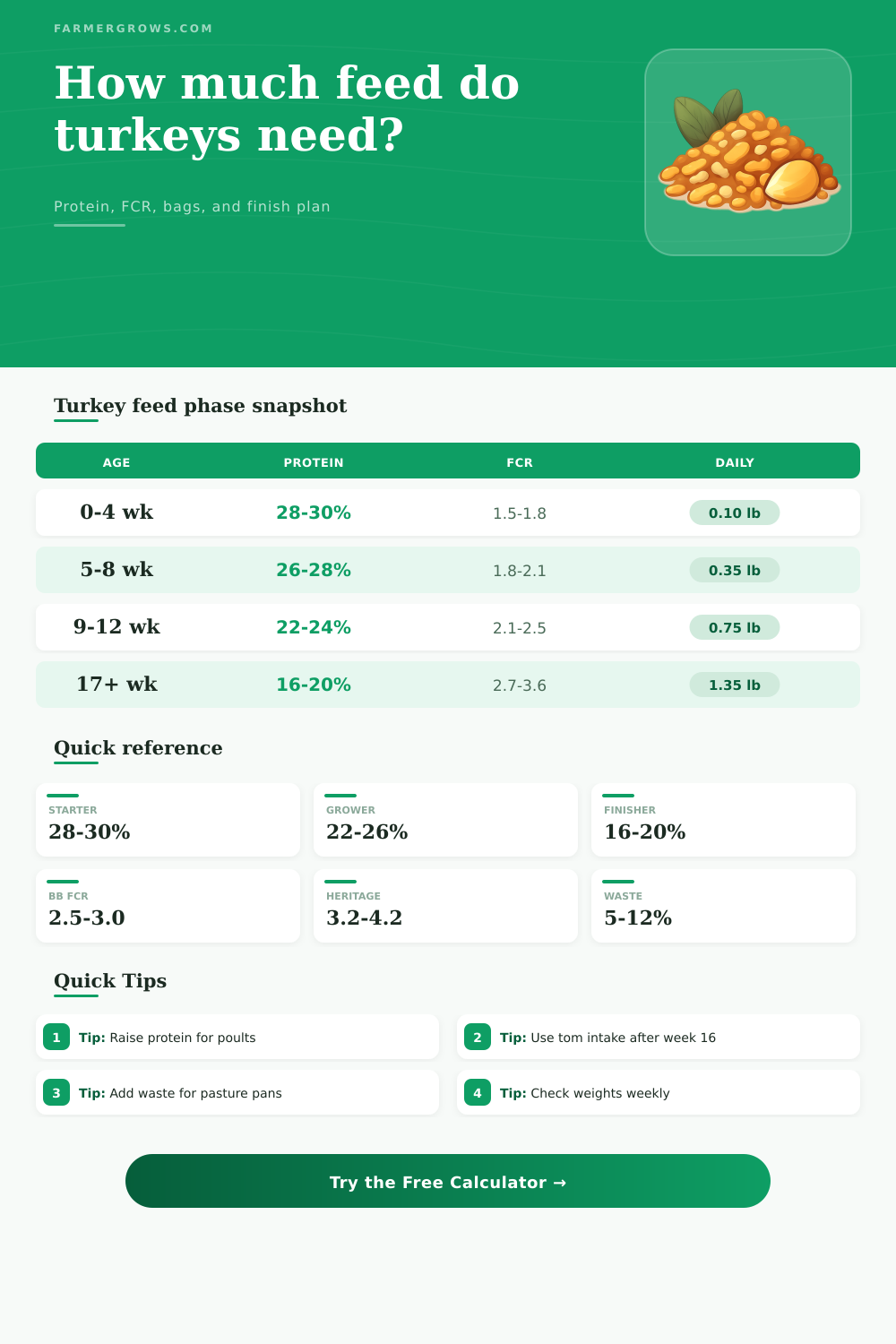
| 0-4 weeks, brooder poults | 28-30% | 0.06-0.18 lb/day | 1.5-1.8 | Fine crumble; keep feed clean and constantly available. |
| 5-8 weeks, starter | 26-28% | 0.22-0.48 lb/day | 1.8-2.1 | Crumble or small pellet; avoid sudden protein drops. |
| 9-12 weeks, grower | 22-24% | 0.55-0.90 lb/day | 2.1-2.5 | Grower pellet supports frame and feather growth. |
| 13-16 weeks, developer | 20-22% | 0.85-1.20 lb/day | 2.4-2.8 | Separate toms and hens if weights diverge. |
| 17-22 weeks, meat finisher | 16-20% | 1.05-1.75 lb/day | 2.7-3.2 | Large pellet; intake rises sharply in toms. |
| 17-30 weeks, heritage finish | 18-20% | 0.55-1.05 lb/day | 3.4-4.2 | Longer growing period; pasture adds variation. |
| Mature breeder maintenance | 16-18% | 0.45-0.75 lb/day | Not finish driven | Control condition; increase protein before lay. |
| Turkey type | Typical finish age | Target live weight | Useful FCR range | Calculator preset |
|---|---|---|---|---|
| Broad Breasted White hen | 14-16 weeks | 16-22 lb | 2.4-2.8 | Good for smaller roasters. |
| Broad Breasted White tom | 18-22 weeks | 28-40 lb | 2.5-3.0 | Highest feed volume near finish. |
| Broad Breasted Bronze hen | 15-17 weeks | 17-23 lb | 2.5-2.9 | Similar to white hens. |
| Broad Breasted Bronze tom | 18-22 weeks | 28-38 lb | 2.6-3.1 | Plan a small extra buffer outdoors. |
| Bourbon Red / Narragansett | 24-30 weeks | 14-24 lb | 3.4-4.2 | Slower, flavorful heritage finish. |
| Royal Palm / light heritage | 24-30 weeks | 10-16 lb | 3.6-4.4 | Lower intake and lighter carcass. |
| Midget White | 20-26 weeks | 10-18 lb | 3.2-3.9 | Homestead-scale efficient heritage bird. |
| Order unit | Feed weight | Days for 25 hens at 0.95 lb/day | Days for 25 toms at 1.45 lb/day | Best use |
|---|---|---|---|---|
| 40 lb bag | 40 lb | 1.7 days | 1.1 days | Small flocks or phase changes. |
| 50 lb bag | 50 lb | 2.1 days | 1.4 days | Most common retail feed bag. |
| 80 lb sack | 80 lb | 3.4 days | 2.2 days | Farm-store sack or mill bag. |
| 1000 lb tote | 1000 lb | 42.1 days | 27.6 days | Large same-phase grow-out. |
| 1 ton bulk | 2000 lb | 84.2 days | 55.2 days | Commercial or coordinated grow-out. |
| Named plan | Count and window | Protein phase | Daily intake | Waste buffer |
|---|---|---|---|---|
| Broad Breasted White toms | 25 birds, 6 weeks | 18% finisher | 1.45 lb/bird | 8% |
| Broad Breasted White hens | 30 birds, 5 weeks | 20% hen finisher | 0.95 lb/bird | 8% |
| Bourbon Red heritage | 18 birds, 10 weeks | 20% range grower | 0.72 lb/bird | 12% |
| Royal Palm light flock | 16 birds, 9 weeks | 18% finisher | 0.58 lb/bird | 10% |
| Breeder hen maintenance | 12 birds, 8 weeks | 16% maintenance | 0.52 lb/bird | 5% |
Reference values are practical planning ranges from common turkey production guides, extension poultry feeding tables, and commercial grow-out benchmarks. Adjust with your feed tag, strain guide, weather, and weekly scale weights.
To calculate how much turkey feed a flock of turkeys will consume, one must take into consideration the fact that the turkeys will grows at different rates. A feed calculator ask for several different variables to determine the total amount of feed that will need to be ordered for the turkeys. The variables include the number of turkeys, the stage of growth of each turkey, the target weight of each turkey, and the daily intake of each turkey.
The age or growth stage of the turkeys will be one of the questions the feed calculator asks of the turkey farmer. The age of the turkeys will allow the feed calculator to determine the amount of protein that each turkey will require, as well as the consumption rate of each turkey. For example, young poult turkeys (young turkeys) will require a high level of protein to aid in the development of there young frames and features.
How to Calculate Feed for Your Turkeys
However, as the turkeys reaches the developer phase of their lives, they will require less protein to develop their frames compared then the starter phase of their lives. The breed of each turkey is another variable that the turkey farmer will require. Different breed of turkeys have different appetites.
For example, broad-breasted breeds of turkeys reach their market weight faster than other breeds of turkeys. However, the opposite is true of the heritage breeds of turkeys; they will require more feed to reach their market weight due to the fact that they will eat less feed per day on average. Another variable that the feed calculator will ask of the farmer is the target weight that the turkeys should reach, as well as the ratio of feed consumed by the turkeys compared to the live body weight of the turkeys.
The daily intake of feed of the turkeys is important to know to prepare feeders for the turkeys. However, the feed conversion ratio indicates the efficiency with which the turkeys consume feed and convert it to live body weight. If the turkeys are consuming more feed than the feed conversion ratio suggest, the feed may be wasted.
Another value that the farmer can adjust in the feed calculator is the waste buffer. Some feed will be lost due to the management of the turkeys. For example, feed may fall off the feeders while the turkeys are eating, or the feed may get mixed with the bedding in the turkey coop.
Additionally, the turkeys may access the pasture in which they live; poor weather conditions may also affect the amount of feed the turkeys consume. The feed calculator will also ask the farmer for the protein phase settings for the turkeys. If there is too little protein given to the turkeys, their frames will not grow as fast as they should.
However, if the farmer provides too much protein to the turkeys, the feed will be wasted. Additionally, the turkeys may become too fattily. The feed calculator will provide two figures based on the information given by the turkey farmer.
The total feed to order will include the waste buffer. Additionally, the daily flock intake is the amount of feed that the turkeys will consume each day. This help to indicate how often the feeders will need to be filled with feed.
The feed conversion ratio finish check will allow the farmer to ensure that the feed will allow the turkeys to reach their target weight in the time available to the turkeys. Reference tables will display the different breeds of turkeys and the stage of growth of each turkey. Additionally, these tables will list the target weight of each turkey.
If the farmer knows that the target weight of the turkeys are more than what is listed in these tables, the farmer will need to adjust the target weight upward on the calculator so that it reflects the actual target weight that the farmer would like to achieve for each turkey. The calculator will automatically compute the answer to the turkey farmer once the turkey farmer has decided the actual activities of each turkey in the flock. The feed calculator will also ask for the water demand of the turkeys.
Water demand will increase with the feed intake of the turkeys. Thus, the water demand may be used to determine whether the water drinkers for the turkeys are of an appropriate size for the flock of turkeys. While the temperature and humidity of the area in which the turkeys live may influence the amount of water that the turkeys consume, or whether the turkeys have access to the pasture in which they live, the water demand linked with the feed will ensure that the farmer does not underprovide water for the turkeys during the summer months.
Finally, the farmer should of run this calculator at the beginning of each new growth phase of the turkeys. For example, poult turkeys will grow into the grower phase of their lives; the appetites of the toms will differ from those of the hens. Additionally, the waste buffer may need to be updated if the farmer manages the turkeys in new conditions in the pasture.
Updating these variables will ensure that the amount of feed to order is matched to the current population of the farm, instead of a plan created several months prior to growing the turkeys to market weight.