🌷 Tulip Water Calculator
Calculate exactly how much water your tulips need at every growth stage
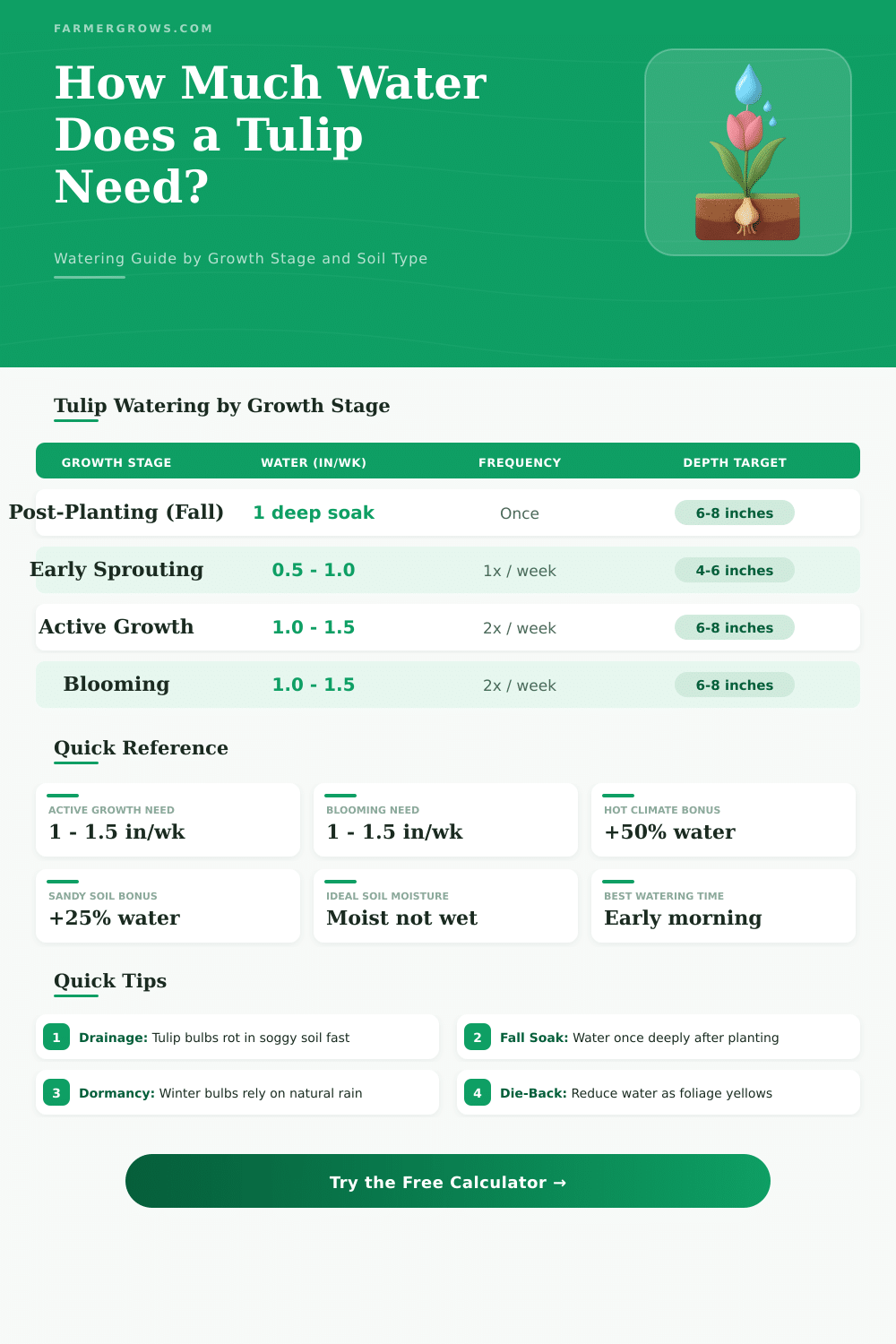
| Growth Stage | Water / Week | Frequency | Depth Target |
|---|---|---|---|
| Post-Planting (Fall) | 1 deep soak | Once after planting | 6–8 inches |
| Winter Dormancy | Minimal | Rely on rainfall | N/A |
| Early Sprouting | 0.5–1.0 in | 1x per week | 4–6 inches |
| Active Growth (Spring) | 1.0–1.5 in | 2x per week | 6–8 inches |
| Blooming | 1.0–1.5 in | 2x per week | 6–8 inches |
| Post-Bloom / Die-Back | 0.5 in | 1x per week | 4 inches |
| Soil Type | Drainage | Water Adjustment | Notes |
|---|---|---|---|
| Sandy | Fast | +25% more water | Water drains quickly; water more often |
| Loam | Balanced | Baseline (no change) | Ideal for tulips; retains even moisture |
| Clay | Slow | –15% less water | Risk of waterlogging; ensure drainage |
| Amended / Raised Bed | Good | +10% more water | Dries faster than ground; monitor closely |
| Climate | Rainfall | Adjustment | Watering Notes |
|---|---|---|---|
| Cool & Rainy | Frequent | –25% less water | Skip watering if rain exceeds 1 in/wk |
| Mild & Average | Moderate | Baseline (no change) | Water when top 1 inch of soil is dry |
| Warm & Dry | Low | +30% more water | Mulch to reduce evaporation |
| Hot & Arid | Very Low | +50% more water | Water early morning; add 2–3 in mulch |
💡 Overwatering Warning
Overwatering is the number one killer of tulip bulbs. Tulips are native to regions with dry summers and cold winters. Soggy soil causes bulb rot, fungal diseases, and poor root development. Always ensure your planting area has excellent drainage, and never var tulip bulbs sit in standing water. When in doubt, err on the side of less water rather than more.
💡 Best Watering Practices for Tulips
Water tulips at the base of the plant in the early morning to minimize evaporation and reduce the risk of fungal disease on foliage. During active growth and blooming in spring, provide 1 to 1.5 inches of water per week if rainfall is insufficient. Apply a 2–3 inch layer of organic mulch to conserve moisture and regulate soil temperature. After blooming, reduce watering gradually as foliage yellows and the bulb enters dormancy.
Tulips belong to the group of simple plants. They require ground with good drainage, plenty of sunshine and only little food. Simply place the bulbs during autumn and almost fully forget them from your thought.
Although those flowers do not require much trouble the care still stays important for their good state.
How Much Water Do Tulips Need
How much Water do tulips truly need? It must be around 17 mm, or two thirds of an inch, weekly. This matters especially during the end of winter and start of spring, when the plant prepares to bloom.
Except in cases of long drought, tulips require only minimal extra care above what rain gives.
Too much Water is more dangerous than too little for tulips. Rainy summers, watering systems and damp soil truly can destroy them. Too wet ground leads to fungus and diseases, that rot the bulbs.
Never Water a bed of bulbs on purpose, except during lasting drought. Tulips that receive too much Water or go through a gentle winter commonly simply do not grow. Standing Water is especially harmful, so never allow tulips to sit inn it.
When tulips grow in the soil, watering must happen only during times of dryness. Give them enough Water, if it did not rain for some weeks. You rarely need to Water them, if the region receives enough weekly rain.
When the bulbs are planted in a place that needs watering, try to limit it to once a week or even less.
Deep watering is important for the health of Tulips. During planting, make sure that there is a bit of Water in the hole, and add a little more after the hole is closed. Covering with mulch is also useful.
If the climate gives enough rain and snow through the winter, no extra watering is needed. Otherwise, some deep watering during winter and early spring will be required.
For tulips in jars things work somewhat differently. A Tulip in a five-gallon jar, that does not receive direct sunlight, needs around half a cup of Water every nine days. Checking the ground also helps.
If it seems dry and crumbly, add Water until it gets damp again. Watering weekly, when the ground mix is dry at five to six centimeters of depth, is another method that works for potted tulips.
Soaking bulbs before planting is not required, but it can help. A damp bulb, that is not fully soaked, more easily grows strong roots. Such a dip also helps fight rot.
After tulips end their bloom, reduce the wateringevn more. This is their rest time before the next growing cycle starts. Good drainage in the pots is key, because bulbs in Water much more easily rot.