Triangle Acreage Calculator
Calculate acreage for triangular lots, field wedges, pivot corners, and survey triangles with base-height, three-side Heron, or right-triangle methods.
Choose a starting point that matches the way your parcel was measured. Each preset loads method, unit, parcel count, usable percentage, fence buffer, and slope correction.
Triangle Parcel Output
Results include flat acreage, slope-adjusted surface acreage, usable acres, perimeter, and the buffer-adjusted working area.
These four cards update from your current triangle and are useful when planning fence, field access, planting area, and paperwork notes.
| Unit | Equals | Use in calculator | Field note |
|---|---|---|---|
| 1 acre | 43,560 sq ft | Main output | Common land unit in the United States |
| 1 hectare | 2.47105 acres | Metric comparison | Useful for larger fields and international plans |
| 1 sq meter | 10.7639 sq ft | Metric input area | Used when entering meter-based measurements |
| 1 sq yard | 9 sq ft | Optional conversion | Handy for small market garden beds |
| 1 rood | 0.25 acre | Historic reference | Sometimes appears in older land descriptions |
| Buffer width | Typical use | How it affects area | Planning note |
|---|---|---|---|
| 0 ft | No setback | No acreage deduction | Use for pure deed acreage or survey reporting |
| 5 ft | Fence access strip | Small deduction along edges | Enough for walking checks on small lots |
| 12 ft | Equipment access | Moderate edge deduction | Common for compact tractor or utility vehicle paths |
| 20 ft | Headland strip | Larger working-area reduction | Useful where turning space matters |
| 30 ft | Road or drainage setback | Major acreage deduction | Check local easements before relying on it |
| Average grade | Surface factor | Added surface | Use case |
|---|---|---|---|
| 0% | 1.000x | 0.0% | Flat field, nursery row, level building site |
| 5% | 1.001x | 0.1% | Gentle field slope with little practical change |
| 10% | 1.005x | 0.5% | Noticeable hillside pasture or orchard row |
| 20% | 1.020x | 2.0% | Steeper land where surface distance matters |
| 35% | 1.059x | 5.9% | Rough hillside estimate; survey before purchase |
| Example triangle | Measurements | Approx acres | Typical use |
|---|---|---|---|
| Small garden wedge | 100 ft base x 80 ft height | 0.092 ac | Market garden corner or trial crop area |
| Roadside produce plot | 220 ft base x 160 ft height | 0.404 ac | High-visibility roadside growing space |
| Pasture corner | 360 ft base x 280 ft height | 1.157 ac | Grazing wedge or fence cutoff |
| Pivot leftover | 520 ft base x 410 ft height | 2.448 ac | Irrigation corner or leftover dryland piece |
| Woodlot triangle | 760 ft base x 640 ft height | 5.588 ac | Timber patch, wildlife strip, or buffer land |
When a person own a piece of land that is in the shape of a triangle, the person will need to determine the size of that land. The land may have been acquired as a triangular piece of land, for instance, as a result of the construction of a road, or it may have been a wedge of land that an irrigation system left behind. Regardless of the reason for the shape of the land, the size of the land is important to the owner in that the size will determine how many seed is required to cover the land, and how much fencing is required to contain the land.
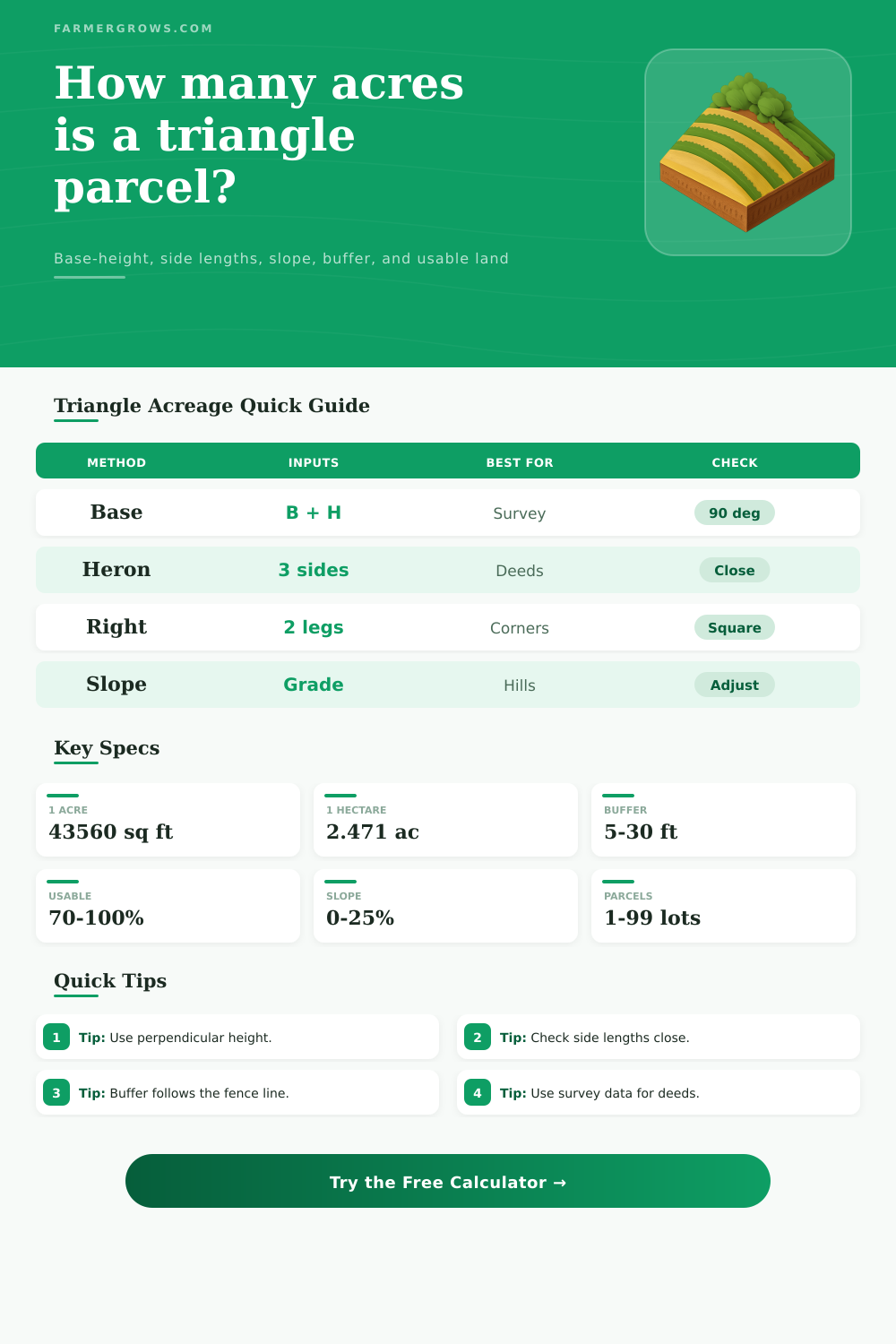
There are different ways that a person can calculate the acreage of the land. For instance, if the survey map of the land include a base line and a perpendicular height to that base line, those two measurements can be used to calculate the acreage of the land. Furthermore, if the land deed include the three lengths of the land, those three lengths can be utilized to calculate the acreage.
How to Calculate Usable Acres of a Triangular Piece of Land
Finally, if the land includes a right-angle corner, the two lengths of the triangle that connect to that corner can be used to calculate the acreage of that triangular plot of land. Each of these measurements will lead to a flat acreage figure for the land. However, the land may not be level.
In this case, a buffer zone may exist within the land that cannot be used for farming purposes. Furthermore, the acre that are calculated may need to be adjusted according to the slope of that land. The flat acreage figure can be adjusted according to the slope of the land to determine the surface acreage of that land.
Finally, the owner can subtract the buffer zone of that land from the total acreage to determine the usable land percentage for that plot. The acres that are calculated in this way are the working acres for that plot of land. Many people may believe that the acreage that is listed on the deed for the land is the same as the working acres for that land.
However, the two figures are not the same due to the need to account for the buffer zones within the land and the slope of the land. The flat acreage figure can be used for legal records regarding the land, but the working acres should be used to manage that land. By calculating the acres that will actualy be used for the land, the land owner can avoid buying too many seed for that land, and they can also accurately estimate the cost that will be incurred in the purchase of fencing for that land.
Tables is provided on the page to help the landowner understand the impact of certain factors on the land. For instance, a small buffer zone will have a minimal impact on a large plot of land, but it may remove a large percentage of the land from a small roadside garden. Furthermore, the slope tables will allow a landowner to understand how steepness of the land may impact how water flow across that land.
Finally, if the land is to be divided into several lots, the parcel count field can be used to divide the land into those lots. Each lot will have adjusted measurements according to the number of lots into which the land is divided. However, the buffer zone and the usable land percentage for each lot can remain independent of one another.
For instance, one person may wish to use one lot for grazing land, while another person may desire to use that land as a garden area. Each person can have there own percentage of the total area of that land that will be utilized. By calculating each of these figures in advance of the purchase of that land, or its subdivision into several lots, those who intend to own and use that land will be able to transform that triangular piece of land into a resource that can be managed.
Specifically, the working acres will allow those land owners to determine the amount of seed that should of been budgeted for that land, as well as the fencing budget for that plot of land. Furthermore, by calculating the slope of the land, those land owners will also understand if the slope will make it difficult to utilize equipment on that plot of land.