Trapezoidal Pond Volume Calculator
Estimate a rectangular trapezoid pond from top length, top width, bottom length, bottom width, water depth, side slopes, shelf benches, freeboard, gallons, acre-feet, and metric volume.
Load a realistic pond profile, then tune the top dimensions, bottom dimensions, depth, slope, bench shelf, freeboard, and allowance for your site survey.
Trapezoidal Pond Volume Results
The result uses a rectangular frustum formula, then subtracts shallow shelf displacement and applies the selected storage allowance.
These quick profiles compare how bank slope, shelf width, and depth usually change storage behavior for rectangular trapezoidal pond sections.
| Side slope | Horizontal run per side at 6 ft depth | Typical pond fit | Volume effect |
|---|---|---|---|
| 1.5:1 | 9 ft each side | Lined garden or controlled excavation | More storage in smaller footprint |
| 2:1 | 12 ft each side | Small farm pond with firm banks | Good depth without very wide banks |
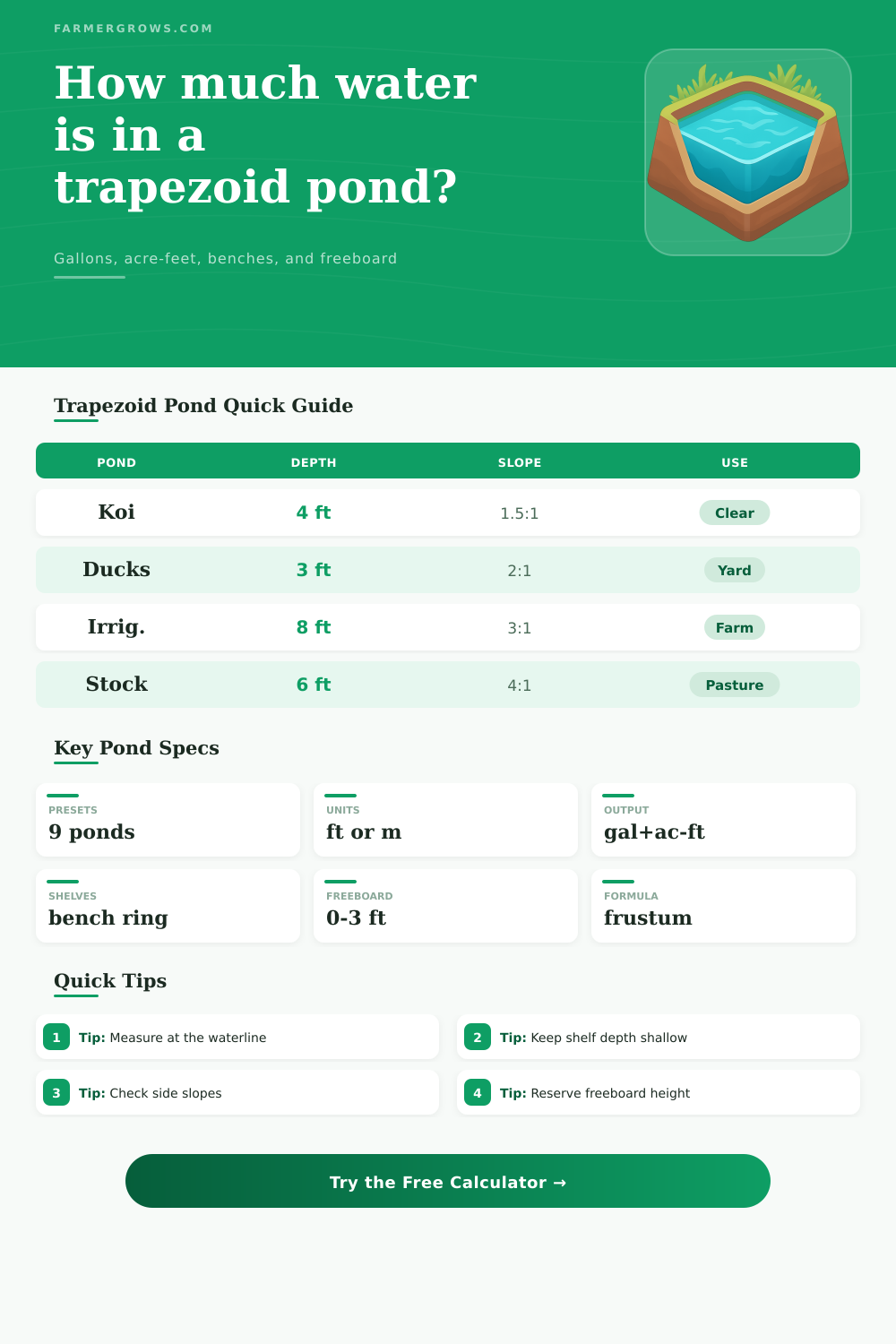
| 3:1 | 18 ft each side | Irrigation and equipment-service ponds | Moderate footprint, easier access |
| 4:1 | 24 ft each side | Livestock, wildlife, and public-edge ponds | Less storage per surface acre |
| Unit | Equivalent | Best use | Calculator output |
|---|---|---|---|
| 1 cubic foot | 7.48052 US gallons | Small liner and excavation checks | Cubic feet card |
| 1 cubic meter | 35.3147 cubic feet | Metric pond design and survey work | Metric subline |
| 1 acre-foot | 43,560 cubic feet | Farm reservoir and irrigation storage | Acre-feet card |
| 1 acre-inch | 3,630 cubic feet | Drawdown and irrigation depth planning | Acre-inch subline |
| Shelf style | Typical width | Typical water depth | Storage note |
|---|---|---|---|
| No bench | 0 ft | Full slope depth | Maximum water storage for the same waterline |
| Planting shelf | 1.5 to 3 ft | 0.5 to 1.5 ft | Reduces volume around the pond edge |
| Access bench | 3 to 6 ft | 1 to 2 ft | Useful for maintenance and shallow habitat |
| Safety bench | 6 ft or wider | 1.5 to 3 ft | Large shelf areas can noticeably lower gallons |
| Profile | Top size | Bottom size | Depth and use |
|---|---|---|---|
| Garden liner basin | 18 ft x 10 ft | 10 ft x 4 ft | 3.5 ft depth, small water feature |
| Stock water pond | 80 ft x 45 ft | 52 ft x 22 ft | 6 ft depth, pasture water reserve |
| Irrigation cell | 160 ft x 95 ft | 100 ft x 45 ft | 8 ft depth, farm storage |
| Fire reserve pond | 125 ft x 75 ft | 70 ft x 30 ft | 9 ft depth, emergency reserve |
Field survey, soil stability, liner design, spillway sizing, and local rules should be checked before excavation.
For a true trapezoidal pond volume, measure the waterline rectangle and the flat bottom rectangle separately. A single average length can miss a large amount of side-slope storage.
Freeboard is dry reserve height, not normal water storage. Use it to check crest footprint and excavation envelope while keeping the gallons based on planned water depth.
A trapezoidal pond is a pond that has sides that slope outward from the bottom to the top. Such a pond is the shape that most people make when they dig into teh soil that is present in the land. The top of the pond is wider than the bottom since the slopes of the pond have to go outward from the pond.
Because of the outward slopes of the sides of the trapezoidal pond, the volume of the pond will be different than a rectangular pond of the same surface area. Calculating the volume of such a pond is essential in determining the amount of water that is needed for irrigation of the fields, livestock, and for fire reserves. To calculate the volume of the trapezoidal pond, it is necessary to measure the rectangle that is created by the waterline of the pond as well as the rectangle created by the flat bottom of the pond.
How to Calculate the Volume of a Trapezoidal Pond
Each of these measurements must be taken separately. The depth of a shelf that is created within the pond is another feature of a trapezoidal pond. Such a shelf take away from the volume of the pond.
The volume that is measured within the pond is the usable volume of the pond. The depth of the pond to which water is allowed to evaporate is known as the freeboard. This depth of the pond does not get measured in the gallons of water that is stored within the pond.
However, the freeboard helps to determine the width of the crest of the pond and how deeply it must be dug into the land. The side slope is a parameter that must be chosen when constructing a trapezoidal pond. A slope of 1.5-to-1 allows more water to be stored in a smaller area.
However, such a slope will require an liner for the pond. A slope of 3-to-1 or 4-to-1 allows the animals to walk into and out of the pond and allows mowing equipment to approach the pond. However, the waterline will cover less depth in each acre of land.
Many ponds use a side slope of 2.5-to-1. This slope offers a good balance between depth and access to the pond. Shelf benches can be incorporated into a trapezoidal pond design.
A narrow shelf allows plants to grow as well as provides a location for frogs and dragonflies to breed within the pond. A narrow shelf does not take away from the total storage of the pond. A wider shelf increases ease of maintenance and adds to the safety of the individuals near the pond.
However, an access bench that is too wide will lower the total number of gallons of water that can be store in the pond. The depth of a shelf takes place at a constant, shallow depth that surrounds the entire perimeter of the pond. An allowance of percentage of the total volume need to be provided for the variations in the fields.
Factors such as sloughing of soil, folding of the liner and the difference between the depth of the pond as measured on the plan and as it is dug will affect the amount of water that is in the pond. A 10 percent allowance for these normal conditions usually will provide enough water for most farms. However, if the land is rough or if it was not graded with laser levels, an allowance of 15 to 20 percent may be needed.
The calculator will perform the arithmetic for you once you have enter the dimensions and the allowances. The seasonal drawdown of the pond will decrease the water level of the pond. Factors that contribute to drawdown include irrigation and livestock use of the pond as well as the amount of water that evaporates into the air.
It will be necessary for farmers to know how many day of use of the pond’s water are stored in the pond at a given depth. This will allow the farmer to decide if additional storage is needed in the form of an additional pond cell or deeper main basin of the pond. These reference tables allow farmers to see how the different profiles of a trapezoidal pond will change with different side slopes and shelves.
The tables are not rules, but they do provide a starting point for farmers to compare the numbers of their fields to those typical of pond profiles. Once you have established the trapezoidal pond, there is additional choices to be made regarding its use and safety. It is important to consider the three dimensional shape of the pond rather than the area that it covers multiplied by the depth.
By considering the three-dimensional aspect of the pond, the calculation of its volume will be accurate and farmers will not overestimate the volume of a trapezoidal pond.