🚜 Tractor Horsepower Calculator
Find the right engine HP, PTO HP, and drawbar HP for your tractor and implements
⚙️Calculator Inputs
📊 Your Tractor HP Results
📋Implement HP Requirements Reference
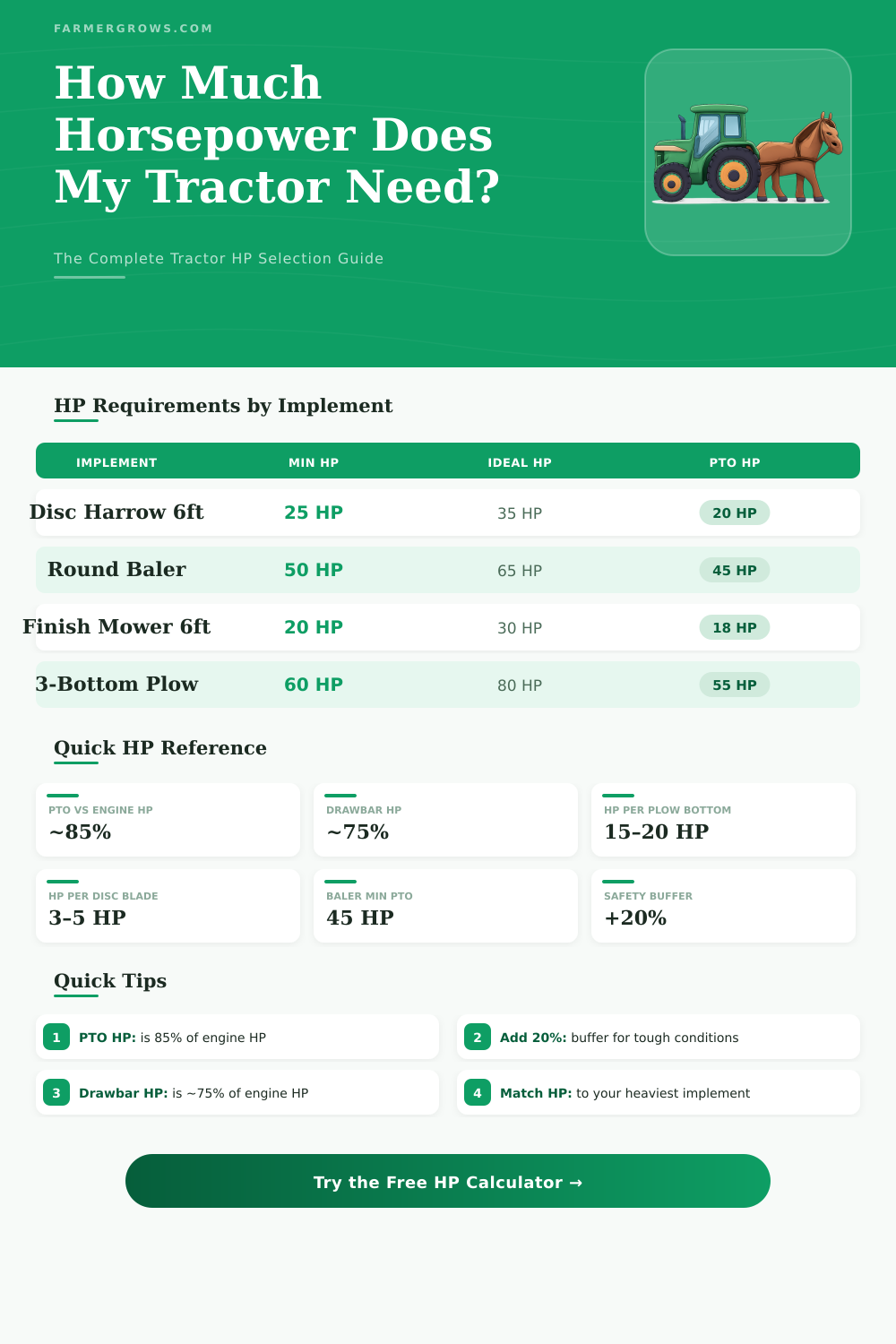
📊Implement Horsepower Requirements
| Implement | Min Engine HP | Ideal HP | PTO HP Req. | Drawbar HP |
|---|---|---|---|---|
| Disc Harrow 4 ft | 20 HP | 30 HP | 17 HP | 15 HP |
| Disc Harrow 6 ft | 30 HP | 45 HP | 26 HP | 23 HP |
| Disc Harrow 8 ft | 40 HP | 60 HP | 34 HP | 30 HP |
| Disc Harrow 12 ft | 65 HP | 90 HP | 55 HP | 49 HP |
| Moldboard Plow 1 Bottom | 15 HP | 25 HP | 13 HP | 11 HP |
| Moldboard Plow 2 Bottom | 30 HP | 45 HP | 26 HP | 23 HP |
| Moldboard Plow 3 Bottom | 45 HP | 65 HP | 38 HP | 34 HP |
| Moldboard Plow 4 Bottom | 60 HP | 85 HP | 51 HP | 45 HP |
| Finish Mower 5 ft | 18 HP | 28 HP | 15 HP | — |
| Finish Mower 6 ft | 22 HP | 35 HP | 19 HP | — |
| Finish Mower 8 ft | 35 HP | 50 HP | 30 HP | — |
| Round Baler | 50 HP | 70 HP | 45 HP | — |
| Square Baler | 40 HP | 60 HP | 35 HP | — |
| Subsoiler 1 Shank | 25 HP | 40 HP | — | 21 HP |
| Subsoiler 3 Shank | 55 HP | 80 HP | — | 41 HP |
| Rotary Tiller 4 ft | 25 HP | 40 HP | 21 HP | — |
| Rotary Tiller 6 ft | 40 HP | 60 HP | 34 HP | — |
| Front End Loader | 30 HP | 50 HP | — | — |
| Grain Auger 8 in | 20 HP | 35 HP | 17 HP | — |
| 3pt Sprayer | 20 HP | 35 HP | 10 HP | — |
🔄HP Conversion Table
| Engine HP | PTO HP (~85%) | Drawbar HP (~75%) | Kilowatts (kW) | PS (Metric HP) |
|---|---|---|---|---|
| 20 HP | 17 HP | 15 HP | 14.9 kW | 20.3 PS |
| 30 HP | 25.5 HP | 22.5 HP | 22.4 kW | 30.4 PS |
| 45 HP | 38.3 HP | 33.8 HP | 33.6 kW | 45.6 PS |
| 60 HP | 51 HP | 45 HP | 44.7 kW | 60.8 PS |
| 75 HP | 63.8 HP | 56.3 HP | 55.9 kW | 76.0 PS |
| 100 HP | 85 HP | 75 HP | 74.6 kW | 101.4 PS |
| 125 HP | 106.3 HP | 93.8 HP | 93.2 kW | 126.8 PS |
| 150 HP | 127.5 HP | 112.5 HP | 111.9 kW | 152.1 PS |
🚜Tractor Size Classes
| Class | Engine HP Range | Typical Use | Common Implements |
|---|---|---|---|
| Sub-Compact | 15–25 HP | Small gardens, estates | Tillers, small mowers, loaders |
| Compact | 25–45 HP | Hobby farms, landscaping | Disc harrows, finish mowers, small balers |
| Utility | 45–75 HP | Small farms, livestock | Plows, balers, sprayers |
| Mid-Size | 75–120 HP | Row crops, hay production | Multi-bottom plows, large disc |
| Large Utility | 120–180 HP | Grain farms, large ops | Large planters, tillage tools |
| 4WD / Articulated | 180–400+ HP | Commercial farming | Wide tillage, large planters |
⏱️Work Capacity by HP & Speed
| Implement Width | Speed (mph) | Efficiency 80% | Acres/Hour |
|---|---|---|---|
| 4 ft | 4 mph | 80% | 0.97 ac/hr |
| 6 ft | 5 mph | 80% | 1.82 ac/hr |
| 8 ft | 5 mph | 80% | 2.42 ac/hr |
| 10 ft | 6 mph | 80% | 3.64 ac/hr |
| 12 ft | 6 mph | 80% | 4.36 ac/hr |
| 15 ft | 7 mph | 80% | 6.36 ac/hr |
| 20 ft | 7 mph | 80% | 8.48 ac/hr |
Tractor horsepower measures how much power the engine of a tractor can make. It matches 550 foot-pounds of work in a second or around 746 watts. The metric version is a bit smaller, namely 735.5 watts.
Simply said, it shows the force of the engine. Accurate value helps farmers and gardeners choose a good machine for specific works, which guarantees good output and efficiency
Tractor Horsepower and How to Choose the Right Tractor
Dynamometer measures the torque and uses a formula to convert it to horsepower. The equation is: horsepower matches torque multiplied by revolutions in minute (RPM), divided by 5252. Horsepower results from a math calculation, where torque is muliplied with RPM and divided by a number.
Because of that engines with big cylinder volume and high torque commonly have low horsepower… They simply do not reach very high revolutions.
The engine delivers the power, but part of it goes to accessories of the tractor and various functions. Simple engine reaches 100 horsepower at the flywheel in specific RPM. Horsepower at the PTO extraction commonly matters more than that of the engine.
You find the PTO usually at the back of the tractor, it hands over force to tools like a mower or rotary tiller. Choosing only according to engine horsepower can cause weak attachments.
Tractors come in a wide range of horsepower, from 15 horsepower to more than 100. For little farms, gardens and yards 15 to 20 horsepower work for usual tasks like mowing, ploughing and pulling little trailers. Compact model with 25 horsepower is ideal for a half-acre property, used only for mowing.
The range of 21 to 35 horsepower cover subcompact tractors and cheap utility machines, good for crops like potatoes, beans, paddy and rice.
For many uses the best range is 35 to 50 horsepower. Tractor of 50 horsepower well raises round bales, especially those of five or six feet. Utility tractors offer 45 to 280 horsepower for works like ploughing and sowing.
Balers for round bales mostly require at least 70 to 80 horsepower.
General rules about acres help to choose: zero to one acre require 12 to 18 horsepower, one to three acres require 18 to 24, three to ten acres want 24 to 35, and more than ten acres need 35 or more. Hills and rough lands drain the horsepower need. Tractor of more than 100 horsepower for three acres is excessive.
There are no fixed numbers for any work, because horsepower demands depend on tool size, speed, soil and many other factors. Always consider the farmsize and everyday works.