
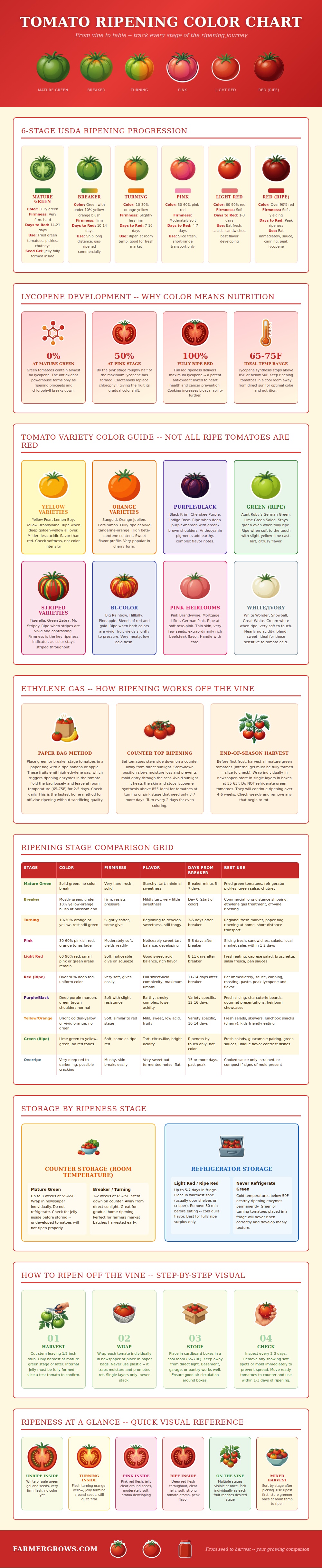
If you’ve ever stood there clutching green tomatoes with a frost warning in the prediction, I bet you know what I mean: A sense that you’re wasting money, since all you’re hoping for is that they’ll get red, but instead they remain obstinately firm. It’s chemical, not magic. If a tomato hasn’t fully ripened… Meaning ripe… It isn’t going to transform itself into something different simply because you want or need it to. This chart details the process from beginning to end, in six steps, and will help you know where your crop is on the scale. (Knowing whether your tomato is a breaker or turning makes all the difference.)
First, there’s ripe green, when the fruit has finished growing but is still green. It will also have some internal jelly formation, meaning it can be harvested and allowed to ripen off the plant. Too soon, and what you get are a rock. Then there’s the breaker stage, when less than ten percent of the fruit’s surface displays orange or yellow blush. That’s about as far as most tomatoes go before they’re shipped commercially. They’re firm enough to survive packing, but they is ready to become delicious once they reach your home. In the turning phase, the color extends to thirty percent coverage; the sugars starts developing and the flesh softens a bit. Half the fruit covered in pink tones? Salad time in a matter of days. Light red signals full ripe red, with lycopene content peaking and the flavor reaching its highest level of complexity.
How to Tell When Tomatoes Are Ready
Color isn’t only cosmetic. It’s a message: Nutrition. As the plant’s chlorophyll fades, lycopene builds up. A green tomato? Practically zero. One that’s starting to turn pink? About half of its lycopenic promise. To get the most health benefit, wait until the fruit turns deep red; otherwise, your efforts might be wasted if you leave it on the counter too long.
Why does temperature change this chemical process? If it’s really warm; above eighty-five degrees (it’ll stop synthesizing). Too cold… At less than fifty… And it will, too. Store your crop in a dark and cool spot where it can hold onto the enzymes necessary to transform itself. But not go to mush.
And then there’s the exception to the red script: Not all varieties goes that way. Green Zebra (and other heirlooms such as Aunt Ruby) will remain green when ripe. Cherokee Purple forms maroon shoulders. Go by the old color standards, and you’ll be disappointed. Trust your nose and fingertips instead. A ripe tomato will yield slightly to light pressure; its smell will be unmistakably sweet and earthy. If it looks beautiful but is as hard as a rock, give it another day. If it stinks, and is squishy to boot, it has passed the point of no return. Understanding those varietal exceptions, so you don’t toss out perfectly sound tomatoes because they didn’t match your mind’s picture of red, is what the variety guide section is for.
How you harvest also matters. Remove from the plant by cutting off the stem, leaving a small stub intact to prevent rot entry. To store, wrap in paper; not plastic; don’t suffocate them, just let them breathe! Layer in one layer at room temperature. Once in the refrigerator, ripening halts forever because it will stop enzyme action cold (literally). But that’s only for truly ripe fruit. Otherwise, don’t put green tomatoes in there at all. If you must have them now rather than later, only put them in for a short time. Flavor compounds are dulled no matter how long they’re stored by the cold. If you leave them to warm back up again first they’ll be somewhat brighter when you do eat them.
Ripeness has its own continuum, something we commonly assume is simply an on/off switch, as in: done/not done. Instead, it’s a range, and one you determine yourself. Following the changing color; from all-green to breaker to turning (is how you time things); you choose when to cut the fruits at their best flavor and also when they will be right for what you want to do with them, such as slicing them early for salsa where firmness counts. Or let ’em get red for sweetening a sauce or a lycopene-filled dish). No, not waiting till red is the point; it’s matching the stage of the fruit to your desired use, while keeping a respectful eye on the inner workings. That’s when knowledge meets patience: a truly great thing on the plate.
Actually, you should of waited for more color if you want sweetness, but realy, its all about usage. Some people preferer them greener than others based off how they cook. It would of been better to use moddern techniques, but this works too. One might find that different than expected when using luxurios ingredients. If you want the most flavor, just dont wait to long.