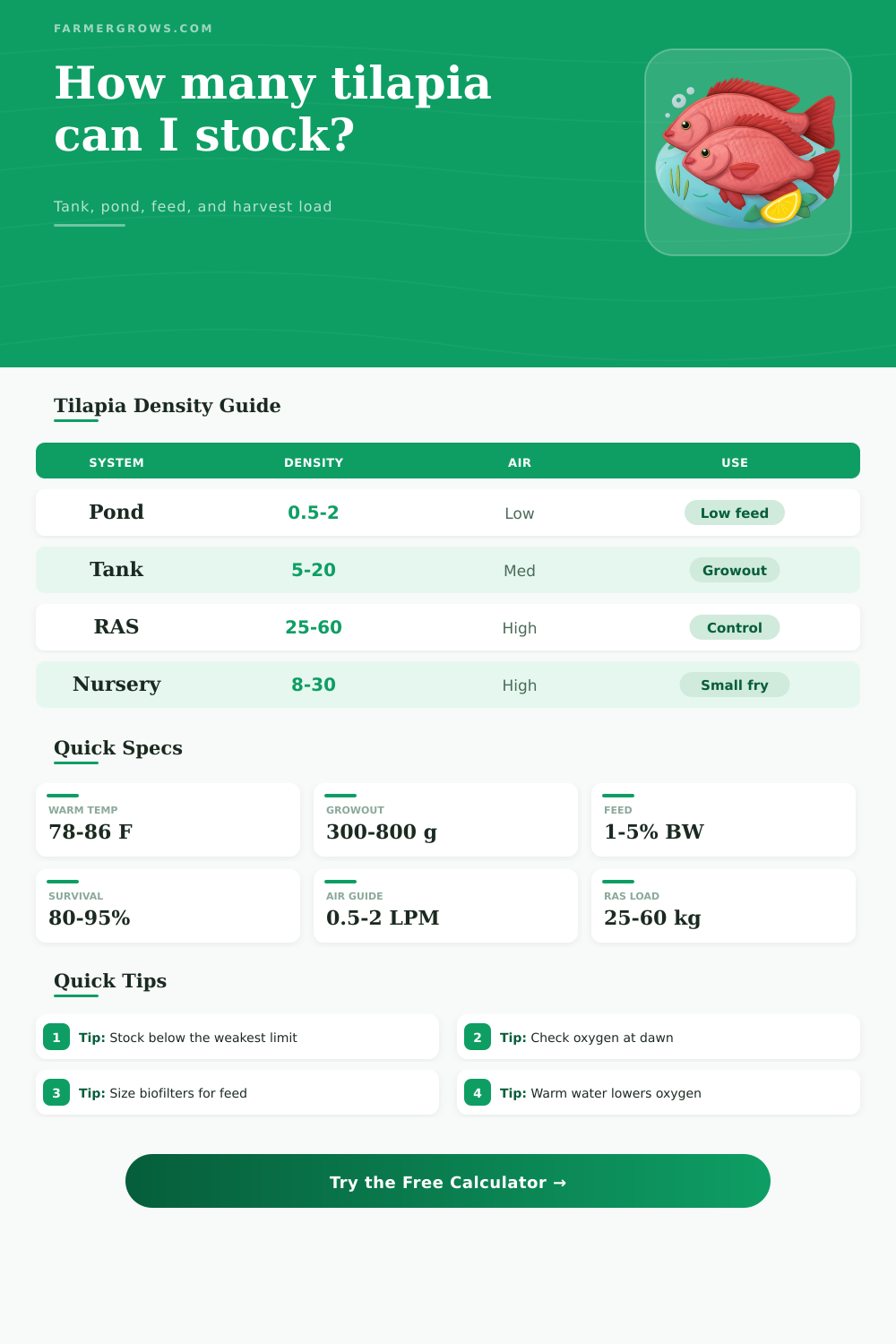
Tilapia Stocking Density Calculator
Estimate tilapia count from tank or pond volume, culture system, aeration, biofilter feed capacity, target fish size, survival, feeding rate, water temperature, and harvest timing.
Use this as a planning calculator, then confirm the final stocking rate with dissolved oxygen readings, ammonia control, local climate, genetics, feed quality, and farm management experience.
Uses natural productivity and low feed. Good for low-risk, low-input production.
Volume is not the only limit because warm still water can lose oxygen overnight.
Plankton bloom supports growth, with supplemental feed used carefully.
Watch bloom crashes and reduce density after cloudy weather.
Works for small farms when feed, solids, and air are managed daily.
Tank harvest density should be limited by biofilter and oxygen together.
High density requires filtration, oxygen transfer, backup power, and water testing.
Biofilter feed capacity often becomes the practical ceiling.
Tilapia Stocking Output
The recommendation rounds down because the practical stocking rate is set by the tightest limit: volume density, aeration, biofilter feed capacity, temperature, and safety buffer.
| System type | Planning density | Aeration need | Biofilter role | Best use |
|---|---|---|---|---|
| Extensive earthen pond | 0.5 to 2 kg/m³ | Low, but dawn checks still matter | Natural pond processes | Low-input harvests and forage-supported growth |
| Fertilized pond | 2 to 6 kg/m³ | Light to moderate | Mostly plankton and sediment biology | Supplemental feed with bloom management |
| Fed aerated pond | 6 to 15 kg/m³ | Continuous or nightly air | Not media-based, but waste load rises | Small commercial pond production |
| Aerated tank or aquaponics | 8 to 22 kg/m³ | Continuous aeration | Must match daily feed rate | Backyard or greenhouse growout |
| RAS intensive growout | 25 to 60 kg/m³ | High aeration or oxygen | Primary limiting system component | Controlled production with testing |
| Water temperature | Calculator factor | Tilapia response | Stocking advice | Feed note |
|---|---|---|---|---|
| Below 20°C / 68°F | 0.45x | Slow growth and stress risk | Stock very lightly or delay | Reduce feed sharply |
| 20 to 24°C / 68 to 75°F | 0.75x | Growth continues but slower | Use conservative density | Watch uneaten feed |
| 25 to 30°C / 77 to 86°F | 1.00x | Preferred growout range | Normal stocking plan | Feed can be efficient |
| 31 to 33°C / 88 to 91°F | 0.88x | Oxygen demand increases | Add air and reduce load | Split feeding times |
| Above 33°C / 91°F | 0.70x | Oxygen margin can shrink | Use emergency aeration | Feed lightly |
| Fish stage | Typical size | Feed rate guide | Density caution | Planning note |
|---|---|---|---|---|
| Fry nursery | 0.1 to 5 g | 8% to 12% body weight | High numbers but low biomass | Grade often to reduce size spread |
| Fingerling | 5 to 50 g | 4% to 8% body weight | Oxygen swings after feeding | Transition carefully to growout feed |
| Juvenile growout | 50 to 250 g | 2% to 4% body weight | Biomass starts rising fast | Use survival-adjusted stocking count |
| Market growout | 300 to 800 g | 1% to 2.5% body weight | Harvest biomass sets final load | Biofilter sizing should use peak feed |
| Example volume | System | Target fish | Expected density | Practical note |
|---|---|---|---|---|
| 1,000 L IBC | Aquaponic tank | 400 to 600 g | 8 to 18 kg/m³ | Biofilter and air should be sized before stocking |
| 10,000 L tank | Greenhouse RAS | 500 to 800 g | 25 to 45 kg/m³ | Requires backup air and frequent water tests |
| 0.1 acre pond | Fed aerated pond | 300 to 600 g | 4 to 12 kg/m³ | Depth, bloom, and night oxygen matter most |
| Pond cage | Cage growout | 400 to 700 g | 15 to 35 kg/m³ | Water exchange through mesh must stay strong |
Stock by final biomass: Fingerlings look small at stocking, but the tank or pond must support their harvest weight, daily feed, oxygen demand, and waste load.
Keep a backup plan: High-density tilapia systems need emergency aeration, quick harvest options, and a way to stop feeding during heat, ammonia, or low oxygen events.
Calculator outputs are planning estimates. Confirm density with actual dissolved oxygen, ammonia, nitrite, alkalinity, pH, water exchange, feed behavior, and local aquaculture guidance before stocking heavily.
The farming of tilapia become difficult when the number of tilapia in a tank or an pond becomes too high for the water or the equipment to support. The problems that become present with tilapia farming are not caused by space alone, but oxygen demand at night, ammonia from uneaten feed, the speed of tilapia growth in warm water, and the size of a biofilter also causes the problems. If a person want to avoid these problems, a person must consider many different limits at once rather than guessing at one single limit.
The amount of tilapia biomass that a system can carry without running out of oxygen and without overwhelming the filtration system are called the stocking density. All of the components mentioned here is important. The oxygen and biofilter capacities are two constant that will always limit the number of tilapia that an aquarium can carry whether it’s a pond or a tank.
How to Find the Right Number of Tilapia for Your Tank or Pond
The difference between a pond and a tank is the equipment, but the difference is also the daily work of testing the water, cleaning solids, and watching the behavior of tilapia. The calculator require several inputs so that the calculator can perform the math for the user. These inputs are: water volume, target harvest weight, stocking weight of the tilapia, survival rate at harvest time, feeding percentage, temperature of water system, and what type of aeration and filtration system that you has set up.
Each of these inputs will change the answer for the number of fish you should keep in your system. For example, the growth rate of tilapia depend on temperature. If a tilapia’s growth rate increase, you will feed more to each tilapia and increase demands on the system.
Every one of these inputs has some effect on how many fish your system can support. The tightest limit on a tilapia farm is rarely the limit that a person would expect. The calculator check each one of these factors and then outputs which factor limits the farm at its lowest safe stocking number.
No factor can be higher than another component capacity or stress might appear. Temperature is critical for tilapia because they are tropical fish. Too low or too highly temperatures will slow growth and limit food consumption which affects many variable.
Tilapia grow better between 20 and 31 degrees Celsius. The calculator adjust for temperature properly. It is important to consider how much space your fish take up rather than how many fish there are.
Somebody might think you can fit alot of fingerlings into a space but fewer large fish; we have to consider growth rate over time. The calculator take this into consideration since it needs stocking weight as well as harvest weight. It is also important to consider what survival rate is close to what people would expect under good conditions so you can account for this in case something bad happen during your raising process like disease or power outages.
The aeration and biofiltration systems are going to affect how many fish you can stock as well. Even if you think there’s room for more, all these factors play together so if you haven’t adjusted for these factors properly then you will have to many fish stressing out in your pond. The point of this calculator is to help people figure out the proper stocking number they need for their ponds or tanks so they dont stress their fish or waste money stocking too many fish.
There are other factors that might make differences in your farming too that we are not aware of here including thing like regulations, feed quality, etc.
In summary then, stocking density isnt just about how much volume you have for fish but how much oxygen, filtration capacity, food, waste, temperature, etc., interacts with your fishs growth over time compared to their survival rate too. If any single one of these factors is even just slightly shift then it makes a big difference for stocking quantity. This calculator do all this work so you should of not had to!