Tank Storage Calculator
Estimate usable farm tank volume, daily water demand, rainfall capture, and reserve-day coverage for livestock, irrigation, greenhouse, and mixed-use systems.
This calculator subtracts freeboard before volume is computed, uses 7.48052 gallons per cubic foot, 3.78541 liters per gallon, and the standard 0.623 gallon per square foot per inch rainfall capture factor.
Tank Storage Results
Usable storage, rain capture, and reserve-day coverage are calculated from the current inputs.
| Shape | Formula before conversions | Best field use | Freeboard treatment |
|---|---|---|---|
| Vertical cylinder | pi x r² x usable height | Poly tanks, silos, cisterns | Subtract from vertical height |
| Horizontal cylinder | Segment area x length | Nurse tanks, trailer tanks | Usable fill depth = diameter - freeboard |
| Rectangular tank | Length x width x usable height | Open storage, vaults, trough tanks | Subtract from vertical height |
| Rated tank | Nameplate gallons x usable height ratio | Known manufacturer capacity | Prorate by freeboard percent |
| Use | Typical daily planning range | Peak-weather note | Storage caution |
|---|---|---|---|
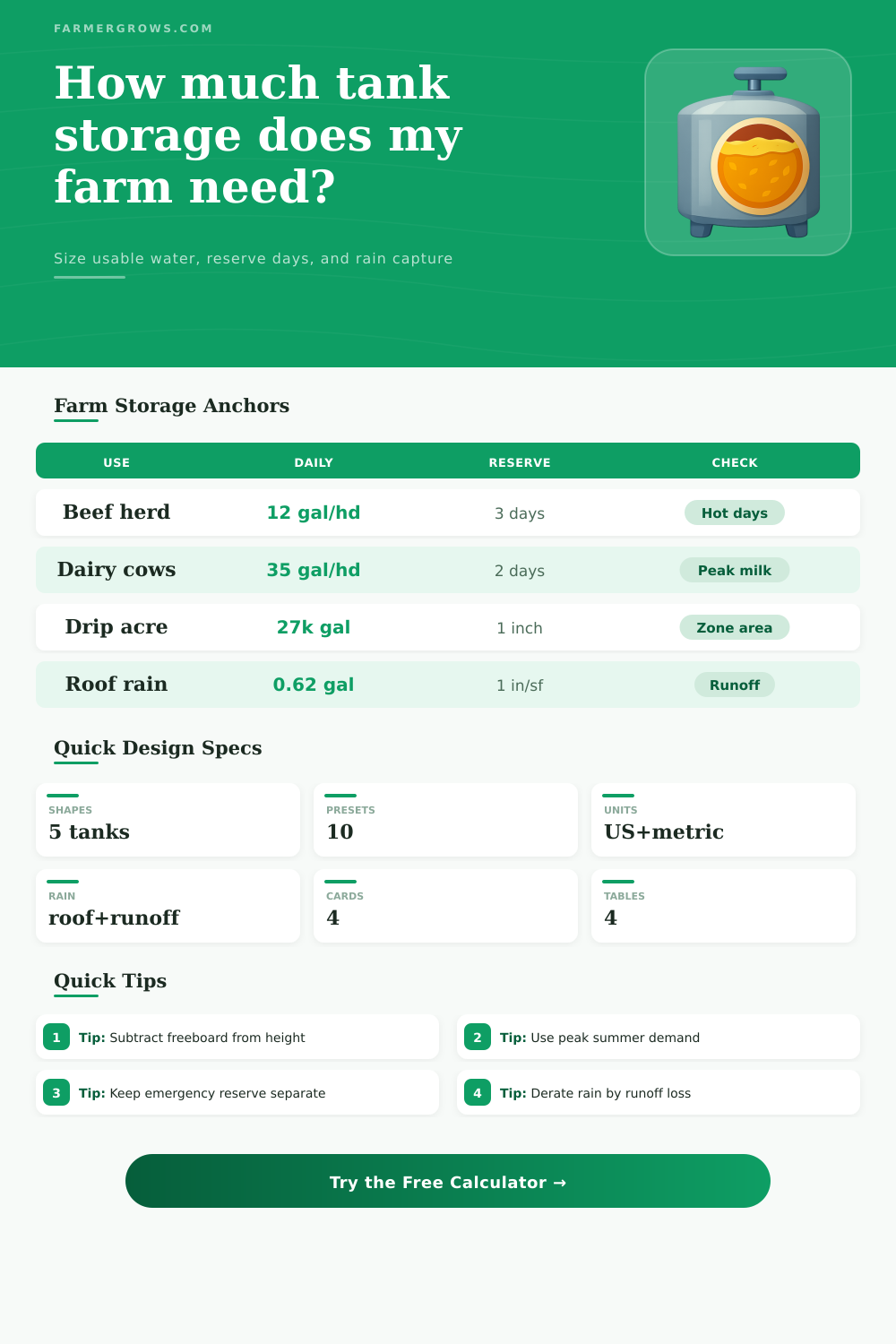
| Beef cattle | 10 to 20 gal per head | Heat and lactation increase use | Use a hot-day value for reserves |
| Dairy cows | 30 to 50 gal per head | Milk yield drives demand | Keep milking wash water separate if needed |
| Horses | 8 to 15 gal per head | Workload can double intake | Allow extra for trough cleaning |
| Sheep or goats | 1 to 4 gal per head | Dry forage raises demand | Small tanks need freeze protection |
| Poultry | 0.05 to 0.25 gal per bird | Ventilation and age matter | Use house records when available |
| Greenhouse | 0.3 to 1.5 gal per sq ft | Sunny days drive evapotranspiration | Separate fertigation flush water |
| Planning item | US value | Metric value | How to use it |
|---|---|---|---|
| One acre-inch | 27,154 gal | 102,790 L | Water to apply 1 inch over 1 acre |
| One inch on 1,000 sq ft | 623 gal | 2,358 L | Useful for garden and high tunnel zones |
| Drip reserve | 1 to 3 days | Same | Bridge pump repairs or cloudy solar days |
| Rain capture factor | 0.623 gal/sq ft/in | 25.4 L/m²/25.4 mm | Multiply by runoff efficiency |
| Catchment surface | Typical efficiency | Best use | Losses to remember |
|---|---|---|---|
| Clean metal roof | 90% to 95% | Barns and machine sheds | First-flush and gutter overflow |
| Shingle or rough roof | 75% to 85% | Older barns and houses | Surface wetting and debris |
| Greenhouse roof | 80% to 90% | Bench and propagation water | Valley gutters and screen filters |
| Lined ground catchment | 55% to 70% | Remote livestock storage | Sediment and evaporation |
Freeboard matters: a six-inch air space in a wide tank can remove hundreds of usable gallons, so size storage from the usable height rather than the outside label.
Separate reserve from refill: rainfall capture is helpful after storms, but reserve days should still be checked against tank water already on hand during dry weather.
A water tank is an container that can be used to store water for agricultural uses. Additionally, the water tank can act as a buffer for periods of interruption in the supply of water to a farm. A water tank can provide water for the farm’s animals, the farm’s irrigation systems, and the greenhouse benches where plants is cultivated.
The size of the water tank that is needed can be determined based off the daily use of water on the farm, the length of dry periods that are to be survived, and the amount of rain that can be collected from the farm’s existing surfaces. The size of the water tank depends on various different inputs. For instance, the shape of the tank influence the volume of water that can be stored.
How to Size a Water Tank for a Farm
Other factors includes the daily demand for water from the farm, the number of days that the water tank is to provide water for the farm without needing to refill the tank with fresh water, and the amount of water that can be collected from the farm’s surfaces during the rainfalls. Multiplying the area of the roof by the depth at which the rain falls on that area calculates the amount of water that can be collected from the farm’s area. However, you must also account for the efficiency of the run-off of water from the farm to the water tank in the calculation of the volume of the tank.
For instance, metal roofs will have a more higher efficiency for run-off of water compared to shingle roofs, as shingle roofs tend to hold the water on the roof’s surface. Additionally, ground catchments have the lowest efficiency for run-off due to the evaporation of the water from the collected water. The first-flush of water that flows from gutters after rain falls on the catchment area will also contain substances that can potentially clog the gutters; thus, the first-flush losses and overflows in gutters will reduce the amount of water that can reach the water tank.
The water requirements of livestock vary according to the type of animal that is to be watered and the weather conditions. For instance, beef cattle require ten to fifteen gallon of water per head in weather that is moderate in both hot and cold temperatures; however, more water will be required of the cattle if the temperatures rises. Dairy cows require more water than beef cattle due to the milk production requirements of the cows and the requirements of the cows to water their bodies to perform their routines.
Horses require double the amount of water compared to the usual amount of water that the horses use if the horses are to perform heavy work. Sheep and goats require relatively small amounts of water; however, they use smaller water tanks that are either easy to forget or to potentialy freeze. Finally, the poultry houses in the farm may contain thousands of birds, indicating a high requirement of water to the water tank for the farm.
The water from the water tank can also be used to water the crops on the farm. Drip irrigation systems are one of the methods that can be used to water the farm’s fields; however, the drop irrigation system will require a volume of water to the tank to ensure that the water can be dispensed in the case that the pump for the drip irrigation system should fail. Additionally, greenhouse benches will lose water to the evaporation of water, especially during the sunny days; furthermore, greenhouse benches will lose even more water if the fans in the greenhouse are turned on to increase the ventilation of the greenhouse.
If the water tank is to provide water for the livestock and the irrigation systems, then the daily demand for water should be adjusted to account for these need. The freeboard of the water tank is the amount of water that is contained in the tank that cannot be used due to the fact that the water cannot rise to the top of the tank. Thus, if the water tank has six inches of freeboard, then six inches of water will be lost to the water tank that cannot be accessed for use.
The total height of the water tank should not be used to calculate the volume of water that is to be provided by the tank; the total height of the tank will provide an overestimate of the volume of water that will be provided. Additionally, the manufacturer of the tank may rate the total capacity of the water tank. However, the capacity of the tank that is usable will be less than the total rating of the tank because the capacity that can be used is less than the total capacity of the tank.
Rainfall is one of the inconsistent source of water that can be used to refill the water tank. Thus, water tanks cannot rely on the rain to provide the water that is required for the farm. Rather, water tanks will rely on the reserve days for the water to ensure that the water requirements of the animals and crops are met.
The calculated number of days that the tank will provide water to the farm without needing to refill the water tank can be used to determine if the stored water alone can meet the target for the farm. Thus, farmers should not solely rely on the storm and the stored water that will fall into the tank to provide water for the farm. Some common mistakes in the sizing of water tanks include using the average demand for water for an area rather than the peak amount of water that is used during periods of extreme hot weather or dry seasons of crops.
Additionally, farmers may not account for the efficiency with which the rain water runs off the farm’s structures into the tank; thus, the other factor that can be used to calculate the required volume of the tank is the runoff efficiency of the farm’s structures. To avoid these mistakes in sizing water tanks for farms, farmers can simply provide honest and accurate answers to the various fields that ask for the sizing of the tank. For instance, the peak demands of the water for the livestock during the summer season can be provided, as can the length of the dry spell in the area that is to be irrigated by the tank.
The area of the tanks catchment structures can also be provided. If the number of days that is to be provided by the tank is increased, the volume of the tank will increase. Additionally, if the area of the farm that is to be irrigated by the tank is increased, the volume of water that will be contributed from the rain will also increase; however, the runoff efficiency factor limits the contribution of rainwater.
If the amount of freeboard for the tank is adjusted, the number of gallons of water that can be present in the tank will drop. The goal is for the water tank to provide enough water for the farm to bridge the gaps in the supply of water to that farm. Thus, the use of a calculator that estimates the volume of water that is required by the farm can help the sizing of water tanks.