🐖 Swine Breeding Calculator
Plan gilt and sow service timing, repeat heat checks, pregnancy checks, farrowing due dates, crate entry, and batch group load from one breeding date.
Use this planning tool with herd records and veterinary guidance. Real farrowing timing can shift with genetics, parity, season, heat detection, semen handling, nutrition, and sow health.
Breeding Calendar Results
Dates are calculated from service date, parity, estrus cycle, wean-to-estrus interval, service count, conception rates, and batch interval.
| Parity class | Calendar adjustment | Breeding focus | Farrowing note |
|---|---|---|---|
| Replacement gilt | Use 114 days, wider watch | Confirm standing heat, age, weight, and second-service timing | Move calmly and avoid crowding before first farrowing |
| Parity 1 sow | Use 114 days, watch WTEI | Track wean-to-estrus interval and body condition after first litter | Review feed and comfort because recovery can affect service success |
| Parity 2 to 5 sow | Use standard batch center | Usually the most predictable core breeding group | Good group for tight crate and labor scheduling |
| Parity 6+ sow | Use 114 days with wider watch | Track soundness, repeat returns, and cull decisions | Start observation early if previous farrowing was difficult |
| Method | Common service count | Timing basis | Management note |
|---|---|---|---|
| Observed AI | 2 services | Standing heat, often 12 to 24 hours apart | Needs reliable heat checks and semen handling |
| Timed AI | 1 to 2 services | Protocol time after synchronization step | Works best when protocol compliance is high |
| Natural service | Exposure window | Boar contact over heat period | Still record dates and check repeats at 18 to 24 days |
| Return heat reservice | 2 services | Next standing heat after open check | Decide whether the female stays in the batch or moves groups |
| Milestone | Common timing | What to record | Why it matters |
|---|---|---|---|
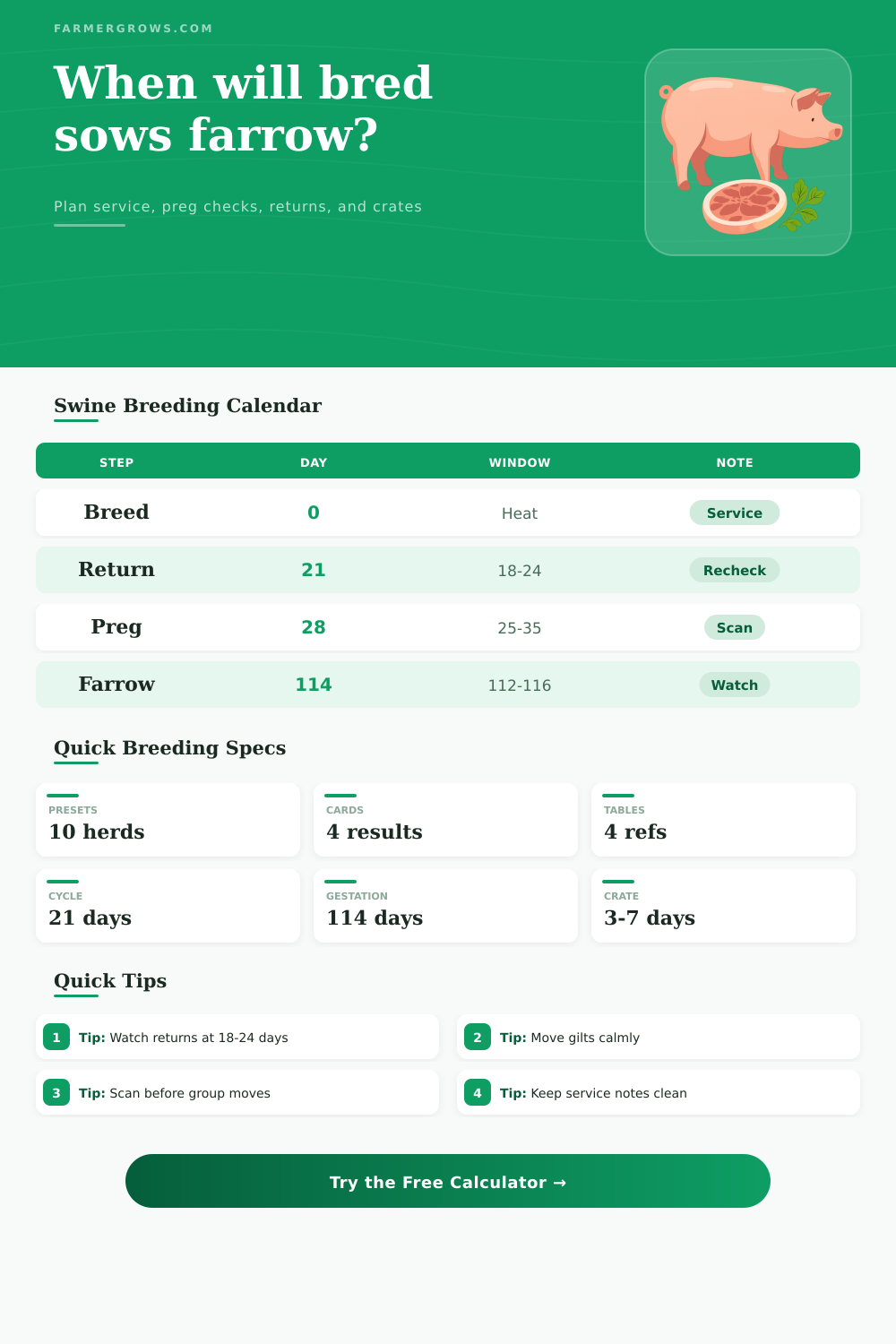
| Service date | Day 0 | Female ID, parity, method, boar or semen batch | Everything else in the calendar keys from this date |
| Repeat heat check | Day 18 to 24 | Standing heat, discharge, appetite, and crew notes | Find open females before they miss another batch |
| Pregnancy check | Day 25 to 35 | Scan result, doubtful animals, and rescan date | Sort bred, open, and reservice groups early |
| Farrowing prep | Day 107 to 111 | Crate, room, feed, and expected litter notes | Improves room flow and farrowing supervision |
| Farrowing watch | Day 112 to 116 | Due date, signs, assisted births, total born | Supports piglet care and next-cycle records |
| Batch interval | Groups per year | Best fit | Breeding calendar note |
|---|---|---|---|
| 1 week | 52 groups | Large continuous-flow herds | Requires steady crate and nursery movement every week |
| 2 weeks | 26 groups | Moderate batch systems | Balances labor blocks with shorter room idle periods |
| 3 weeks | 17 groups | All-in, all-out nursery flow | Matches the normal sow estrus cycle after a missed service |
| 4 weeks | 13 groups | Small herds or simpler labor blocks | Creates larger groups and longer gaps between farrowing weeks |
| 5 weeks | 10 groups | Very small or seasonal systems | Useful when farrowing rooms need deeper cleanout between groups |
Heat checks: Treat day 18 to 24 after service as a real work list. Repeats found there save feed, crate space, and missed batch time.
Batch flow: Compare expected farrowings with actual crate count before moving females. A small overrun can disrupt piglet care and room cleaning.
In order to establish an effective swine breeding schedule, a strict schedule must be establish, and a strict schedule is necessary to prevent the farrowing room from becoming overwhelmed with newborn piglet. In order to map out the breeding dates for each of the gilts and sows in the facility, you must account for the variables for each of the individual pig. These variable includes parity, lactation length, and heat detection reliability.
A planning tool can help to account for each of these variables to ensure that the breeding schedule for each sow are appropriate. The inputs to the planning tool are critical for modeling the breeding facility. One of the most important variable to account for is the parity of each of the sows.
Plan a Breeding Schedule for Sows
For instance, the parity will determine if the sow is experiencing it’s first pregnancy, or if it is a prime breeder. Prime sows typically take 114 day to gestate, while gilts may have a different gestation period. The wean-to-estrus interval for each sow is another important input to the planning tool, as it will help determine if the sow will be able to become pregnant again.
Finally, the service count and spacing for the facility are important, as it will indicate whether the facility utilize artificial insemination for the facilitys sows. Each of these different inputs will impact the output of the planing tool. The reference tables that are provided alongside the calculator help to explain the shifts of the planning tool.
For instance, the reference tables can help to indicate why certain sow require comfort checks performed at specific times in relation to farrowing. Additionally, the reference tables can help to explain why a batch of sows may be bred in three-week intervals. These tables can help to indicate why repeat heat check are performed between days 18 and 24, for instance.
These repeat heat checks will allow the facility manager to determine if the sow will remain in its current group, or if it should be moved to the breeding group that cycles later in relation to the farrowing period. It is important to read the rows within the reference tables to understand the calendar within the planning tool. The herd of sows that are bred within the facility will never follow the same number.
For instance, heat detection may fail during the hot weather within the facility. Additionally, the body condition of the sows may lead to longer interval between estrus and after the birth of a litter. Finally, the availability of crate space is also a limited resource within the facility.
The planning tool accounts for some of these variable, such as allowing the facility to model different conception rate and different counts of crates available for the sows. However, no amount of technology can account for the sow standing for service on day zero but returning to heat after 21 day. Thus, heat checks must be performed.
By running the number prior to breeding a group of sows, the breeding facility will be able to ensure that the number of farrowings will fit within the available amount of crates for the facility. Additionally, the facility can use these breeding schedule to ensure that pregnancy check fall on a day that is convenient for the facility. Furthermore, by running these numbers, the facility will be able to determine if the service date for the sows will coincide with another major task within the barn.
These adjustment will be helpful in that they will eliminate the need to move sows between different farrowing room, and they will eliminate the need to hold open (non-farrowing) female that should of been recognized as such at an earlier date. The planning tool will only be effective if the notes used to account for each of the sow variables are accurate. For instance, the breeding facility will need to record each of the service date for each of the sows in the facility.
In addition to these dates, the facility will need to keep accurate record of the standing heat observation of each of the sows, as well as the scan results for each of the sows. These records will ensure that each new group of sows is following a tighter breeding cycle than the previous group of sows in the facility.