Superfat Soap Calculator
Calculate full-strength lye, discounted lye, excess oil, water, fragrance, additives, and cured batch weight from oil percentages and editable SAP values.
Use weights, not volume, for soapmaking ingredients. SAP values vary by supplier and oil lot, so treat the table as a planning aid and confirm the numbers on your ingredient records before mixing lye.
| Oil | Recipe % | NaOH SAP | Role |
|---|---|---|---|
| mild, slow trace | |||
| cleansing, bubbles | |||
| hardness, creamy | |||
| conditioning | |||
| lather support | |||
| firmness |
| Oil | Percent | Weight | SAP lye |
|---|
| Superfat | Lye amount | Lye discount | Excess oil estimate |
|---|
| Oil or butter | NaOH SAP | Typical range | Planning role |
|---|---|---|---|
| Olive oil | 0.134 | 0.133 to 0.136 | Mild, slower trace, long cure. |
| Coconut oil 76 | 0.183 | 0.181 to 0.186 | Cleansing, hard bar, strong bubbles. |
| Palm oil | 0.142 | 0.141 to 0.145 | Hardness and creamy stable lather. |
| Shea butter | 0.128 | 0.126 to 0.130 | Conditioning feel and dense bar. |
| Castor oil | 0.128 | 0.127 to 0.130 | Lather support at modest percentages. |
| Cocoa butter | 0.137 | 0.136 to 0.139 | Firmness and brittle snap if high. |
| Avocado oil | 0.133 | 0.132 to 0.136 | Mild conditioning oil. |
| Rice bran oil | 0.128 | 0.127 to 0.130 | Balanced conditioning and mildness. |
Keep SAP values traceable: Write down the SAP source used for each oil, especially when switching suppliers or replacing a major oil in the recipe.
Separate superfat from water: Superfat changes the lye amount. Water ratio changes the lye solution. Adjust one at a time so the batch record stays readable.
In order to make soap, you will need to balance the amount of lye that you use with the amount of oil that is included in the recipe. You will need enough lye to ensure that the oil is chemically transformed into soap, yet you will also need to ensure that you dont use too much lye, which would result in a harsh bar of soap. The percentage of superfat is the number that will allow you to control this balance, and that which will change the way that you approach each of your recipes.
The superfat in a bar of soap is the oil that does not chemically react with the lye. Because the lye is chemically calculated to react with less than the total weight of oils that is to be used in the recipe, there will always be a small percentage of oil in the bar of soap that does not chemically react to the lye. This unreacted oil softens the bar of soap, and helps to stabilize the lather (in some soap recipes).
How Superfat Affects Soap
Additionally, this oil acts as a buffer to the chemical reaction in the case that the weights of the ingredients are not completely accurate to the recipe. Using a higher percentage of superfat means that there will be a greater amount of oil that does not chemically react to the lye; therefore, the bar of soap will be softer due to the increased oil yet it may also go rancid more readily. The calculator will perform the mathematical calculations necessary to determine the weights of each ingredient in the soap recipe once you enter the weights of the oils that are to be used and the SAP values for each oil.
The total weight of the oil is used to calculate the relationship between the oils and the other ingredients, while the SAP (saponification) values indicate the amount of lye that each type of oil requires in order to transform into soap. The field for the superfat is calculated as a reduction to the amount of lye that would be required if there was no superfat in the soap bar. The ratio of water to soap ingredients will impact the rate at which the ingredients will chemically thicken to form soap.
The percentages of fragrance and other additive ingredients is calculated in relation to the total weight of oil. Finally, the estimate of the percentage of water that will evaporate during the curing process allows for calculations of the total weight of the cured soap bars. The amount of superfat can vary with the type of soap that is to be created.
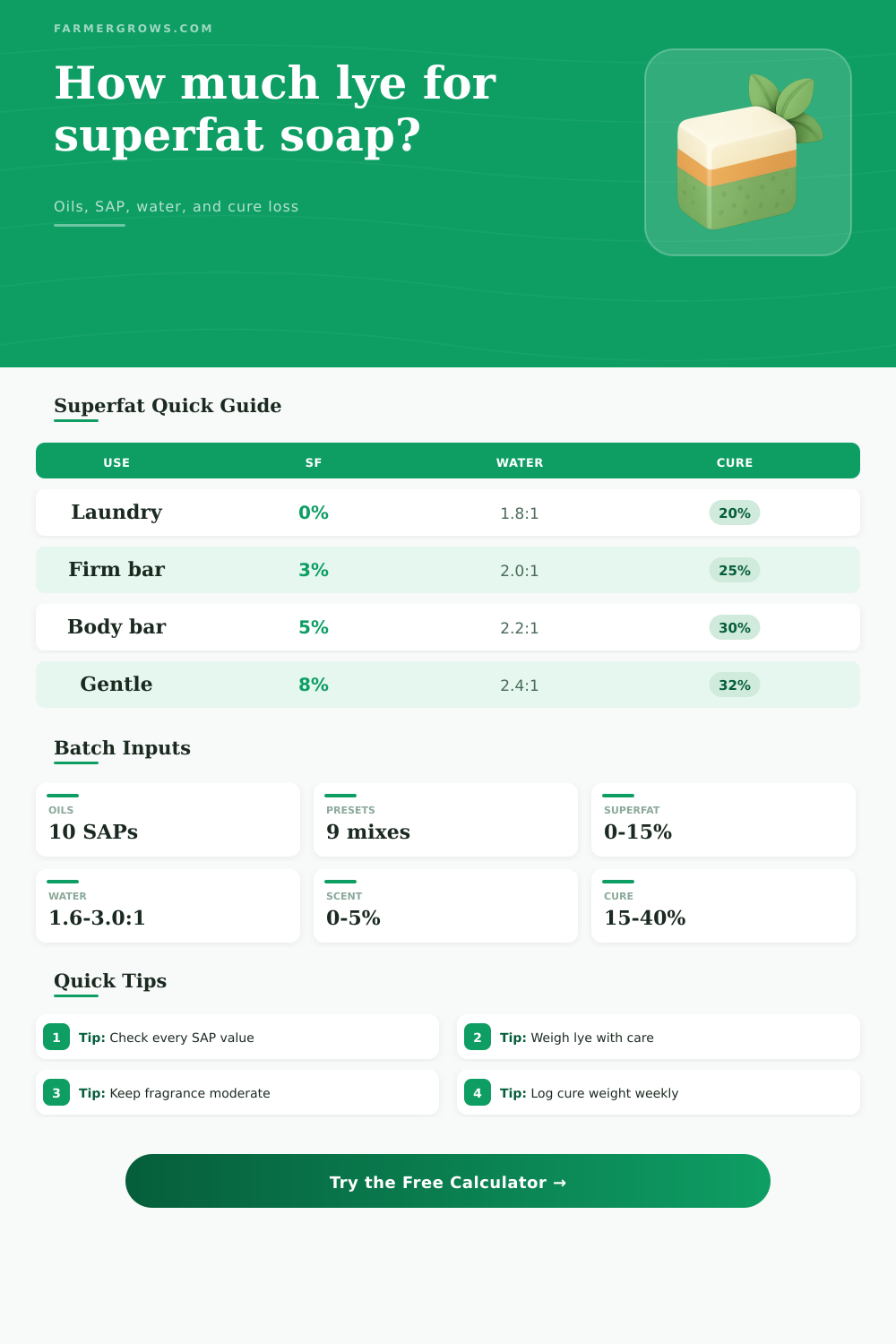
For instance, the percentage of superfat for a bar of soap that is to be used in the laundry can be 0%; the bar does not need to be gentle on the skin. Body bars contain approximately 5% superfat; this amount is sufficient for bodily use yet does not lead to the bar being too soft. Shaving and facial bars contain 8% or 10% superfat; because of the sensitivity of these areas, the extra oil reduces the chance of irritation.
Each of these scenarios can be tested with the calculator; altering the superfat percentage will alter the amount of lye that is required, and the amount of oil that is excess to the amount that chemically reacts with the lye. The water ratio for a soap bar is a separate selection of variables from the percentage of superfat. The superfat alters the weight of the lye that is to be used in the reaction.
The water ratio alters the amount of liquid that is used to prepare the lye. A lower ratio of water to soap ingredients will create a stronger lye solution than a higher ratio of water to soap ingredients; this is beneficial in hot weather, or if the recipe is one that readily reaches trace. Using a higher ratio to water allows for more time to add color to the soap before it reaches trace.
The settings do not work in both variables simultaneously; altering both the superfat and the water ratio will make it difficult to separate the effect of each of those variables on the outcome of the batch of soap. Although it may seem unnecessary to pay attention to the field for cure loss, this field has the most significant impact on the finished bar of soap. While the oil and lye in the soap bar do not chemically change during the curing process, the water content of the bar does chemically decrease.
Using a high ratio of water will lead to a greater percentage of water lost during the curing process. The calculation of cured batch weight allows for planning of where the soap bars are to be stored. The weight of the cured batch of soap can also help to determine the number of soap bars that can be produced.
Therefore, it is necessary to ensure that the batch of soap will fill the mold in which it will be cured. Each of the oils in the recipe can be altered in the recipe to adjust for different SAP values from different suppliers of the oil. The SAP values of oils can differ from those that are published in soap making textbooks due to the different analyses of each oil by different suppliers.
Additionally, the SAP value of the oil may change from lot to lot of the same supplier. Creating the same recipe with different SAP values will reveal the differences in the amount of lye that is required to create each batch; it is also necessary to log from which SAP value was used in each batch of soap. Additionally, if the flavor of the bar of soap differs between batches, it may be necessary to adjust the recipe to account for the differences.
One of the most common errors in the creation of soap recipes is treating the percentage of superfat as a rule that should remain the same, regardless of the outcome of the batch of soap that is produced. A recipe that incorporates a superfat of 5% may begin to feel too conditioning if the percentage is increased to 10%. A recipe that incorporates 0% superfat may feel too mild if oil is intentionally added to the batch.
These relationships are made visible to the creator of the recipe through the inclusion of both the lye amount that is required for the recipe with the amount of lye that is discounted due to the superfat; additionally, the superfat calculator also calculates the excess oil that is created in the reaction. The type of lye that is used may also interact with the percentage of superfat. The same percentage reduction to the weight of potassium hydroxide will create a different bar of soap than the same percentage reduction of the weight of sodium hydroxide.
The calculator accounts for the different weights of each type of lye; yet, it is essential to understand whether one desires to create a bar of soap or a paste that will dissolve in water. Each of the reference tables on the page is an essential tool to understand the role of each of the oils that may be used in soap recipes. Each of the tables include information on the SAP values of the oils, and the roles of each type of oil in bar of soap.
For instance, understanding the roles of oils in the bar of soap will allow a creator of soap to understand which percentages of each type of oil will provide the desired qualities of the bar of soap. The value of the creation of soap recipes with this type of calculation is that the numbers eliminate guesswork in the creation of soap. A bar of soap can be created with a specific amount of superfat, oil, lye, and water; the math ensures that the outcome of these variables will result in the desired outcome of a bar of soap.
Therefore, the mathematics behind the creation of each batch of soap allows for the creation of the specific type of bar of soap that each individual intends to create.