🍓 Strawberry Plant Spacing Calculator
Calculate exactly how much space your strawberry plants need based on variety, planting system, and garden size
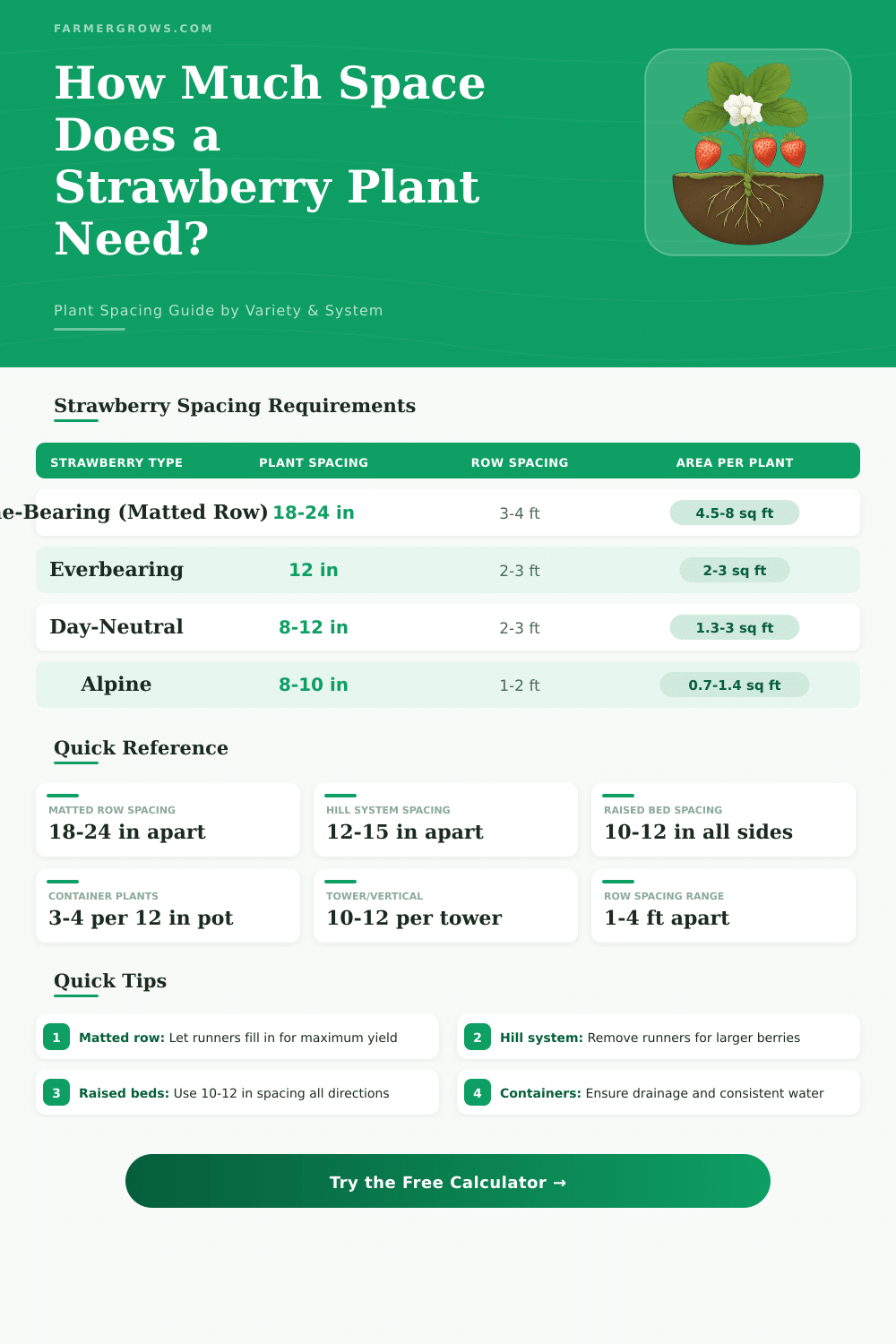
| Planting System | Plant Spacing | Row Spacing | Best For |
|---|---|---|---|
| Matted Row | 18–24 in (45–60 cm) | 3–4 ft (90–120 cm) | June-bearing, large gardens |
| Spaced Row | 12–18 in (30–45 cm) | 2–3 ft (60–90 cm) | All types, controlled runners |
| Hill / Mound | 12–15 in (30–38 cm) | 2–3 ft (60–90 cm) | June-bearing, premium berries |
| Raised Bed | 10–12 in (25–30 cm) | 10–12 in (25–30 cm) | All types, small spaces |
| Container / Pot | 3–4 plants per 12 in pot | N/A | Everbearing, day-neutral |
| Tower / Vertical | 10–12 plants per tower | N/A | Day-neutral, alpine |
| Container Type | Size | Plants Per Unit | Best Varieties |
|---|---|---|---|
| Standard Round Pot | 12 in (30 cm) wide | 3–4 | Everbearing, day-neutral |
| Window Box | 24 in (60 cm) long | 3–4 | Alpine, day-neutral |
| Strawberry Jar | 12–16 in (30–40 cm) | 6–10 | Everbearing, alpine |
| Hanging Basket | 12–14 in (30–35 cm) | 3–5 | Everbearing, alpine |
| Vertical Tower | 3–4 ft (90–120 cm) tall | 10–12 | Day-neutral, everbearing |
| Grow Bag | 5–10 gallon | 3–6 | All types |
| Planting System | Runner Strategy | When to Prune | Notes |
|---|---|---|---|
| Matted Row | Allow runners to fill in | Keep bed 18–24 in wide | Thin if overcrowded after year 2 |
| Spaced Row | Allow 2–4 daughter plants | Remove extras monthly | Space daughters 6–8 in from mother |
| Hill / Mound | Remove all runners | Weekly during growing season | Directs energy to larger berries |
| Raised Bed | Remove most runners | Every 2–3 weeks | Keep spacing at 10–12 in minimum |
| Container | Remove or root in new pots | As they appear | Runners drain container nutrients |
| Tower / Vertical | Remove all runners | As they appear | Runners unbalance vertical systems |
| Garden Size | Matted Row Plants | Raised Bed Plants | Expected Yield |
|---|---|---|---|
| 4 × 4 ft (1.2 × 1.2 m) | 4–6 | 9–16 | 2–8 lbs |
| 4 × 8 ft (1.2 × 2.4 m) | 8–12 | 18–32 | 4–16 lbs |
| 4 × 12 ft (1.2 × 3.7 m) | 12–18 | 27–48 | 6–24 lbs |
| 10 × 10 ft (3 × 3 m) | 20–30 | 64–100 | 10–50 lbs |
| 10 × 20 ft (3 × 6 m) | 40–60 | 130–200 | 20–100 lbs |
| 20 × 50 ft (6 × 15 m) | 150–250 | 600–1000 | 75–500 lbs |
The right spacing of strawberries makes a big difference for their growth and fruits. The ideal distances are around 30 to 45 centimetres between plants although many succeed even with 40 centimetres. If you lay them closer than 30 cm, you simply waste precious garden space, and at least pollination can suffer.
For day-neutral species the cause adjusts a bit. I noticed that they benefit well planted in 20 to 30 cm between themselves in the rows, while between rows one leaves 75 to 90 cm.
How Far Apart to Plant Strawberries
Even so June-bearing species requires more space for themselves. Here one must plan around 45 to 60 cm between plants, with rows separated by around 1.2 metres. The reason is that their runner children spread quiclky and root alone, what results in dense cover broad in around 60 cm.
The most many gardeners so lay rows in 90 to 100 cm one from the other to give them enough air flow. About continuously fruiting strawberries? They are more flexible, one can grow them in single, double or triple rows, but from my experience single rows work best for that species.
Raised beds are really very liked, and here the key: arrange plants in 1.2 x 1.2 metre bed requires a bit of tactics. Square foot method offers four plants per square metre, what is quite a lot dense. Many growers start with only one plant each square metre; one lays it in one corner and leaves the rest empty.
Later the runner children do their work. In the second year, almost each strawberry plant gives three to six children. One can leave them root naturally, or even more well, transplant those children too the vacant places.
Franke said, strawberries like a bit of chaos between the plants. They do not stay in sorted rows, they simply spread and fill each given space. Even so too much density is real danger.
Five plants pressed in a little jar? Likely too much. Those plants require air moving around them, place for roots to unroll and enough place for new growth.
Without good spacing and loose, well draining soil, diseases because of moisture buildup becomes almost unavoidable. Slugs and snails like such thickets also, but copper fences and traps help to control them.
Here what is nice about strawberries: they are perennial, that returns yearly after yearly. One can plant them in beds, jars, hanging baskets, they adapt to almost every setup and to many climates. Vertical gardens work surprisingly with them, and some vertical systems give more than seven harvests yearly.
Vertically grown strawberries commonly turn out a bit bigger than their traditionally growing relatives.
Here something wonderful about a species called Seascape. It is day-neutral, so light period does not bother it. Scientists at Purdue believe that it could serve for astronauts growing foods during long missions.
Already one successfully grew fresh strawberries in conditions alike to those of Mars inlaboratories, what is really amazing.