🚜 Tillage Calculator
Estimate draft load, field capacity, soil volume, and fuel use for plows, disks, chisels, and tillers.
Use this calculator to compare tillage setups before you head to the field. It estimates tractor horsepower demand, pass time, soil disturbed, and a practical fuel range using the width, depth, speed, and soil condition you enter.
🚜 Tillage Results
Estimate draft, time, and fuel for your tillage pass.
Calculation Breakdown
| Soil condition | Factor | Draft impact | Planning note |
|---|---|---|---|
| Light loam | 0.90 | Lower draft | Easy pull |
| Medium loam | 1.00 | Baseline | Typical field |
| Heavy clay | 1.15 | Higher draft | Slow down |
| Wet sticky soil | 1.35 | Much higher | Avoid if possible |
| Sandy soil | 0.80 | Low resistance | Watch depth |
| Heavy residue | 1.05 | Moderate load | More trash drag |
| Width | Speed | Efficiency | Approx capacity |
|---|---|---|---|
| 8 ft | 4 mph | 70% | 0.68 ac/hr |
| 12 ft | 5 mph | 75% | 1.09 ac/hr |
| 16 ft | 6 mph | 80% | 1.94 ac/hr |
| 20 ft | 6 mph | 80% | 2.42 ac/hr |
| 25 ft | 7 mph | 82% | 3.47 ac/hr |
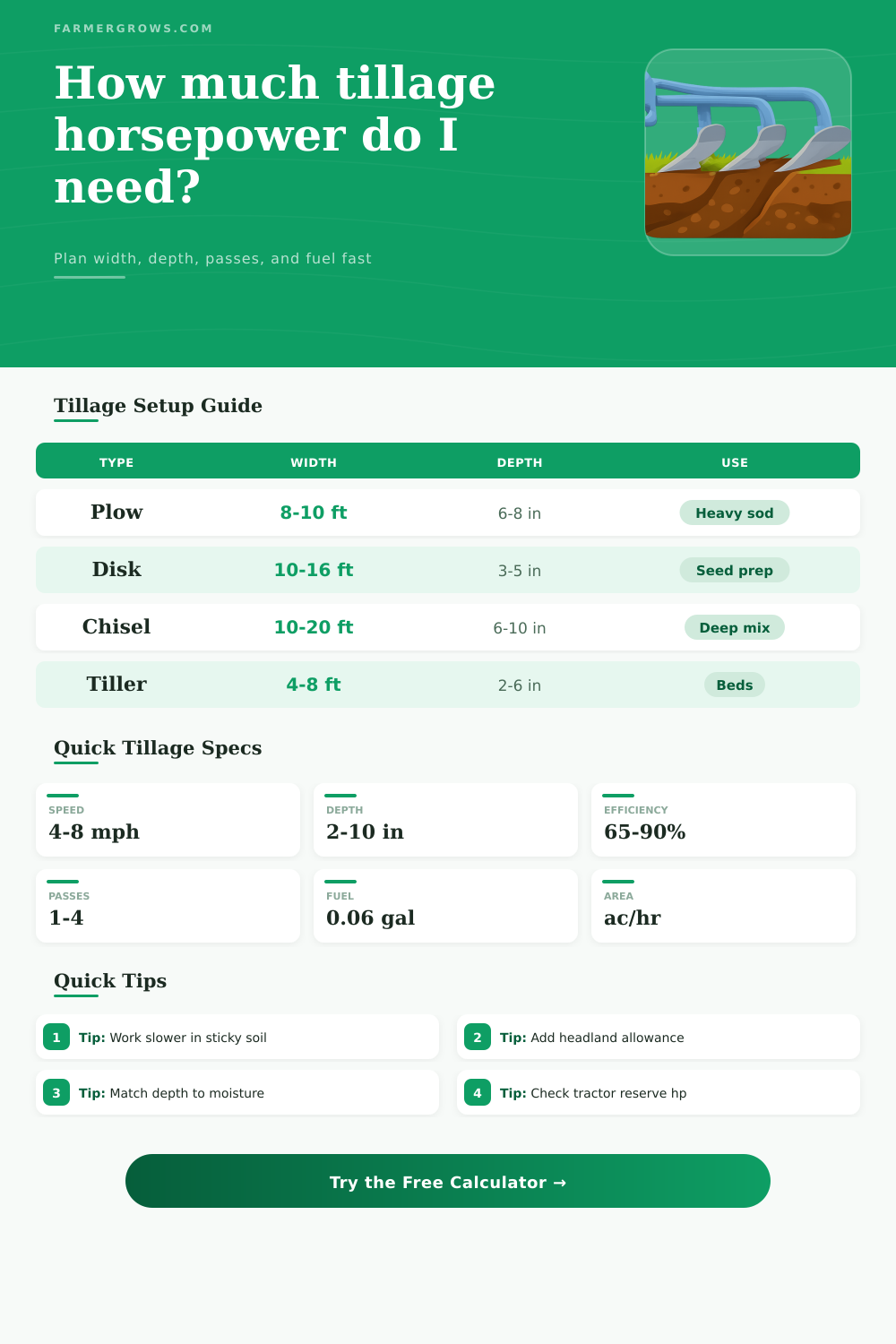
| Preset | Width | Depth | Typical use |
|---|---|---|---|
| Moldboard plow | 7.5 ft | 7 in | Heavy sod |
| Offset disk | 14 ft | 4 in | Residue mix |
| Chisel plow | 18 ft | 8 in | Deep loosen |
| Subsoiler | 10 ft | 14 in | Hardpan break |
| Rotary tiller | 6 ft | 5 in | Garden beds |
Tillage involve several variables that have to be taken into account when planning to till a field with a tractor. When performing tillage, four main variable to consider are draft force, speed, fuel consumption and field efficiency. If these variables isnt considered and the tillage implement isnt appropriately matched with the tractor, that implement will consume more fuel and the tillage will be inefficiently.
Draft force is a variable that must be considered when planning tillage operation. Draft force is the resistance that a tractor must overcome while tillage operations is performed, and it is measured in pound or kilonewtons. Implement manufacturers indicate the draft force that is required for their implements.
Things to Think About When Tilling a Field
For instance, implements like moldboard plows require more draft force than implements like a harrow. Additionally, soil condition can impact the amount of draft force that is required. For instance, clay soil require more draft force than sandy soils.
Speed is another variable for tillage operations. Speed impacts the power that the tractor draws. For instance, higher speed for tillage operations require more power to draw from the tractor.
Therefore, heavy residue in fields can require a reduction of the speed at which the tractor performs tillage operations. Field efficiency is a measurement of the amount of work that is performed during a certain amount of time. Field efficiency will be lower than theoretical maximum value due to time that is required for the tractor to turn at the headlands of the fields.
Two more factors to consider when planning tillage operations are drivetrain losses and headland allowance. Drivetrain losses are inevitable for tillage implements; only eighty-five percent of the power from the tractors engine reaches the drawbar of the implement. Finally, headland allowances are required for tillage operations; headlands are the areas of the fields in which a tractor must turn.
By adding headland allowances to tillage calculation, a person can accurately calculate the number of hours that will be required to complete the tillage operations. Fuel consumption for tillage operations is related to the amount of work that the tractor performs. As the amount of horsepower that is required to till a field increase, fuel consumption will increase as well.
You can estimate fuel for tillage operations by calculating the time that the tractor will spend till tillage and the amount of horsepower that will be used. Additionally, the tractor also consumes fuel while idling at the headlands. Thus, idling time should of also be included in estimates for fuel consumption for tillage operations.
Soil volume is another variable to consider in tillage operations. Soil volume is the total amount of soil that is to be moved in tillage operations. The volume of soil can be calculated by multiplying the area of the field by the depth of the tillage operations.
Deep tillage operations will move more soil than shallow tillage operations. Additionally, deeper tillage operations will require more draft force and fuel to perform those operations. Finally, moving large amount of soil may lead to soil erosion if the soil is not covered by crop residue.
Soil moisture and soil residue can impact the tillage operations for a field. Soils with high moisture content will require more draft force to till than dry soil because wet soils are harder to till. Tillage operations on soils that are too moist will increase draft force requirement for the tillage operations and decrease field efficiency.
Additionally, soil residue can impact tillage operations. Soils with high level of residue will require more draft force for tillage operations. However, crop residue may prevent soil from being compacted during tillage operations.
The correct tillage method must be selected according to the soil that will be tilled and the goal for that soil. Deep primary tillage operations such as using a chisel plow will break up deep soil compaction; however, deep primary tillage operations require large tractor that use more fuel. Shallow secondary tillage operations such as using a disk implement are faster to perform and use less fuel; however, they do not break up deep soil compaction.
Each type of soil will respond differently to tillage operations; sandy soil will respond differently to tillage than clay soil. Finally, the time of year that tillage operations are performed can have an impact on those operations. In the fall, soils can be tilled and frost can help to loosen the soil.
Fall tillage operations may be more efficient than spring operations. Spring soils can be wet with moisture from the winter and spring rains. If tillage operations are performed in the spring, care must be taken to ensure that the soil isnt too wet for the tillage operations because wet soil will require increased draft force to till the soil; additionally, wet soil can become compacted.
Thus, considerations of draft force, speed, soil moisture content, fuel consumption and soil residue will allow a farmer to effective plan his tillage operations.