Sprinkler Precipitation Rate Calculator
Estimate irrigation application rate from sprinkler spacing and nozzle flow, then compare it with catch can results, distribution uniformity, crop need, and soil infiltration.
Use the calculated rate for early design checks and the catch can rate for scheduling once the zone is running. Recheck after nozzle swaps, pressure changes, repairs, or seasonal wind shifts.
Sprinkler precipitation snapshot
Calculated rate, measured catch can rate, uniformity, and runtime will appear here.
| Soil intake profile | Typical intake | Metric rate | Scheduling note |
|---|---|---|---|
| Sand or loamy sand | 0.75-1.50 in/hr | 19-38 mm/hr | Shorter, more frequent sets usually fit best. |
| Sandy loam | 0.50-1.00 in/hr | 13-25 mm/hr | Moderate rates work when surface cover is good. |
| Loam | 0.35-0.65 in/hr | 9-17 mm/hr | Watch compaction and crusting after tillage. |
| Silt loam | 0.25-0.50 in/hr | 6-13 mm/hr | Cycle and soak helps avoid surface sealing. |
| Clay loam | 0.15-0.35 in/hr | 4-9 mm/hr | Use lower rates or split runtime. |
| Clay or compacted clay | 0.08-0.20 in/hr | 2-5 mm/hr | High runoff risk with spray heads. |
| Sprinkler type | Common spacing | Typical rate | Field use |
|---|---|---|---|
| Fixed spray head | 8-15 ft | 1.2-2.0 in/hr | Small turf, beds, narrow strips. |
| Rotary nozzle | 12-24 ft | 0.35-0.80 in/hr | Retrofits where runoff is an issue. |
| Gear rotor | 25-45 ft | 0.25-0.75 in/hr | Lawns, parks, and sports turf. |
| Impact sprinkler | 35-70 ft | 0.20-0.60 in/hr | Pasture, hay, orchards, and frost sets. |
| Wobbler or spinner | 10-35 ft | 0.30-1.20 in/hr | Market gardens, nurseries, and cooling. |
| Traveler or gun pass | Lane based | 0.20-1.00 in/hr | Large fields with moving application. |
| Target depth | At 0.25 in/hr | At 0.50 in/hr | At 0.75 in/hr |
|---|---|---|---|
| 0.25 in / 6 mm | 60 min | 30 min | 20 min |
| 0.50 in / 13 mm | 120 min | 60 min | 40 min |
| 0.75 in / 19 mm | 180 min | 90 min | 60 min |
| 1.00 in / 25 mm | 240 min | 120 min | 80 min |
| 1.25 in / 32 mm | 300 min | 150 min | 100 min |
| 1.50 in / 38 mm | 360 min | 180 min | 120 min |
| DU low-quarter | Rating | Scheduling adjustment | What to check |
|---|---|---|---|
| 85% or higher | Excellent | Small adjustment | Maintain pressure and nozzle match. |
| 75-84% | Good | Moderate adjustment | Look for clogged nozzles or wind exposure. |
| 65-74% | Fair | Noticeable adjustment | Check spacing, pressure, and arc coverage. |
| 55-64% | Poor | Large adjustment | Repair before long irrigation sets. |
| Below 55% | Very poor | Not reliable | Redesign or rebuild the zone. |
Tip: Use a catch can test when pressure changes, a pump screen plugs, or a nozzle package is replaced. The measured rate should control runtime once the zone is built.
Tip: If precipitation rate is higher than the soil intake rate, split the same total runtime into two or three cycles with soak time between starts.
When you are planning an irrigation system for your crops, you have to look at many different factor. You could focus on the irrigation system hardware, but the most important measurement is a precipitation rate. The precipitation rate is the rate at which the water that come from your irrigation system lands on the ground.
This rate will dictate whether the plants in the area recieve enough water or whether the water gets wasted due to runoff. If you calculate the precipitation rate proper for each zone, your irrigation system will function smooth. Calculating it incorrectly will result in some area being too dry or too soggy for the crops in those zones.
How to calculate the precipitation rate for irrigation
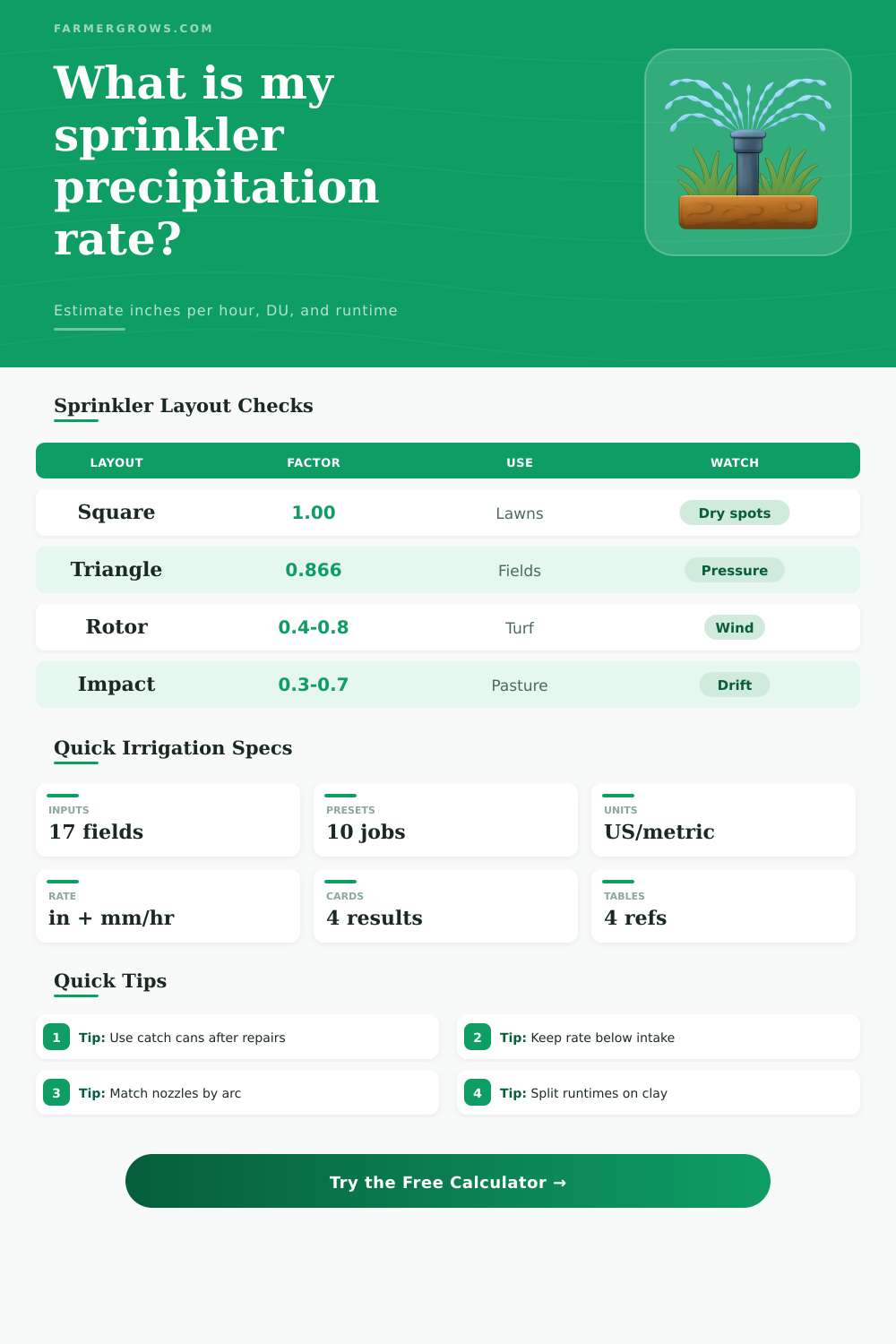
The precipitation rate will change according to the nozzle’s flow rate, the spray pattern of the nozzles, and the way that the sprinkler heads is spaced. For square layouts of sprinkler heads, the water will land on the ground in a rectangular grid. These layouts are easy to design with irrigation programs and layouts.
However, the areas diagonally to the sprinkler heads will be vulnerable to the wind. For triangular layout spacings, there will be more overlap in how the sprinkler heads releases water. Due to this increased overlap, the precipitation rate will be increased.
By entering the spacing between the sprinkler heads and the flow rate of each of the nozzles into a calculator, that device will be able to remove the guesswork regarding the area that each sprinkler head will water. Furthermore, if some of the sprinkler heads are part-circle nozzles, the calculator can also adjust the rate to account for this feature of the nozzles. Another important factor in irrigation system design is soil intake.
This is another factor that is just as important as the sprinkler heads’ output. Soil intake will determine how much water your soil can take in. Sandy soil will absorb water quite quick, but clay will absorb a small amount of water per hour.
If the sprinklers are set to apply water at a faster rate than the soil can absorb it, the water will spread sideways across the soil instead of going into the ground. The irrigation system design software can ask for the soil profile of the fields where the crops are grown. Based off the slope of the land, the software will adjust for soil intake.
If the precipitation rate is higher than the soil’s intake rate, the software will flag this and offer a suggestion of shorter irrigation cycles with soak period between each irrigation cycle. Another way to determine the theoretical precipitation rate is to perform a catch can test. For this test, you will have to lay out irrigation cups in your fields.
You will run the irrigation system for a specific duration and measure how deep the water was in each cup. Based on these measurements, the irrigation system design software will calculate the average application rate for the sprinkler system and the distribution uniformity of the system. The distribution uniformity tells you the difference between the driest part of the fields and the average depth of water at any point in the fields.
If the distribution uniformity is low, the effective precipitation rate of the system will also be low. To ensure that the fields do not become dry spots due to this low rate, the design software will lengthen the runtime of the irrigation system. The third important factor is the amount of water that each crop require.
Different crops will need different amounts of water. Vegetables with shallow roots may require more light and frequent irrigation than crops like pastures or orchards. This rate can also be entered into the irrigation system design software.
The software will compare the depth of water that is entered to how much water the soil will hold. The software will flag any suggestion of too light or too heavy an irrigation schedule for each of the field with these crops. While the irrigation system design software will calculate the irrigation requirements for these crops, the software does not replace the need for agricultural expert to observe the crops in their fields.
A series of reference tables are included with the irrigation system design software. These tables show the performance of different types of sprinklers at different spacings. Another table within the software allows the user to see how the soil intake will differ according to soil texture.
Additionally, another important reference table will show the lowest distribution uniformity for each sprinkler system before the irrigation zones will need to be redesigned. These tables give the irrigation designer the information necessary to find context for their irrigation system for the field. Rather than memorizing the different coefficients, these tables can be referenced to determine how the sprinklers will perform in the fields.
In order to use the irrigation system design software, you must understand what each input field represent. The spacing of the sprinkler heads will determine how much ground each nozzle must cover. The flow rate of the nozzles, when divided by the area that they water, will determine the precipitation rate.
Finally, soil intake will change based on how the fields slope and how the soil in those fields becomes compacted. It is easy for many irrigation designers and farmers to make mistakes during the planning of irrigation zones. For example, many individual will find sprinkler nozzles with specific flow rates.
However, many will forget that if the sprinkler heads are set up in a triangular layout, the precipitation rate will be increased due to the overlapping water from each sprinkler head. Additionally, many irrigation designers will set an irrigation time for their fields based on how long it worked in the past for that particular field. However, the distribution uniformity of the sprinkler heads may have evened out due to wear and tear on the sprinklers.
Other irrigation designers will use the same runtime for all of the zones within the same property. However, this is a mistake if some zone have clay soil and other zones have sandy soil. Although the irrigation system design software will determine the runtime that each zone will run for, it will not fix the irrigation issues caused by a poorly designed irrigation system.
When you know the precipitation rate of each zone within the irrigation system, the catch can test results, and the adjusted runtime determined by the irrigation system design software, you will be able to make decisions regarding irrigation. You will know the rate at which the sprinklers will deliver water to the fields. Additionally, you will know the amount of time that you will have to add to compensate for the distribution uniformity of the sprinklers.
Finally, you will also know if the crops in each zone require the amount of water that you have programmed into the irrigation system design software. By knowing these variables, the irrigation designer can turn the irrigation process into a repeatable process while also respecting both the irrigation equipment and the land itself.