Sprayer Pump Calculator
Calculate required pump flow rate, system pressure, horsepower, and the right pump type for your boom sprayer
✅ Pump Sizing Results
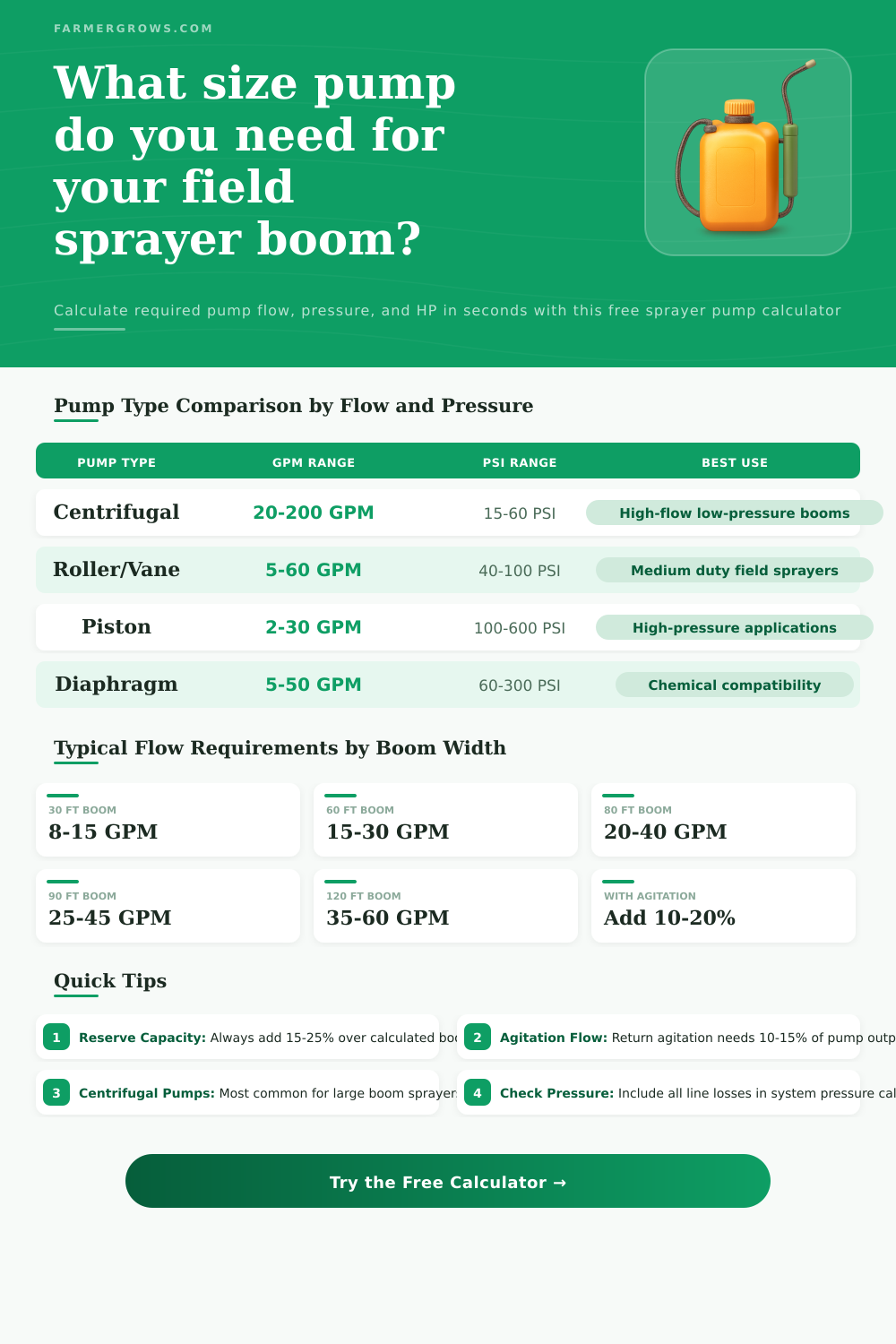
| Pump Type | GPM Range | PSI Range | Best Use |
|---|---|---|---|
| Centrifugal | 20–200 GPM | 15–60 PSI | High-flow, low-pressure large booms |
| Roller / Vane | 5–60 GPM | 40–100 PSI | Medium-duty field sprayers |
| Piston | 2–30 GPM | 100–600 PSI | High-pressure spot sprayers |
| Diaphragm | 5–50 GPM | 60–300 PSI | Chemical-resistant applications |
| Gear | 5–40 GPM | 50–150 PSI | PTO-driven medium pressure |
| Boom Width | Nozzles (20" spacing) | Boom GPM (0.3 GPM) | With 15% Agitation |
|---|---|---|---|
| 30 ft | 18 | 5.4 GPM | 6.2 GPM |
| 40 ft | 24 | 7.2 GPM | 8.3 GPM |
| 60 ft | 36 | 10.8 GPM | 12.4 GPM |
| 80 ft | 48 | 14.4 GPM | 16.6 GPM |
| 90 ft | 54 | 16.2 GPM | 18.6 GPM |
| 120 ft | 72 | 21.6 GPM | 24.8 GPM |
| Pump GPM | HP @ 40 PSI | HP @ 60 PSI | HP @ 80 PSI |
|---|---|---|---|
| 10 GPM | 0.6 HP | 0.9 HP | 1.2 HP |
| 20 GPM | 1.2 HP | 1.8 HP | 2.5 HP |
| 30 GPM | 1.8 HP | 2.6 HP | 3.5 HP |
| 50 GPM | 3.0 HP | 4.4 HP | 5.9 HP |
| 75 GPM | 4.4 HP | 6.6 HP | 8.8 HP |
| 100 GPM | 5.9 HP | 8.8 HP | 11.7 HP |
Purchasing the correct sprayer pump are a necessary task for any farmer who utilize sprayer pumps to apply chemicals to there fields. The size of the sprayer pump that a farmer purchases will have a significant effect upon the effectiveness of the chemical application process. If the sprayer pump that is purchased is too small for the chemicals that is to be applied to the fields, the sprayer pump will not be able to provide enough liquid to the boom to provide even coverage of the fields.
If the sprayer pump that is purchased is too large for the needs of the spraying process, the sprayer pump will create excess foams within the tank, and will consume more of the tractors horsepower than is required to perform the task. A sprayer pump calculator can help a farmer to determine the flow, the pressure, and the horsepower requirements for the sprayer pump that should be purchased for their needs. The farmer can calculate the flow rate of the sprayer pump from the number of nozzle of the boom, and the desired pressure of those nozzles.
How to Choose the Right Sprayer Pump
The flow rate requirements may need to be increased if the chemical tank is agitated to prevent the chemicals from settling at the bottom of the tank; agitation of the tank returns 10% of the sprayer pumps output, and this 10% must be accounted for in the calculation of the flow rate. The pressure requirements for the system must also be calculated, because there will be a loss of pressure through the hoses of the sprayer system, at the fittings of the system, and due to the elevation of the boom relative to the tractor. The calculated pressure requirements may need to be increased by 15% to 25% to allow for these loss.
If not accounted for, the pressure at the nozzles may drop to the point that the chemical droplets exit the nozzles as a mist rather than droplet. The horsepower requirements of the sprayer pump can be determined using the flow rate of the system, and the pressure of the sprayer pump. A farmer can calculate the required horsepower by multiply the flow rate of the system by the pressure of the sprayer pump, and dividing that value by 1714 times the efficiency of the sprayer pump.
The efficiency of the sprayer pump is a variable in that efficiency decrease with the age of the sprayer pump, as well as with any instances of cavitation within the sprayer pump. When selecting a sprayer pump using the calculator, one can account for the efficiency of the sprayer pump. There are different type of sprayer pumps that is available for farmers, and each type can be used in different tasks.
Centrifugal sprayer pumps are used for high volume applications at low pressures (under 60 PSI); centrifugal pumps can move between 20 and 200 gallon of liquid per minute. Roller and vane pumps are used for medium-duty task; roller and vane pumps are self-priming and can handle pressures of 100 PSI. Piston and diaphragm pumps are used for high pressures (above 100 PSI); piston and diaphragm pumps can handle high pressures, and often corrosive chemicals.
Gear pumps are typically used in PTO (power take-off) setups that requires a steady push from the sprayer pump. A person must be careful to not ignore the relationship between nozzle flow and nozzle pressure. If a person increases the pressure at a nozzle, the flow rate of liquid that emerges from that nozzle will increase, as well.
For example, if the pressure at a nozzle is increased from 40 PSI to 60 PSI, the flow rate at that nozzle may increase 20%. Thus, a farmer needs to be sure to review all of the specification of nozzles if they are to change the pressure at which the chemicals are dispensed from those nozzles. Additionally, the sprayer pump must be primed prior to use; centrifugal pumps, for instance, will not work well if there is air within the sprayer pump.
Finally, a farmer uses these calculated values to purchase a sprayer pump that will meet the needs of their sprayer and boom. The calculations can reveal the amount of gallon per minute that are required, based off the width of the boom. The calculations can reveal the horsepower requirement of a sprayer pump based upon the horsepower of the tractor; tractors may lose some of their horsepower pushing the sprayer pump.
Thus, selecting the correct sprayer pump will allow that sprayer pump to distribute the chemicals more even across the fields, and for the sprayer pump to function correctly during the growing season.