🌿 Sprayer Boom Height Calculator
Find the optimal boom height for uniform spray coverage based on nozzle angle, spacing & overlap pattern
| Nozzle Angle | 15 in Spacing | 20 in Spacing | 30 in Spacing | 40 cm Spacing | 50 cm Spacing |
|---|---|---|---|---|---|
| 65° | 16.1 in | 21.5 in | 32.2 in | 33.8 cm | 42.3 cm |
| 80° | 10.7 in | 14.2 in | 21.3 in | 28.4 cm | 35.5 cm |
| 95° | 8.0 in | 10.7 in | 16.1 in | 21.4 cm | 26.7 cm |
| 110° | 5.6 in | 7.5 in | 11.2 in | 15.0 cm | 18.7 cm |
| 120° | 4.3 in | 5.8 in | 8.7 in | 11.5 cm | 14.4 cm |
| 130° | 3.2 in | 4.3 in | 6.4 in | 8.6 cm | 10.7 cm |
| Coverage Pattern | 15 in Spacing | 20 in Spacing | 30 in Spacing | Notes |
|---|---|---|---|---|
| Single (100%) | 5.6 in | 7.5 in | 11.2 in | Standard herbicides |
| Double (200%) | 2.8 in | 3.7 in | 5.6 in | Fungicides / insecticides |
| Triple (300%) | 1.9 in | 2.5 in | 3.7 in | Critical applications |
| Nozzle Type | Typical Angle | Pressure Range | Drift Risk | Best Use |
|---|---|---|---|---|
| Flat Fan | 80°–120° | 15–60 psi | Medium | Herbicides, general |
| Even Flat Fan | 80°–120° | 15–40 psi | Medium | Boomless, band spray |
| Flood Jet | 110°–145° | 5–25 psi | Low | Fertilizer, soil-applied |
| Twin Flat Fan | 2 x 110° | 20–60 psi | Medium | Pre/post emergent |
| TurboDrop | 90°–110° | 20–60 psi | Very Low | Drift-critical apps |
| Hollow Cone | 60°–80° | 30–100 psi | High | Fungicides, insecticides |
| Full Cone | 60°–120° | 20–80 psi | Medium | Soil incorporation |
| Air Induction | 110°–120° | 20–60 psi | Very Low | Windy conditions |
| Wind Speed | Drift Risk | Boom Height Adjustment | Recommendation |
|---|---|---|---|
| 0–3 mph (0–5 km/h) | Very Low | None needed | Ideal conditions |
| 3–7 mph (5–11 km/h) | Low–Medium | Lower by 1–2 in | Acceptable, monitor |
| 7–10 mph (11–16 km/h) | Medium–High | Lower by 2–4 in | Reduce height & speed |
| >10 mph (>16 km/h) | High | — | Stop spraying |
Getting the right height of the boom on a sprayer is not that easy as you could believe; it is quite important for good coverage. If the boom stands too high, the spray drifts and does not hit the target, what results in patchy, uneven application Modern sprayers have adjustable booms. The users can adapt the height according to the crop they treat and the conditions they use on any day.
The arms of the boom extend from the main body of the sprayer and hold the nozzles in the right height for the application. How long and wide they must be depend on the area that you want to cover. Most boom sprayers have several spray nozzles arranged equally along every arm, all directed strait down to what you spray.
How to Set the Right Boom Height on a Sprayer
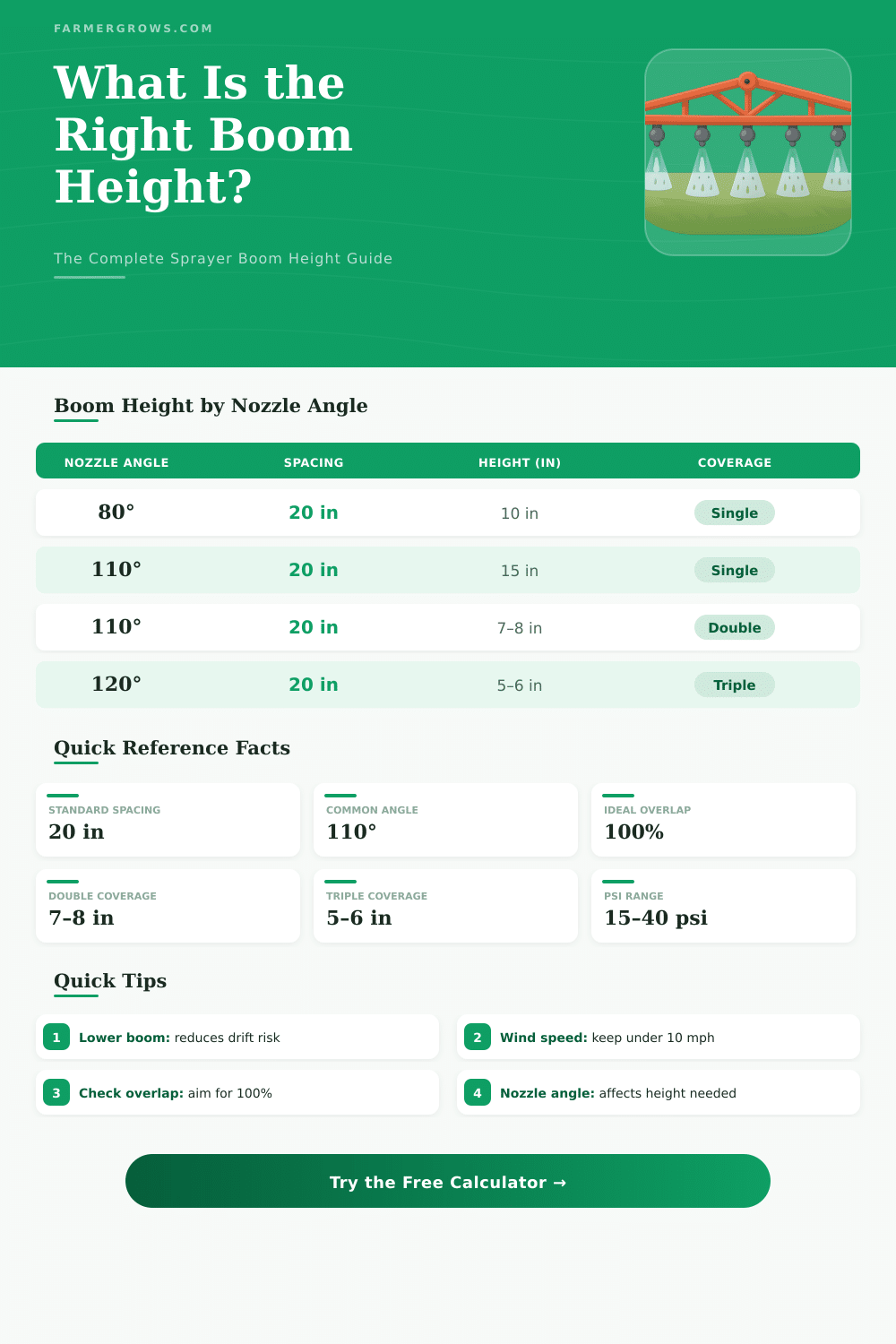
The angle of your nozzles induces a lot about the height of the boom. For instance, an 80-degree nozzle operates best at 30 inches above the target if you want full 100 percent overlap. Those 20-inch distances between nozzles came from old standards that bound boom height, fan angle and pace.
Before, when 80-degree nozzles were usual, you had to keep the boom around 20 inches high for that overlap. The ideal is that the spray cones of neighboring nozzles cross half way down until the target surface. You intend that that spot of overlap hit correctly the top of the weeds or plants that you treat.
Uneven soil, motion of the boom and vibrations all disrupt where the spray doses fall relative to the exit from the nozzle. For good cover and control the drifts, choose boom length and travel speed that match your ground conditions. Some users lay drop nozzles more down in the plant roof, that helps to exactly target and reduce drifts.
At the gear, care that your tubes and links are right sized for the flow that your pump issues through all those nozzles.
Imagine a corn farmer that must spray herbicides between the rows. The operation depends on boom height, row spacing, plant height and herbicide type, everything relates. An adjustable boom with range intervals between nozzles could be exactly the best solution for such a case.
Now technology helps with automatic control of boom height. Some systems use ultrasonic sensors along the spray booms for permanently control and keep fixed height above the soil or crop. The advantages are clear: more uniform spray cones, better coverage, fewer problems with drifts.
Radar systems also operate for precise distance between nozzles and ground. You can find simple versions for little booms until around 100 feet on flat land, and high-end for almost every sprayer. From my experience, manually alter the boom height is not rocket science, although results range when automatic systems meet difficult territories.
Keeping the booms as low as possible, while you get the needed coverage, usually give the best result. Wind however casts everything in confusion; strong gusts during the application can ruin your spray independent of the height that you chose.