🚧 Box Culvert Weight Calculator
Estimate precast box culvert segment weight, total project mass, and lift planning before delivery or set.
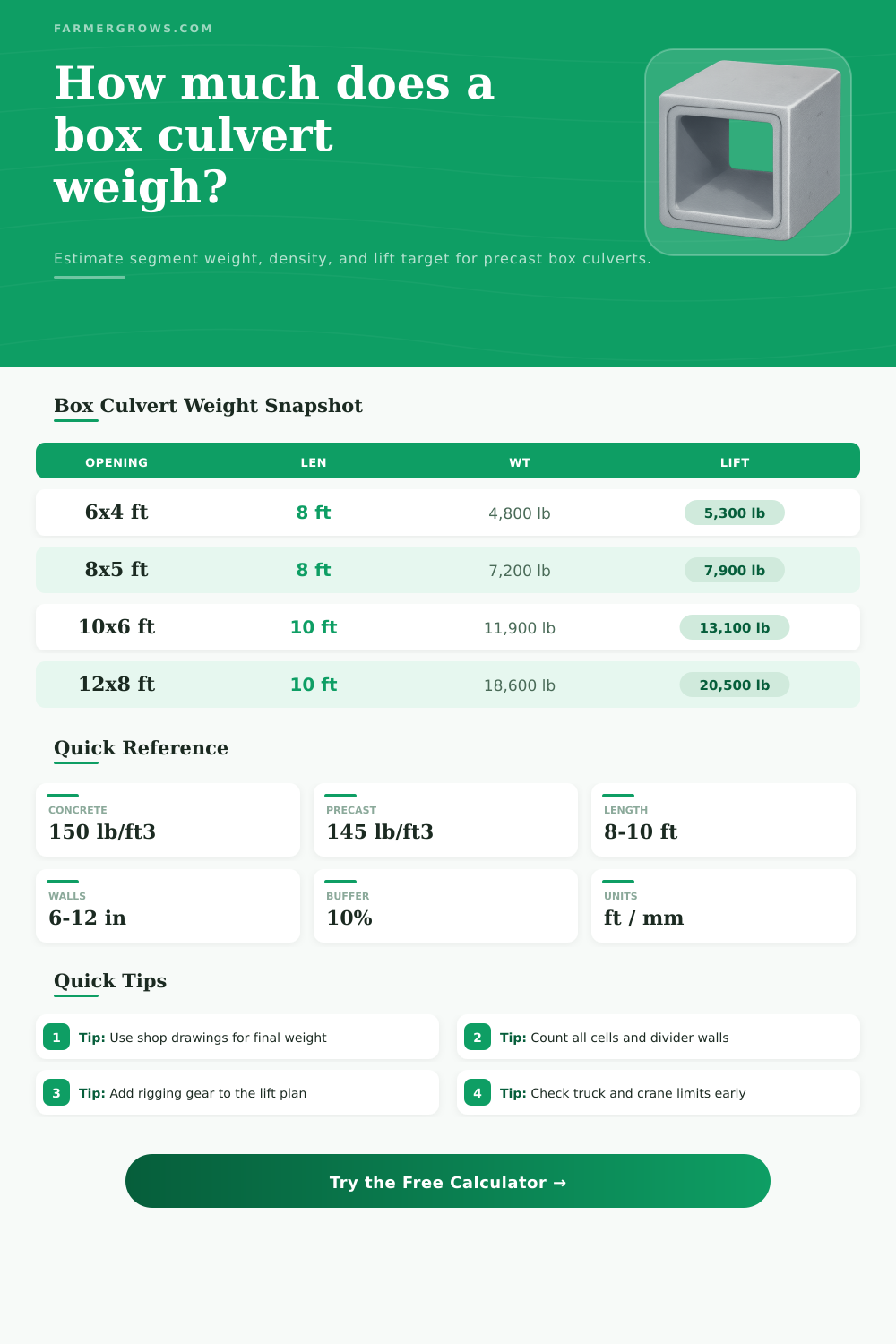
Calculated Segment Weights
These values reflect the selected dimensions, material density, and lift allowance.
| Clear opening | Length | Approx wt | Note |
|---|---|---|---|
| 6 x 4 ft | 8 ft | 4,800 lb | Single cell |
| 8 x 5 ft | 8 ft | 7,200 lb | Daily use |
| 10 x 6 ft | 10 ft | 11,900 lb | Heavy pick |
| 12 x 8 ft | 10 ft | 18,600 lb | Rigging plan |
| Pick size | Target | Allowance | Rule of thumb |
|---|---|---|---|
| Light | Under 5 ton | 10% | Small excavator |
| Medium | 5-10 ton | 10% | Truck crane |
| Heavy | 10-20 ton | 15% | Large crane |
| Extra heavy | 20+ ton | 20% | Engineer lift |
Use the certified shop drawing if your culvert has bevels, end walls, or unusual reinforcement. Those details can move the final weight a lot.
Always include slings, shackles, spreaders, and a small buffer in the lift plan so the crane chart stays honest on site.
Precast box culvert are rectangular concrete structures that are used to channel water under roads or paths. Precast box culverts are manufactured in segment in a foundry, then transport to the construction site in those individual segments. Each segment of a precast box culvert have walls, an top slab, and a base slab.
The weight of each segment of a precast box culvert is the volume of the segment times the density of the concrete. Thus, to find the weight, the volume of all of the concrete in the culvert must be determined, which require subtracting the volume of the empty space within the culvert from the total volume of the culvert segments. To determine the weight of a precast box culvert, the dimensions of each segment of the culvert is necessary.
How to Find the Weight of a Precast Box Culvert
For example, the clear width and height of the precast box culvert indicate the dimensions of the empty space within the culvert, since the empty space do not contribute to the weight of the culvert. The thickness of the walls of the culvert indicate the amount of concrete that will go into the precast box culvert. Additionally, the dimensions of the top and base slabs of the precast box culvert must be determined.
Often, the top and base slab contain heavy rebar that will increase the weight of the precast box culvert. Finally, the length of each segment of precast culvert is typically 8 to 10 feet in length, which is the length of most flatbed truck. The density of the concrete is another primary factor in calculating the weight of the precast box culvert.
Standard reinforced concrete have a density of 150 lbs./cu. Ft. In some cases, however, the density of the concrete may be less than 150 lbs./cu. Ft. In these cases, the resulting weight of the precast box culvert will be less than if the concrete had a density of 150 lbs./cu.
Ft. In any case, the density of the precast box culvert should be the same than that specified by the manufacturer of the precast box culvert. Additionally, 10% buffer in the weight estimate may be introduced to account for the weight of the rigging gear that will be used to lift the culvert. Thus, by introducing this 10% buffer to the weight of the culvert, those lifting operations will be ensured to have sufficient lifting power to lift the culvert.
Multi-cell precast box culverts are precast box culvert segments that have multiple voids within the segment. For example, a twin cell precast box culvert has two voids within the segment; each void have dimensions that are the same as the precast box culvert segment, but there is an additional divider wall that separates the two voids. The addition of this divider wall increases the total weight of the twin-cell precast box culvert in comparison to a single-cell precast box culvert segment of the same size.
Thus, to determine the total weight of a precast box culvert segment that has multiple voids within the segment, the volume of each void within the segment must be accounted for, as well as the volume of each of the walls and slabs of the precast box culvert segment. The weight of a precast box culvert will dictate the type of lifting machinery that will be required to lift the precast culvert segment. For example, if the weight of the segment of precast box culvert is less than 5 tons, it may be possible to utilize an excavator to lift the precast box culvert.
However, if the precast box culvert segments weigh between 10 and 20 tons, a truck crane will be required to lift the culvert segments. Finally, if the weight of the precast box culvert segments is more than 20 tons, an all-terrain crane will be required to lift the precast box culvert segments. In addition to determining the lifting machinery, it is also necessary to calculate the weight of the precast box culvert segments to determine the weight of each of the trucks that will be used to transport the culvert segments to the construction site.
The weight of each segment will determine the number of axles that each truck will have, and the type of permit are required for each type of truck. Should any of the calculations that determine the weight of the precast box culvert segments make errors in calculating the total weight of the precast box culverts, those errors could lead to problems in lifting the precast box culvert segments. For example, if the calculation of the weight used the dimensions of the outside of the precast box culvert segments to calculate the dimensions of the empty space within the precast box culvert, the calculated volume of the empty space will be incorrect.
Thus, the calculated weight will be higher then the actual weight of the precast box culvert segments. Additionally, it is also possible that the weight of the divider walls between the voids within the precast box culvert segments were not accounted for in the calculation of the total weight of the segment. In these instances, it is best to use the shop drawings of the precast box culvert to ensure the accuracy of the dimensions of the precast box culvert.
Beyond the calculations of the weight of the precast box culvert segments, there are additional factors that must be considered in lifting the precast box culvert segments. For example, the strength of the wind at the site where the precast box culvert segments are to be lifted may reduce the lifting strength of the crane that will be used to lift the precast culverts. Additionally, it is possible that the ground at the construction site is too soft for the outriggers of the crane to remain stable on the ground.
In these cases, mats will have to be placed under the outriggers of the crane. Finally, it is also necessary to confirm the sequence in which the precast box culvert segments will be installed. For example, if the segments of a precast box culvert that will be placed at the base of the culvert have a different weight than the segments that will be placed at the top of the culvert, those difference must be taken into account when lifting the culvert segments.