Soil Texture Calculator
Classify a soil by sand, silt, and clay, then estimate water storage and drainage. Use a preset or fine-tune the mix to see how the texture shifts in the USDA triangle.
Pick a realistic profile to seed the inputs. Each preset sets the mineral mix, organic matter, gravel content, bulk density, sample depth, and moisture state.
Texture results
Normalized to the fine-earth fraction, with storage and drainage adjusted by organic matter, gravel, bulk density, and moisture state.
| Class | Sand | Silt | Clay | Typical note |
|---|---|---|---|---|
| Sand | 85-100 | 0-15 | 0-10 | Single grain |
| Loamy sand | 70-90 | 0-30 | 0-15 | Loose and quick |
| Sandy loam | 43-85 | 0-50 | 0-20 | Gritty garden soil |
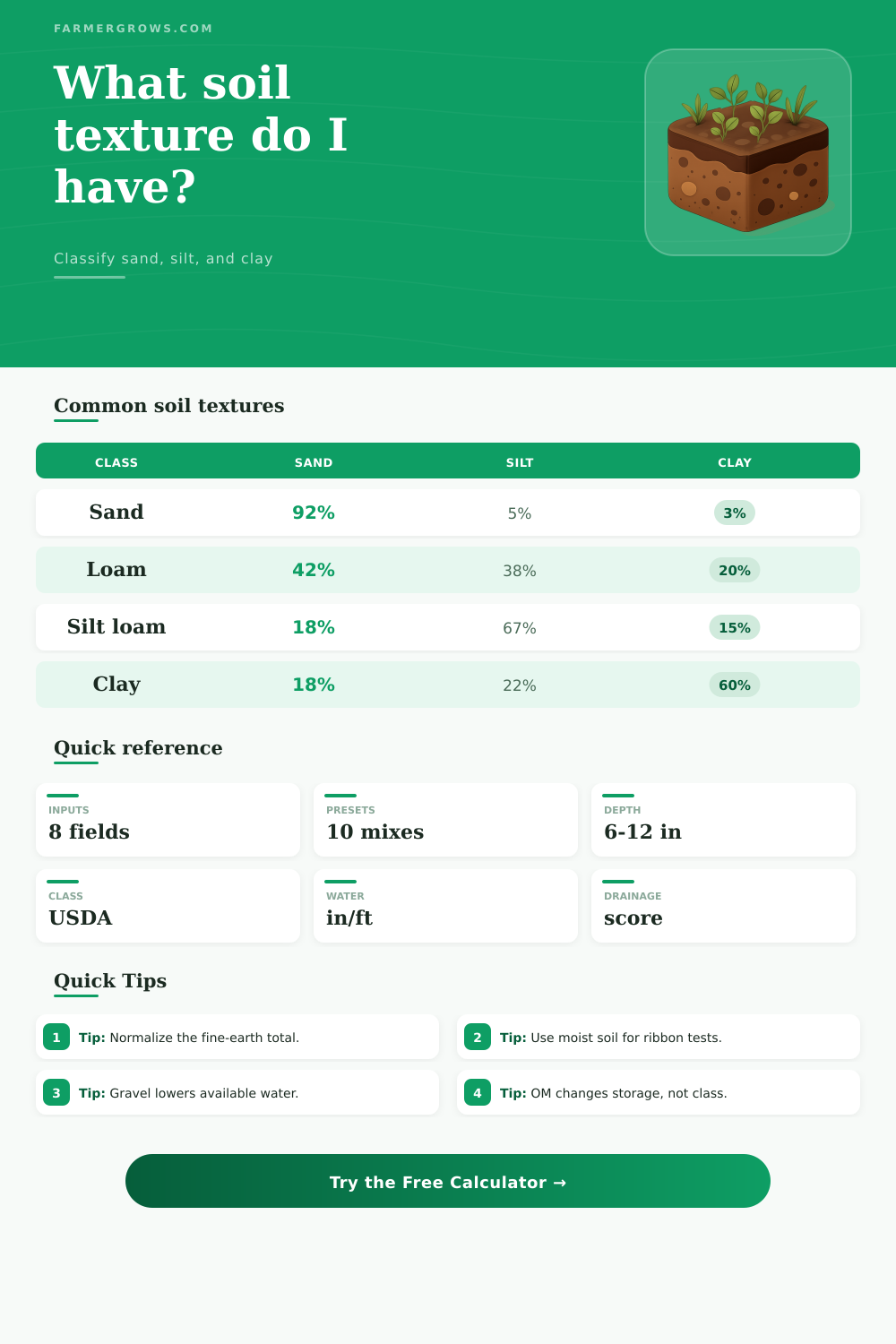
| Loam | 23-52 | 28-50 | 7-27 | Balanced benchmark |
| Silt loam | 0-50 | 50-88 | 0-27 | Smooth, moist |
| Silt | 0-20 | 80-100 | 0-12 | Silky and fine |
| Sandy clay loam | 45-80 | 0-28 | 20-35 | Gritty but sticky |
| Clay loam | 20-45 | 15-53 | 27-40 | Firm, fertile |
| Silty clay loam | 0-20 | 40-73 | 27-40 | Smooth ribbon |
| Sandy clay | 45-65 | 0-20 | 35-55 | Dense, gritty |
| Silty clay | 0-20 | 40-60 | 40-60 | Very sticky |
| Clay | 0-45 | 0-40 | 40-100 | Cracks on dry |
| Separate | Size range | Feel | Behavior |
|---|---|---|---|
| Sand | 2.0-0.05 mm | Gritty | Drains fast |
| Silt | 0.05-0.002 mm | Silky | Compacts easily |
| Clay | <0.002 mm | Sticky | Holds water, nutrients |
| Rock frags | >2 mm | Coarse | Not part of texture |
| Moist sample clue | Likely class | What it suggests |
|---|---|---|
| No ribbon, gritty | Sand / loamy sand | Loose, quick drain |
| Short ribbon, slightly sticky | Sandy loam | Good garden mix |
| 1-2 in ribbon, smooth | Loam / silt loam | Balanced moisture |
| Long ribbon, firm | Clay loam | Slow water move |
| Very slick and shiny | Silty clay | High smearing risk |
| Crumbly after drying | Clay | Cracks and clods |
| Texture | Drainage | Water hold | Management note |
|---|---|---|---|
| Sand | Very fast | Low | Irrigate often |
| Sandy loam | Fast | Moderate | Good starter bed |
| Loam | Moderate | Balanced | Best general soil |
| Clay | Very slow | High | Improve structure first |
The calculator uses USDA texture logic, normalized mineral fractions, organic matter, gravel, bulk density, and sample depth to estimate class, storage, and drainage in one quick read.
Soil texture describe the relative proportion of sand, silt, and clay particle in a soil sample. Soil texture determines how water and air will move through the soil. Sand, silt, and clay is the three primary particles in soil texture.
Sand particles are large; the larger than the sand particles, the larger gaps between the particles in the soil, allowing water to move quick through the soil. Clay particles is very small; the smaller the clay particles, the more the particles will hold onto water and nutrients. Silt particles are medium in size; silt particles are larger than clay particles but smaller than sand particles.
Soil Texture and How It Affects Water and Plants
Soils that contain a balanced mixture of sand, silt, and clay particles is called loam soils. Loam soils are considered to be the most desirabler type of soil. Soil texture calculators are available to determine the specific classification of soil samples.
These calculators uses the USDA texture triangle to determine soil classification. To use the calculator, enter the percentage of sand, silt, and clay particles in the soil sample into the calculator. The calculator will provide a soil texture class for the soil sample.
These calculators perform a process call normalization. Normalization ensures the percentages of sand, silt, and clay particles in a soil sample adds up to 100%. Only include measurements of fine-earth particles in soil samples.
Exclude pebbles and gravel. These particles will not impact soil texture or soil behavior. Organic matter can be added to soil to change soil behavior.
Adding organic matter dont change the soil texture class. Adding organic matter allows sandy soil to hold more water. Organic matter allows clay soil to allow air and water to move through the soil.
Soil texture calculators also consider organic matter and bulk density to determine how much water the soil can store. Bulk density measure the compactness of soil. Soil that is highly compacted will hold less water than soil that is not compacted.
Bulk density affect irrigation practices. To determine soil texture without using a soil texture calculator, perform the field-feel test. Field feel test by taking a moist handful of soil and rubbing the soil between you’re fingers.
Soil that feels gritty and does not form a ball has a high sand content. Soil that feels smooth and forms a short, fragile ribbon is likely a silt loam soil. Soil that rolls into a long, flexible ribbon that does not break have a high clay content.
Use a field feel guide to determine soil texture. Drainage score is a measurement of how to manage water in the soil. Drainage score is influenced by soil texture.
Fast drainage mean water will move quickly through the soil. Watering more frequently will be needed for soils with fast drainage scores. When watering soils with fast drainage scores, provide smaller amounts of water to the soil.
Fast drainage scores leads to nutrient leaching. Slow drainage scores indicate slow movement of water through the soil. Slow drainage scores mean soil should not be watered too often.
Excess watering of soils with slow drainage scores can cause root rot in plant. Sandy loam soils and clay loam soils has different drainage scores. Therefore, different watering schedules will be required for these two soil types.
The soil type and the soil management practices to be used in the soil should be selected according to the needs of the plant that will be grown in that soil. Different plants has different preferences for soil texture and nutrients in the soil. An understanding of soil particle size, organic matter, and soil depth can allow for the effective management of soil in agricultural applications.
By using the information provided in this article, soil can be managed in a way that ensures that water and compost are used according to the need of the soil.