
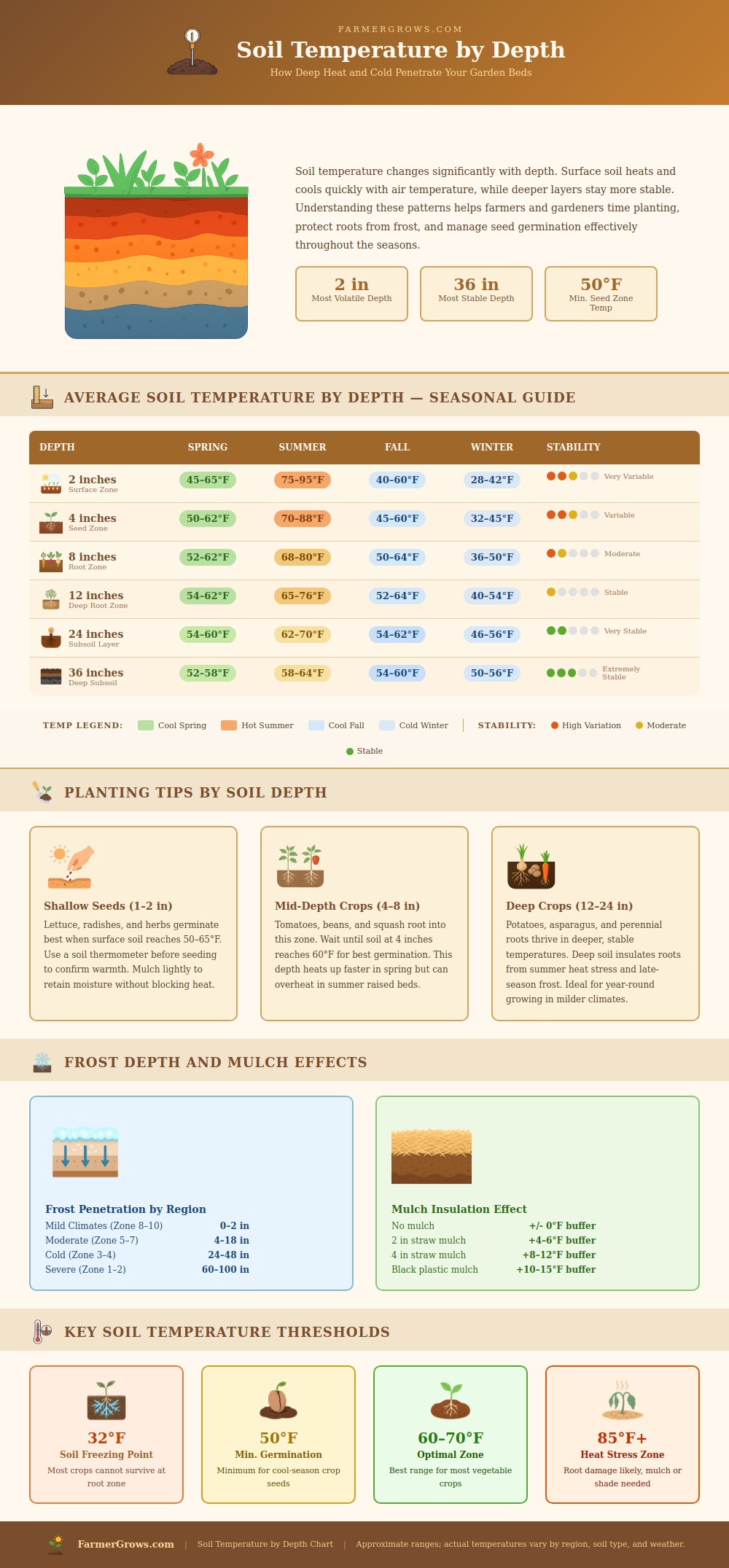
Knowing how the soil warms at different depths really matters for anyone serious about gardening or farming. It helps you decide when to plant, affects the growth of crops and shows what happens in the root zone where it really matters. Learning about the temperature changes as you go deeper can really improve the results of your garden
Most soil thermometers measure the heat at 10 cm depth, although some also check 5 cm. Usually you measure two levels: the surface or bare ground. That 10 cm value above bare soil is used by almost every locall.
How Soil Warms at Different Depths
Here is why that 10 cm standard stayed since the 1960s. It matters more to have the same measures year after year than you think.
Here is why these soil temperatures are useful: they change much more slowly than the air, so they are much more reliable to know what happens where roots live. If the 5 cm depth reaches the germination temperatures for some days, you can plant. Most gardeners wait for spring until the soil warms from 10 to 13 degrees and stays there for at least five days.
For warm grasses like centipede, I found it works best to wait until 10 cm reaches 18 degrees and the grass greens up.
The sun does the main work to warm the ground. That is why the soil temperatures change based on the depth, the top layer heats more quickly than what is below. Right at the surface, it almost follows the air heat above.
Go deep enough however, and the ground stays the same during the whole year. In the center of United States, there is usually around 5 degrees difference between soil and air. My simple trick: take the air temperature and add or subtract 1-2 degrees to estimate the soil.
Daily temperature changes only reach about 40 cm depth. The highest heat here comes 12 hours after the surface peaks and is much less strong. Annual cycles go deeper, until around 4 meters.
The thermal mass of the ground stops fast changes, so the maximum soil heat some meters below comes months after the air peaks.
In more than 3 meters depth the soil temperature almost does not change during the year. Around 10 meters below it becomes the average yearly value for your region. In 15 to 20 meters it stays steady at around 10 to 12 degrees.
Autumn is interesting because the soil cools more slowly than the air, so in winter it is even warmer than the surface. When spring the soil starts to warm, that signals time for seeds, plants or bulbs. Choose the planting depth well, because seeds buried too deep simply won’t emerge.