🌾 Silage Pit Size Calculator
Calculate the exact pit dimensions and volume needed for your silage storage requirements
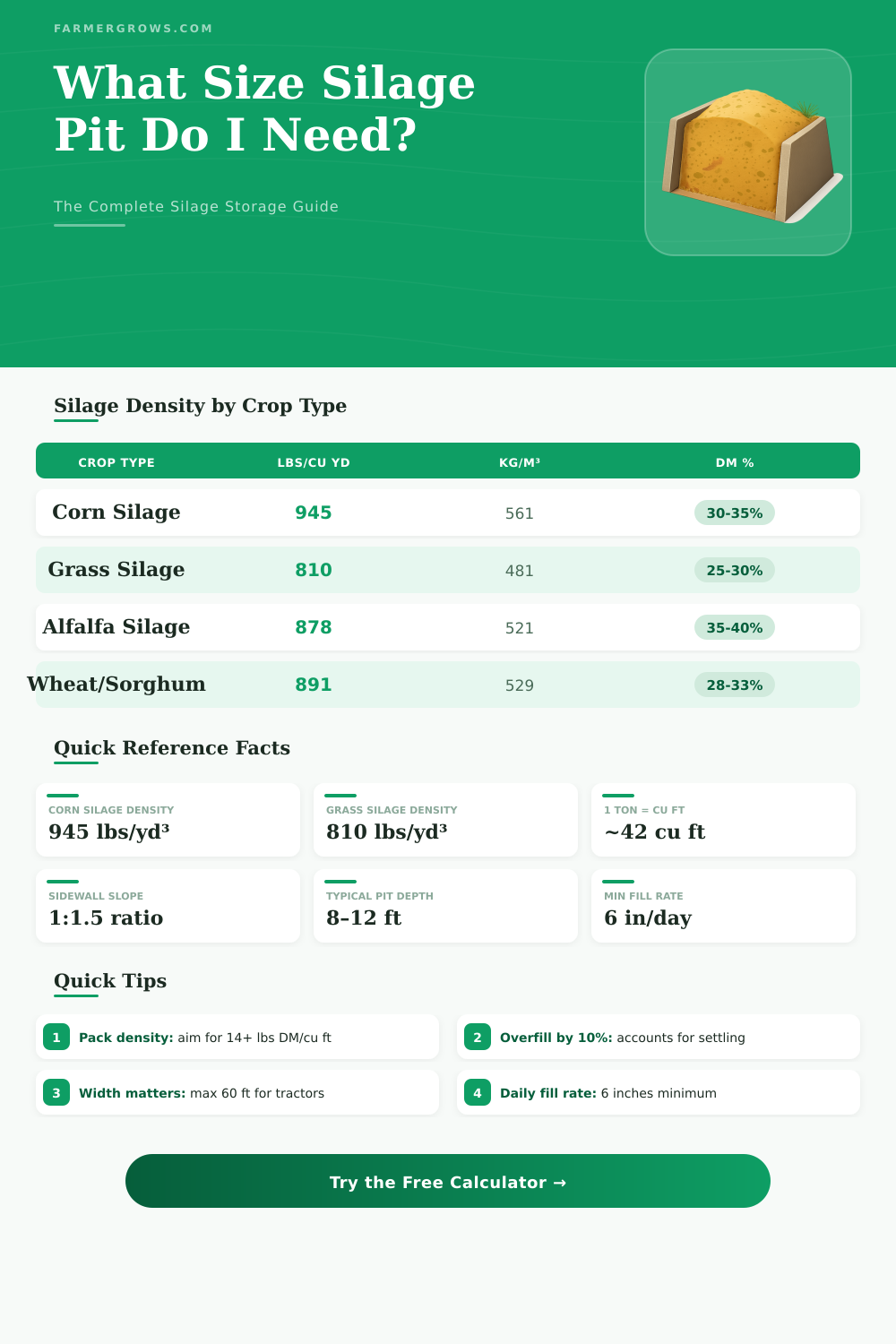
lbs/cu yd
lbs/cu yd
lbs/cu yd
lbs/cu yd
lbs/cu yd
lbs/cu yd
lbs/cu yd
lbs/cu yd
| Depth (ft) | Cu Ft per 1,000 sq ft | Cu Yards per 1,000 sq ft | Cu Meters per 100 m² |
|---|---|---|---|
| 6 ft (1.83 m) | 6,000 cu ft | 222 cu yd | 183 m³ |
| 8 ft (2.44 m) | 8,000 cu ft | 296 cu yd | 244 m³ |
| 9 ft (2.74 m) | 9,000 cu ft | 333 cu yd | 274 m³ |
| 10 ft (3.05 m) | 10,000 cu ft | 370 cu yd | 305 m³ |
| 12 ft (3.66 m) | 12,000 cu ft | 444 cu yd | 366 m³ |
| 14 ft (4.27 m) | 14,000 cu ft | 519 cu yd | 427 m³ |
| Tons AS-FED | Corn Silage (cu yd) | Grass Silage (cu yd) | Alfalfa (cu yd) |
|---|---|---|---|
| 100 tons | 212 cu yd | 247 cu yd | 228 cu yd |
| 250 tons | 529 cu yd | 617 cu yd | 570 cu yd |
| 500 tons | 1,058 cu yd | 1,235 cu yd | 1,141 cu yd |
| 1,000 tons | 2,116 cu yd | 2,469 cu yd | 2,282 cu yd |
| 2,000 tons | 4,233 cu yd | 4,938 cu yd | 4,564 cu yd |
| 5,000 tons | 10,582 cu yd | 12,346 cu yd | 11,416 cu yd |
| Operation Size | Pit Dimensions | Floor Area | Volume @ 10 ft Deep |
|---|---|---|---|
| Small Farm (<50 cows) | 60 x 30 ft | 1,800 sq ft | 667 cu yd |
| Medium Farm (50–150 cows) | 120 x 40 ft | 4,800 sq ft | 1,778 cu yd |
| Large Farm (150–300 cows) | 180 x 55 ft | 9,900 sq ft | 3,667 cu yd |
| Commercial (300+ cows) | 250 x 70 ft | 17,500 sq ft | 6,481 cu yd |
| Beef Feedlot (500 head) | 200 x 60 ft | 12,000 sq ft | 4,444 cu yd |
| Dairy Heifer Unit | 100 x 35 ft | 3,500 sq ft | 1,296 cu yd |
Building silage pits require planning and good organization to preserve the silage well and avoid loss One of the most important things is estimating the size of the pit according to the amount of silage it must store. This avoids many problems later.
For the right pile size, follow step by step. First, decide how many pounds of silage the pile will feed daily. That daily eating amount is key for estimating the right dimensions of the trench.
How to Plan and Build a Silage Pit
A practical way to measure the tonnage in a trench is to turn half of the slope upward and stack it on the other parts, which forms a square for easy calculations. Later, multiply the length by the width by the height, using the kilos for cubic metre from the table, and divide by 1000. That gives the approximate number of tons.
Typical trench of 10 m by 15 m with 150 mm of waste can preserve 50 tons of precious winter feed. This values around 1250 euros. Here the size genuinly matters.
Some ranchers prefer several small silos instead of one big one. For instance, you could build two silos of 120 feet instead of one of 240 feet. Other option is three of 80 feet for more flexibility.
The whole capacity stays the same. Medium bunker silos work well, because they are roomy, high and allow two heavy rows of grass side by side.
One rancher feeds 240 dairy cows and 160 young animals using three bunker silos, each long 180 feet, wide 40 feet and high between 10 and 13 feet, filled with grassy silage during the whole year. Another planned 2400 tons of corn silage in a pile of 150 feet by 150 feet. A client built a trench of 200 feet long by 80 feet wide.
When the silage season arrive, ranchers must check the bottoms, walls and structures of their silos to ensure that everything is ready and fit. Regular check seizes problems early. If you plan to build, redo or expand anything for silage, maybe it is a legal duty to consult a qualified engineer and give the plan to authorities at least 30 days before the works.
For the base, 4 to 6 inches of grit of three-quarter-down work well. Concrete is perfect, but expensive. The secret is to minimize air in the pile to stop decay.
In urgent cases it worked to simply lay plastic on almost flat ground, pile the silage on it and cover the top with other plastic, as if a sandwich with a silage center.