🚧 Culvert Volume Calculator
Estimate the full interior capacity of a round pipe or box culvert, then compare usable volume, fill volume, and unit conversions in one quick layout.
Fill percentage is applied as a simple fraction of the full interior volume, so this tool is ideal for storage checks, transport planning, and quick capacity comparisons.
Calculated Output
Full capacity, usable capacity, and fill-based volume for the selected culvert geometry.
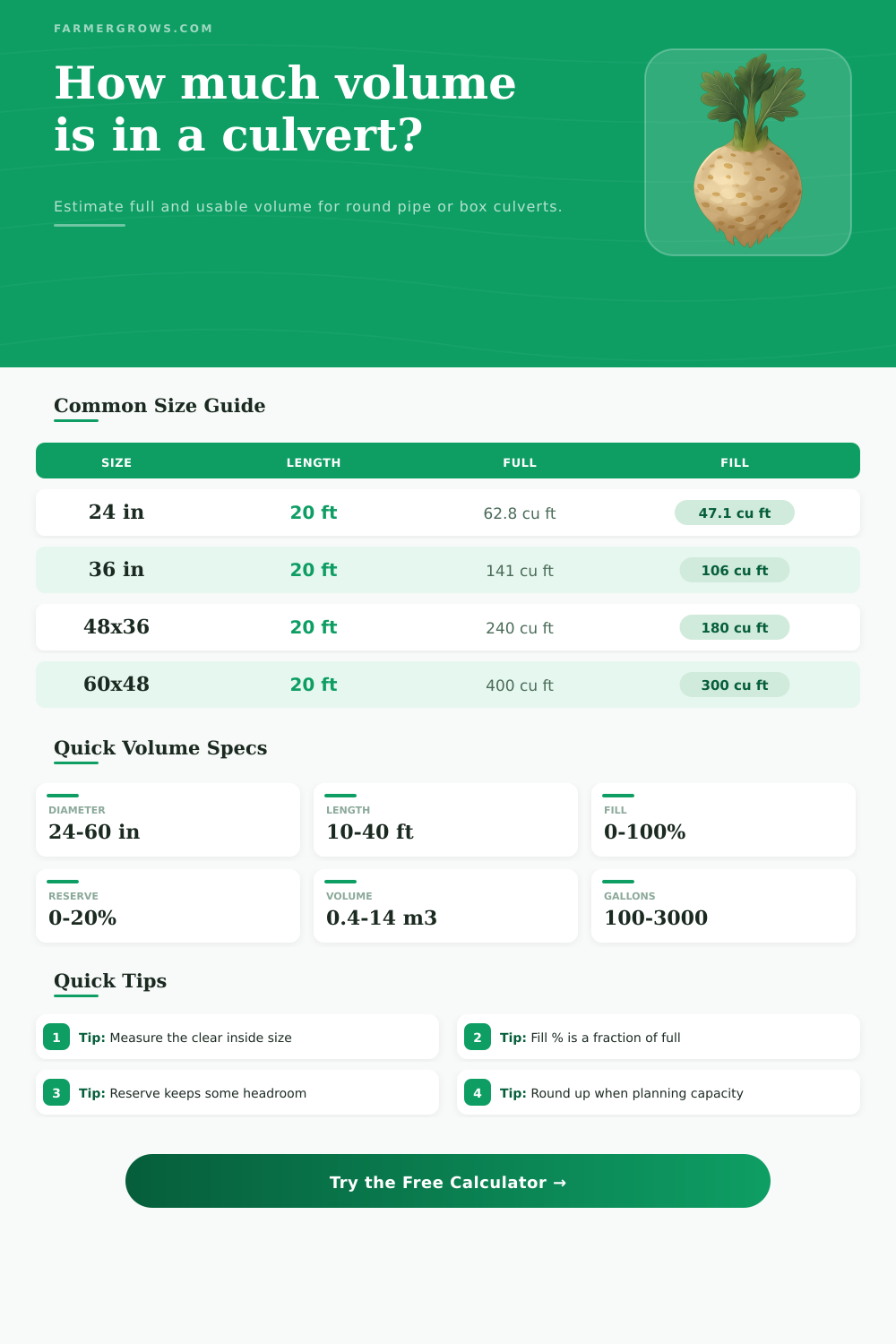
| Shape | Size | Volume / Length | 20 ft Volume |
|---|---|---|---|
| Round | 24 in dia | 1.57 cu ft/ft | 31.4 cu ft |
| Round | 36 in dia | 3.14 cu ft/ft | 62.8 cu ft |
| Box | 48 x 36 in | 12.00 cu ft/ft | 240 cu ft |
| Box | 60 x 48 in | 20.00 cu ft/ft | 400 cu ft |
| Project | Shape | Length | Full Volume |
|---|---|---|---|
| Driveway crossing | 36 in round | 20 ft | 62.8 cu ft |
| Farm lane drain | 48 x 36 box | 20 ft | 240 cu ft |
| Field outlet | 60 in round | 30 ft | 589 cu ft |
| Metric crossing | 1200 x 900 | 12 m | 12.96 m3 |
When you are selecting a culvert, you must calculate the volumes of the culvert that will be created. The volume of the culvert will determine how much water or material can held by the culvert. If the culvert is too small for an amount of water or material that must pass through it, then either a washout or flood will occur.
If the culvert is too large, though, money will be wasted on the purchase of the culvert and it’s material. Thus, the culvert that is selected should be of the appropriate size to avoid either of these situation. In order to calculate the volume of the culvert, you must measure the interior diameter of the culvert.
How to Find the Volume of a Culvert
The manufacturer may stamp the size of the culvert on the outside of the culvert, but that is the exterior diameter of the culvert, not the interior diameter. The interior diameter is the only measurement that is important in calculating the volume of the culvert. For instance, a 36-inch culvert will have a smaller interior diameter than the 36-inch exterior diameter because the thickness of the walls of the culvert take up some of that diameter.
Thus, you should use the interior diameter of the culvert in all calculations regarding its volume. The culvert will have a certain geometry that will help to determine the equation that must be used to calculate the volume of the culvert. If the culvert is round, for instance, you can calculate the volume by multiplying pi by the radius of the culvert squared and multiplying that value by the length of the culvert.
If the culvert is a box culvert, the volume is calculated by multiplying the width of the culvert by the height of the culvert and multiplying that value by the length of the culvert. Box culverts are often used because they can have the same shape as the ditch in which they will be installed. Round culverts, though, is often used because they are more flexible and can better absorb the load of heavy objects passing over the culvert.
It is not necessary for the culvert to be planned to fill to its total capacity. Manufacturers of culverts, for instance, often recommend that there be a 10 percent reserve in the culvert in case of heavy rains or other situations in which there is an influx of water into the culvert. Additionally, sediment may become present in the culvert that would fill some of the capacity of the culvert to hold water.
Thus, leaves or other forms of trash may also fill some of the culverts capacity to allow water to pass through it. Therefore, the volume that is calculated for the culvert should be a practical volume that reflects the conditions in which it will be used rather than the theoretical volume that may be calculated. Common culvert sizes include round culverts with diameters of 24 inches and 36 inches, for instance.
A 24-inch culvert that is 20 feet in length will hold a certain amount of volume, but a 36-inch culvert will hold more volume then the 24-inch culvert. Box culverts may also be of common sizes, as well. For instance, a box culvert that is 48 inches in width by 36 inches in height will provide twelve cubic feet of volume for every one foot of length of the culvert.
These sizes can be used to ballpark the needs of the culvert before beginning to dig the site for it’s installation. There may be some errors in calculating the volume of the culvert. For instance, the measurements of the culvert may be incorrectly measured, or the incorrect units may be used when calculating the volume of the culvert.
For example, if the units of inches are used, but the length of the culvert is to be measured in feet or metric units, the volume of the culvert will be incorrectly calculate. In addition to the units of measurement, the slope of the land may need to be considered when calculating the volume of the culvert. For instance, if the slope of the land is too steep, the water will move too quickly through the culvert.
However, if the slope is too shallow, the water may not move quick enough out of the culvert. Finally, another consideration for the culvert is its maintenance. The culvert should be constructed in a way that allows for it to be kept clean of any sediment that may accumulate in it.
If the sediment fills the bottom of the culvert, the volume that the culvert can hold will be less than expected. Thus, you can construct the culvert to allow for easy access to its interior for the removal of any sediment that may have accumulated in it during use. Overall, then, the culvert should be sized appropriately, allow for a reserve margin for high volumes of water, and include considerations for its maintenance to prevent floods from occurring and to prevent damage to the driveway or road in which it is installed.