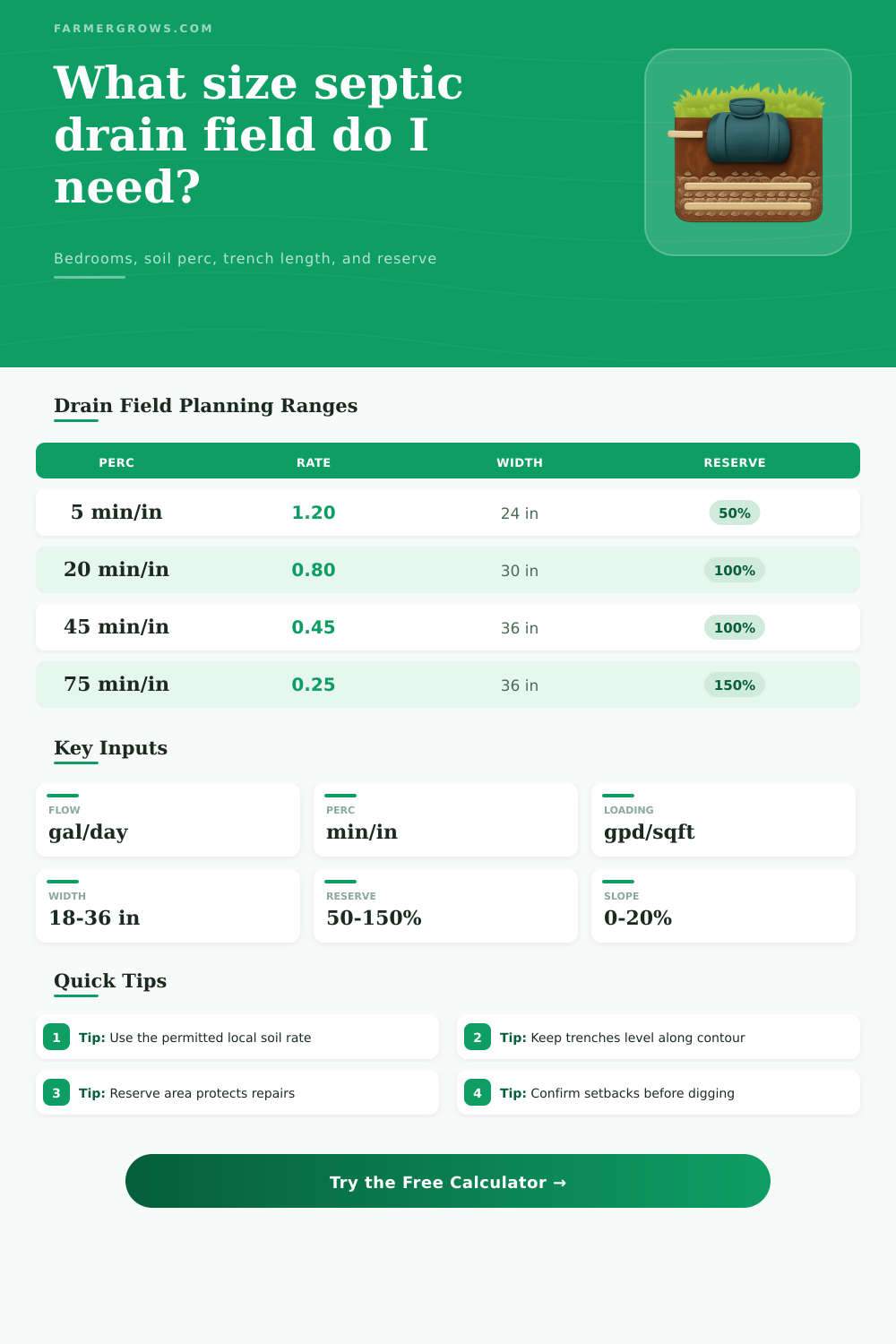
Septic Tank Drain Field Size Calculator
Estimate septic drain field trench bottom area, total line length, reserve area, slope adjustment, distribution box ports, and line count from bedrooms, daily design flow, perc rate, soil loading, and trench width.
This planning tool uses common septic layout math, not a permit. Enter the design flow and the loading rate required by your local authority or designer before using the length, reserve, and distribution box results.
| Soil or perc band | Typical perc range | Planning loading rate | Drain field effect |
|---|---|---|---|
| Coarse sand or gravelly soil | 1 to 5 min/in | 0.90 to 1.20 gpd/sq ft | Fast soil; verify treatment and separation limits. |
| Sandy loam | 6 to 15 min/in | 0.75 to 0.90 gpd/sq ft | Moderate field size when other site limits pass. |
| Loam | 16 to 30 min/in | 0.55 to 0.75 gpd/sq ft | Common planning range for many rural lots. |
| Silt loam | 31 to 45 min/in | 0.40 to 0.55 gpd/sq ft | Longer trench length and more footprint. |
| Clay loam | 46 to 60 min/in | 0.30 to 0.40 gpd/sq ft | Slow acceptance; design review is important. |
| Very slow clay | 61 to 90 min/in | 0.20 to 0.30 gpd/sq ft | Large field or alternative system may be needed. |
| Bedroom count | 120 gpd/bed | 150 gpd/bed | Common design note |
|---|---|---|---|
| 2 bedrooms | 240 gpd | 300 gpd | Small home or cabin design flow. |
| 3 bedrooms | 360 gpd | 450 gpd | Frequently used single-family baseline. |
| 4 bedrooms | 480 gpd | 600 gpd | Needs more trench bottom area. |
| 5 bedrooms | 600 gpd | 750 gpd | Check line length and D-box capacity. |
| 6 bedrooms | 720 gpd | 900 gpd | Reserve area can dominate the lot fit. |
| Bottom width | Sq ft per 100 ft | Best use | Layout note |
|---|---|---|---|
| 18 in trench | 150 sq ft | Tight repair work | More total line length needed. |
| 24 in trench | 200 sq ft | Small to medium homes | Balanced excavation and length. |
| 30 in trench | 250 sq ft | Common gravity trench | Good default for planning checks. |
| 36 in trench | 300 sq ft | Slow soils or larger fields | Wider bottom reduces length but increases footprint. |
| Planning item | Typical range | Calculator role | Field check |
|---|---|---|---|
| Maximum trench length | 75 to 100 ft | Splits total length into lines | Use the local maximum for gravity trenches. |
| Distribution box outlets | 2 to 8 outlets | Compares line count to usable ports | Add outlets or shorten max length if needed. |
| Reserve replacement area | 50% to 150% | Calculates separate future area | Many sites require a full replacement area. |
| Site slope | 0% to 20%+ | Adds layout allowance and warning | Place trenches level along contour. |
Soil rate tip: Do not choose the fastest-looking number from a field test. Use the accepted perc rate or loading rate from the local health department, designer, or permit worksheet.
Layout tip: Keep gravity trenches level along the contour, maintain required setbacks from wells and water bodies, and reserve an undisturbed replacement area before final staking.
When a home is situated beyond the reach of city sewers, the soil itself will be the last line of defense in treating the wastewater from the septic tank. The drain field has to distribute the effluent over a certain area of the site for the soil to complete the treatment process started by the septic tank. If the person that builds the drain field sizes the drain field incorrectly, then the person will experience the consequences of soggy grass, foul odors, and the need for a new drain field.
The size of the drain field is not determined by a single factor; instead, the factors of the soil, the flow of the wastewater in the drain field each day, and the layout of the drain field determines the size. The first factor to consider when calculating the size of the drain field is the volume of wastewater that the house will release each day. The building codes for septic systems relates the number of bedrooms in the house to the amount of wastewater that the occupants of the house will release each day.
How to Size a Septic Drain Field
The number of people in the house is the variable that changes from day to day. For the example of a house with three bedrooms, the residents of the house can release 450 gallons of wastewater each day. However, if the number of people in the house increases, for instance, if an office or in-law suite is added to the house, then the house will release more wastewater, as well.
Although the individual uses the number of bedrooms in the house to calculate the flow of wastewater from the house each day, the calculator allows the individual to adjust this figure to reflect the actual number of people in the house. The second factor to consider in the sizing of the drain field is the type of soil in which the drain field will be built. In order to determine the rate at which water drains through the soil in the lot, a perc test can be performed.
The loading rate of the soil is calculated from the perc test as a number of square feet per gallon. If the soil on the plot of land contains sand, which drains quick of water, the loading rate will be relatively high; this means that the size of the drain field will be relatively small. In contrast, if the soil is clay, which does not permit water to drain quickly, the loading rate will be low; therefore, more area for the drain field is required.
There is a reference table on this page that lists the loading rates for different types of soil. The third factor in the sizing of the drain field is the width of the trench. If the trench is wider, the wastewater load will be distributed over a larger area; this leads to a reduction of the length that the drain field lines must be constructed to dispersing the effluent from the septic tank.
If the trench is narrow, less money will be spent on excavation of the site for the drain field. However, the narrow trench will require the drain field to extend over a larger area on the plots of land that are to be developed. The calculator will provide the length of the drain field once the user sets the width that they plan to use for their drain field.
This length will be the number of lines of drain field that are to be constructed. Each of these lines requires an outlet for the wastewater from the septic tank to exit from the distribution box. Therefore, if the distribution box has fewer outlets than the length of the trench that is calculated, the person will either need to purchase a distribution box with more outlets, or reduce the length of the drain field.
The slope of the land on which the drain field is to be constructed is another variable in the sizing of the drain field. If the land slopes gently, the drain field can follow the slope of the land. If the land slopes steeply, adjustments to the layout of the drain field must be made.
For instance, the trenches may need to be shorter in length so that the septic field lines remain level with the ground. If the site of the septic field slopes at a greater rate than the default settings for the tool, a multiplier will be applied to the length of the trench. This number is merely a reminder to those creating the drain field that the slope of the land has the potential to create mistakes in the construction of the trench.
Another variable to consider is the size of the area that is to be reserved for the future repair of the drain field. Building codes require the establishment of a reserve area of land that is a second patch of land that is to be sized as a percentage of the drain field itself. The percentage area of the reserve field varies according to soil type.
On fast-draining soils, the area of the reserve field can be 50% of the area of the drain field; on marginal soils, the percentage increases to 150% of the area of the drain field. The purpose of this patch of land is to allow for repairs to the drain field without having to excavate the original drain field. This patch of land takes up area that could of been utilized for a lawn or a garden plot for the homeowner.
The sizing of the drain field calculates the area of the reserve field; this can help the homeowner to decide if there land plot is large enough to accommodate the drain field that they would like to build. Another factor in the sizing of the drain field is the capacity of the distribution box for the septic tank, as well as the distance between the trenches. If the trenches are closer together, the trenches will be less in number, but more in the area of the development plot.
The advantage of having trenches closer together is that there is less area for the wastewater to spread beyond the drain field. The disadvantage is that if any of the drain fields becomes saturated with water, it can impact the function of the next trench. The other option is to space the trenches farther apart.
This allows for the septic field to dry between doses of wastewater. The distance between the trenches can determine the approximate size of the footprint of the drain field. This size can help the builder to determine if the number of trenches will fit into the setbacks from the house wells, property lines, and surface water on the plot.
Many mistakes are made when establishing the size of the drain field. One of the most common is using the perc value from a cheap perc test to determine the loading rate; a better perc test would be performed by the soil evaluator before setting the perc rate to a fraction of a gallon per square foot. Another mistake is to use the loading rate that was established when the permit for the house was obtained; after purchasing another bathroom, for instance, the loading rate will have to be increased.
Another mistake is to size the drain field according to the minimum flow rate of wastewater; if the number of people in the house has increased beyond the number initially used in calculating the size of the drain field, the grass will become wet. Although this tool doesnt replace a visit from a septic contractor to the site, it does allow individuals to make informed decisions about the sizing of the drain field. Using the drainage field size calculator allows an individual to see how each of the variables impacts the others.
If a tenth of a gallon per square foot increases the loading rate, the length of the trench will decrease. If the width of the trench is increased by six inches, there may be the potential to remove an entire line of drain field trenches. If the area of the drain field is increased by 20% to provide for a sloped plot of land for the drain field, the area of the reserve field will increase.
These types of connections between the sizing and the drainage field can help an individual to understand how each of these variables relates to the others. A drain field is a type of biological filter; it works best in soils that are unsaturated, with a consistent flow of the wastewater from the septic tank, and with a sufficient area for the microbes that naturaly live in the drain field to complete their processes. The drain field will require unsaturated soil and a consistent flow to function correctly.
The relationships between these factors can be made visible to the individual that uses the drain field size calculator.