
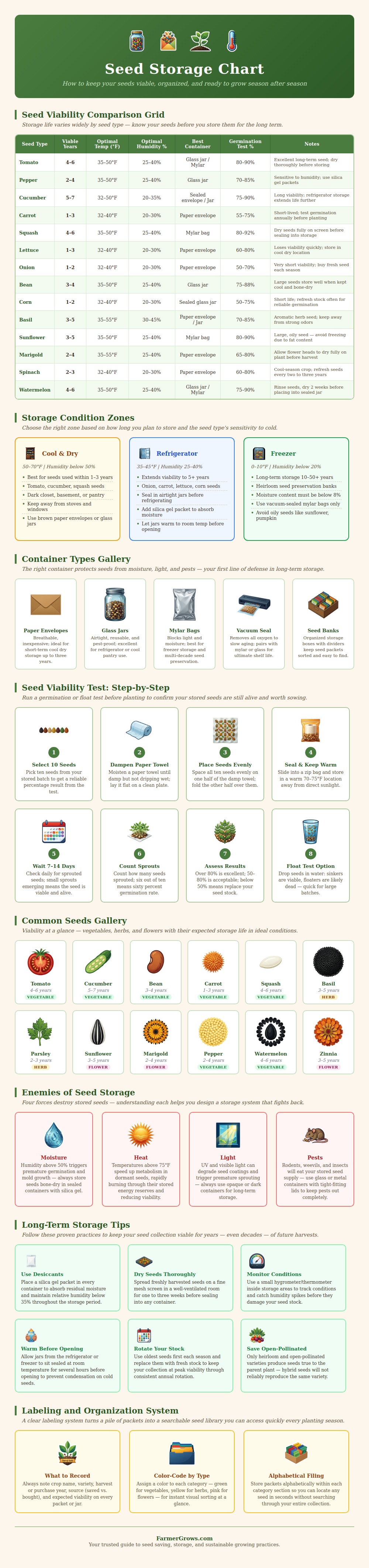
Seed storage is a process that require specific conditions for the seeds to remain viable. Seeds are a form of living tissue that contains a finite amount of energy that the seed can utilize to germinate. If the conditions within the environment in which the seeds are stored are too warmly or too humid, the seeds will utilize their energy to germinate, and eventually, the seeds will lose their ability to germinate.
In order to avoid this issue with the seeds, it is important for farmers to utilize a storage chart to ensure that there stored seeds is maintained in conditions that will allow them to remain viable for later planting. Temperature and humidity is the two factor that have the most significant impact upon the length of time that the seeds remain viable. High temperatures will contribute to the germination of the seeds, and high humidity will lead to the sprouting or mold growth on the seeds.
How to Store Seeds
To avoid these effect, farmers should store different types of seeds in different locations within the farm and within the farmers houses. For example, seeds that will germinate within two years can be stored in a cool and dark pantry location. However, seeds that lose their viability quick should be stored in the refrigerator.
Additionally, if farmers would like to store their seeds for extensive length of time, they can store the seeds in a freezer. However, the seeds must first be dried to a low percentage of humidity prior to storage in the freezer. Another factor that can impact the viability of stored seeds are the container in which the seeds are stored.
Seeds can be stored in paper envelopes, but only for short periods of time due to the ability of the humidity to enter the paper envelope and damage the seeds. Seeds can also be stored in glass jars, but only after the seeds have been dried. Mylar bags prevent the entry of light into the bag, and one can vacuum-seal mylar bags to allow for the long term storage of seeds.
Additionally, one can place a silica packet within the container to prevent the entry of moisture into the container. A viability test can be performed on stored seeds to determine their ability to germinate. One type of test involve placing ten seeds within a damp paper towel and allowing the towel to sit in a warm location for a period of one to two week.
If six or more of the ten stored seeds sprouted, then the seeds still have viability; otherwise, the seeds should be replaced with new seeds. Alternatively, one can perform a float test. This test involves placing the seeds in a period of water.
Viable seeds will sink to the bottom of the water container, while non-viable seeds will float. There are four main factor that can lead to the failure of seed storage. Seeds can fail to store well if the moisture within the environment is too high, as the seeds will rot.
Additionally, if the temperature within the storage areas is too high, the stored seeds will burn through their energy supply. Additionally, if light exposes the stored seeds, the seed coat will degrade. Finally, if the stored seeds are susceptible to pest, those pests will eat the seeds.
Each of these factor can be avoided by storing the seeds in containers with tight lids, in dark locations, and within cool temperature. Lastly, farmers must label the stored seeds. Each label should include the type of crop, the variety of that crop, and the year in which the seeds were collected.
Without the use of labels, farmers wont be able to identify the content of each labeled container. Furthermore, different color can be used for each type of labeled container. Using color coding will make it more easier for those farmers to find the specific types of seeds that they require.
By using a labeling system, farmers will be able to manage their stored seeds for many year.