Seed Starting Calculator
Plan indoor sowing dates, frost-safe transplant timing, direct sow windows, germination temperature, tray space, and succession rounds for common garden crops.
⚙Named crop presets
🌱Seed schedule inputs
📊Planning comparison grid
Indoor start
Calculate to see seed date, hardening start, transplant date, and tray count for the selected crop.
Direct sow
Calculate to see the earliest outdoor sowing window and the likely emergence date.
Succession plan
Calculate to see repeated sowing dates spaced by your chosen interval.
🧮Tray and seed totals
📘Crop timing reference
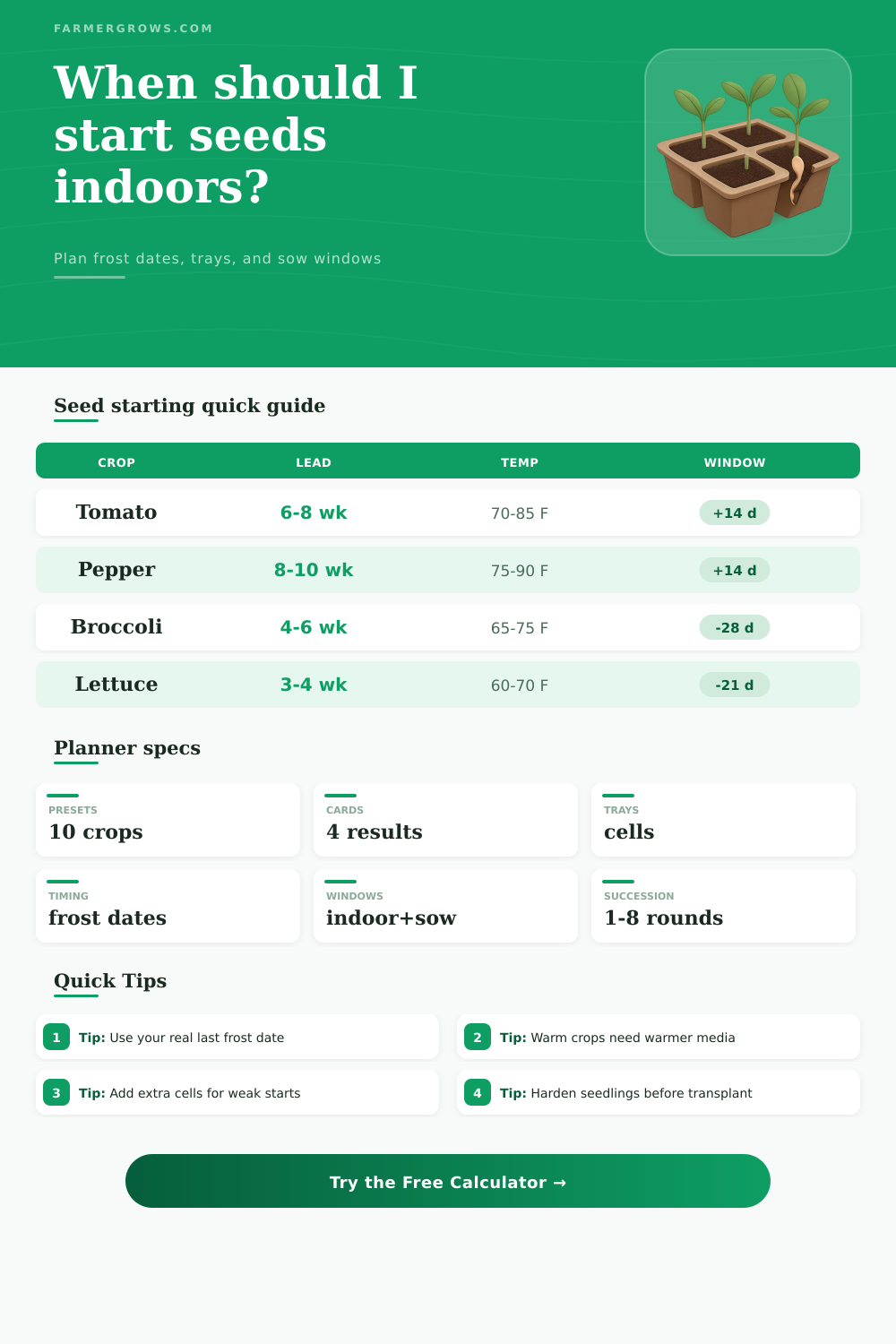
| Crop | Indoor lead | Germination temp | Transplant timing | Direct sow timing |
|---|---|---|---|---|
| Tomato | 6 to 8 weeks | 70 to 85°F | 1 to 2 weeks after frost | Usually transplanted |
| Pepper | 8 to 10 weeks | 75 to 90°F | 2 weeks after frost | Usually transplanted |
| Broccoli | 4 to 6 weeks | 65 to 75°F | 2 to 4 weeks before frost | 2 weeks before frost |
| Lettuce | 3 to 4 weeks | 60 to 70°F | 2 to 3 weeks before frost | 3 weeks before frost |
| Cucumber | 3 to 4 weeks | 70 to 90°F | 1 to 2 weeks after frost | 1 to 2 weeks after frost |
🌡Germination temperature guide
| Crop group | Good range | Slow below | Best tool |
|---|---|---|---|
| Cool leafy greens | 60 to 70°F | 50°F | Unheated tray or cool bench |
| Brassicas | 65 to 75°F | 55°F | Warm room, no extra heat after sprout |
| Tomato and basil | 70 to 85°F | 60°F | Heat mat until emergence |
| Pepper and eggplant | 75 to 90°F | 65°F | Thermostat-controlled heat mat |
🗓Succession interval reference
| Crop style | Typical interval | Common rounds | Planning note |
|---|---|---|---|
| Cut lettuce and salad greens | 7 to 14 days | 4 to 8 | Short intervals keep harvests tender. |
| Broccoli and cabbage starts | 14 to 21 days | 2 to 4 | Use fewer rounds in hot summers. |
| Cucumber and summer squash | 21 to 28 days | 2 to 3 | Later sowings replace tired vines. |
| Carrot and beet beds | 14 to 21 days | 3 to 6 | Keep seedbeds evenly moist. |
🧺Tray capacity reference
| Tray insert | Best for | Cell count | Crop examples |
|---|---|---|---|
| 24-cell insert | Large seedlings | 24 plants | Cucumber, squash, pumpkin |
| 50-cell tray | Medium transplants | 50 plants | Tomato, basil, marigold |
| 72-cell tray | General starts | 72 plants | Broccoli, kale, lettuce |
| 128-cell tray | Small plugs | 128 plants | Onion, herbs, flowers |
💡Practical timing tips
Timing is a critical factor in gardening because the timing will determine whether the seed develops into a healthy plant or a weak plant. Many people experiences difficulties with the proper timing of when to begin to plant the seeds indoors. If you begin the seeds indoors too early, the plants will develop leggy roots and be too large for an containers in which they are growing.
However, if you begin the seeds too late, the plants will not have enough time to develop before the growing season ends. Therefore, you need to calculate the proper timing for planting the seeds indoors by counting backward from the date that you will begin to plant the seeds in your garden. The last frost date in your area is another critical date to consider when determining when to begin to plant your seeds indoors.
When and How to Start Seeds Indoors
However, the last frost date is only an average; it is possible for a frost to occur after the last frost date and can kill the young plant seedlings. Therefore, you must consider the specific condition that each type of seed requires to germinate. For example, pepper plant require warm temperatures to germinate, while lettuce seeds require cool temperatures to germinate.
Each type of seed does not germinate in the same way; thus, you cannot treat all of your seeds in the same manner. Another consideration is the germination temperature of your seeds. The germination temperature is the temperature of the growing medium in which the seed will sprout.
Many people believe that warm air is the necessary temperature to allow the seed to germinate; however, the seed will only germinate if the growing medium is warm. You can use heat mats to warm the growing medium for the seeds. Heat mats are helpful for seeds of warm season plants, such as eggplant and peppers, but they can be detrimental to cool season plants, such as kale and broccoli.
If you place cool season plants on heat mats, the plants may enter into a state of dormancy or may even develop a disease known as damping off. Another consideration is the physical capacity of your gardening equipment. If you would like to grow twenty tomato plant, you will have to account for the fact that not every planted seed will germinate into the necessary number of plants.
Therefore, you should begin with more seeds than you would like to grow from your planted seeds. This provision ensures that you will not run out of plastic cell in your seed tray; planning your tray capacity is essential in determining how many seed you will need to begin with. Succession planting is another method that some gardeners utilize in there gardens.
Succession planting is the process of planting seeds in multiple stages rather than planting all of your seeds at once. If you plant all of the seeds at once, you may experience a glut in your harvest of produce from your garden. However, if you use succession planting, you will have a rolling harvest of your plants.
Succession planting is a good method to use for root crops and leafy plants because these types of plant will bolt if the temperatures in your garden become too high. Therefore, succession planting ensures that you will have a steady supply of vegetables throughout the season. Hardening off is another process that you must complete on all of the plant that you will be moving from indoors to outdoors.
If you do not harden off the plants, the change in their environment may shock the plants and they may die as a result. Hardening off is the process of training your plants to become accustomed to the wind and sunlight outside of your greenhouse or indoor area. You can accomplish hardening off by exposing your plant to the elements for one week.
Begin with one hour of shade exposure, and then daily gradually increase the amount of sunlight that the plant is exposed to. By hardening off your plants, they will be strong enough to survive in your garden when you begin to move them into their outdoor location.