🌱 Seed Rate Calculator
Turn target stand, seed lot quality, row spacing, and field area into a precise seeding rate in kg/ha, lb/ac, and total seed.
✅ Seed Rate Results
Enter your values and click calculate.
Seed Rate Guide at Common Stands
These estimates assume a standard drill, about 95% germination, 88% emergence, 99% purity, and a 10% buffer.
| Stand | 3.5 g | 4.0 g | 5.0 g |
|---|---|---|---|
| 55 plants/m² | 2.8 kg/ha | 3.2 kg/ha | 4.0 kg/ha |
| 70 plants/m² | 3.6 kg/ha | 4.1 kg/ha | 5.1 kg/ha |
| 85 plants/m² | 4.4 kg/ha | 5.0 kg/ha | 6.2 kg/ha |
| 100 plants/m² | 5.1 kg/ha | 5.9 kg/ha | 7.3 kg/ha |
Seed Size and Seed Count
TKW controls how many seeds fit in each kilogram or pound, which is why small seed lots often drill lighter rates.
| TKW | Seeds/kg | Seeds/lb | Note |
|---|---|---|---|
| 3.5 g | 285,714 | 129,730 | Tiny lot |
| 4.0 g | 250,000 | 113,398 | Common lot |
| 4.5 g | 222,222 | 100,898 | Heavier lot |
| 5.0 g | 200,000 | 90,718 | Large lot |
Row Spacing and In-Row Seed Gap
This table uses a 70 plants/m² target and shows how spacing changes the number of seeds needed along each row.
| Spacing | Seeds/m | Seeds/ft | Gap |
|---|---|---|---|
| 15 cm | 10.5 | 3.2 | 9.5 cm |
| 20 cm | 14.0 | 4.3 | 7.1 cm |
| 30 cm | 21.0 | 6.4 | 4.8 cm |
| 38 cm | 26.6 | 8.1 | 3.8 cm |
Spacing and Establishment Guide
Most crops perform best with firm seed contact and enough moisture to avoid crusting and uneven emergence.
| Field | Spacing | Buffer | Note |
|---|---|---|---|
| Firm moist | 1.0-1.5 cm | 0-5% | Best start |
| Normal seedbed | 1.5-2.0 cm | 5-10% | Common |
| Dry topsoil | 2.0 cm | 10-15% | Use care |
| Cloddy/no-till | 1.0-1.5 cm | 15-20% | Watch contact |
Calculating the correct seed rate for you field is a necessary process. Using the wrong rate will result in either not achieving the target plant stand or wasting on expensive seed. The target plant stand is the number of plants per square meter that you would like to grow.
For cereals, a common target stand is between 55 and 80 plants per square meter of acre. However, the actual number of plants will depend upon a few different factors. One factor is the germination rate of the plants.
How to Find the Right Seed Rate for Your Field
The germination rate is the percentage of the seed that will sprout. Another factor is the purity of the seed. The purity of the seed is the percentage of the bag of seed that is live and contains the DNA of the plant species.
If these two factors is not accounted for, you will not achieve your target plant stand. Another factor that impacts the rate at which you should seed your fields is the thousand seed weight (TKW) of the crop. The TKW is the weight of 1,000 seeds of that plant species.
If the plants has a heavy TKW, you will need to add more weight to the soil to achieve your target plant stand than if the TKW is relatively light. Finally, the row spacing will impact your seeding rate. Row spacing will impact the number of plants per meter of row.
If the rows are narrow, such as 15 centimeters, then there can be more plants within each row. Wide rows, such as 38 centimeters, will require more seed per meter of row. Another factor that will impact the rate at which you need to plant your seed is the seeding method.
For example, if you use a drill to plant your seed, you will require a differently rate of seed than if you use broadcast seeding. Broadcast seeding is a less precise method of setting rates because the seeds may not fall evenly onto the field. You will have to increase the rate at which you are planting seed if you use this method.
Furthermore, you will have to add a buffer to the rate of planting to account for any losses of seed to birds or skipped rows by the seeding equipment. A 10% buffer is usually added to the rate of planting seed. However, if the field is difficult to seed, you may have to use a larger buffer.
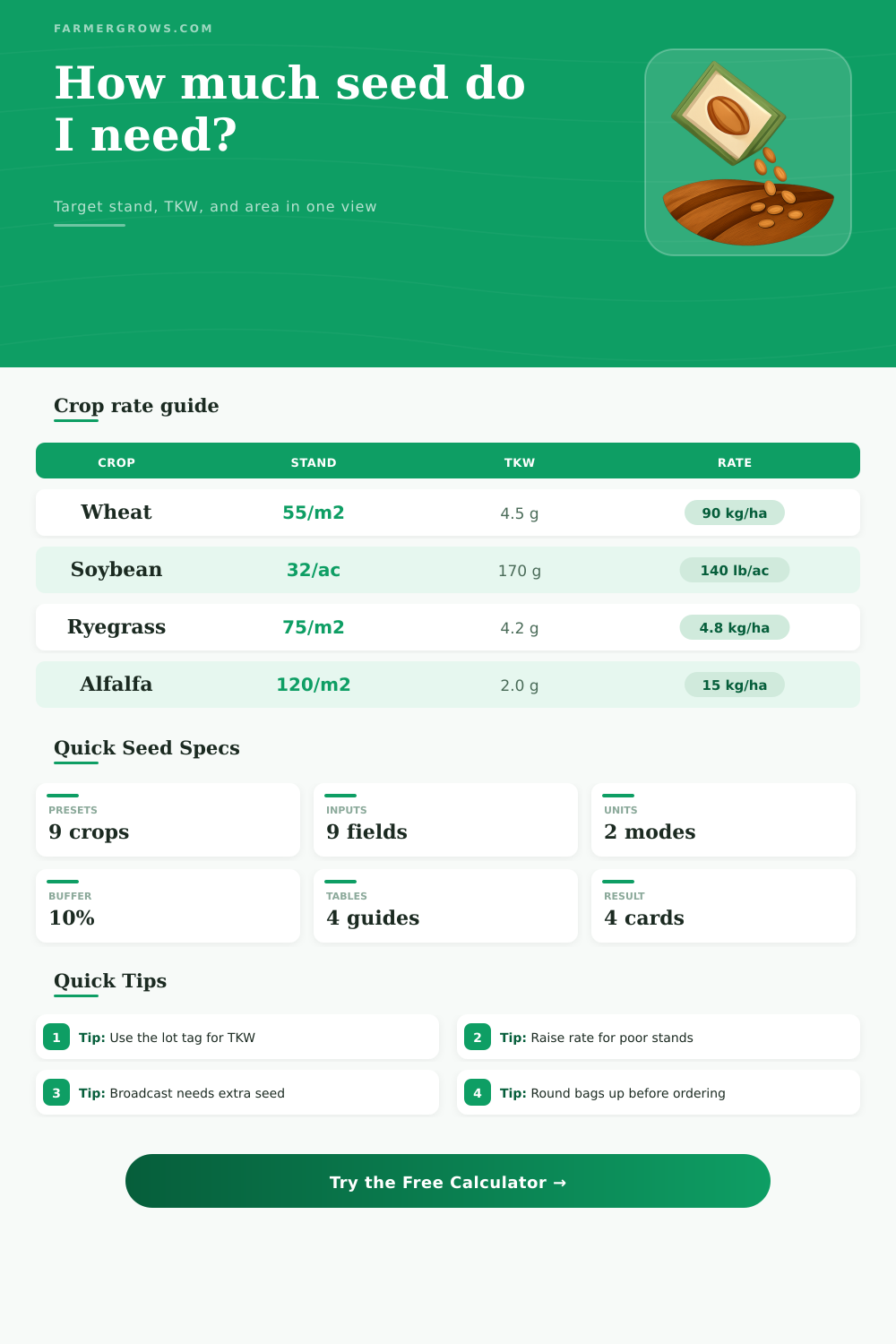
Calculators are available that will determine the total amount of seed that will be required for your field. All that is required is that you input factors such as target plant stand, thousand seed weight, germination rate, row spacing, and the type of method in which you will be planting the seed. The calculator will provide information regarding the rate of seed to be planted per hectare and the number of bags of seed that you will have to purchase.
Furthermore, if you are planting a 25-hectare field, the calculator will provide information regarding the amount of kilograms of seed that will be required to fully seed the 25-hectare field. Using a calculator for determining the amount of seed that is required for your fields is better than guessing at the amount of seed that is needed. If you guess at the amount, you may either have to purchase too much seed, or you may not have enough plants to achieve your target plant stand.
Some of the mistakes that farmers make when calculating the amount of seed to be planted into each field include ignoring the seed tag. The seed tag will contain information regarding both the germination rate of the seed and the purity of that seed. Furthermore, farmers often use the same rate of seed for each field they own.
However, the conditions of each field may differ such that different rates of seed may be required in different fields. For example, if the soil within a field is relatively cold to the touch, you may have to adjust the rate at which the seed is planted into the soil or the depth at which you are planting the seed. Additionally, fields with heavy amounts of crop residue in the soil may require farmers to adjust the buffer for the rate at which they are planting the seed.
Row spacing is one of the most important factors to consider when planting seed into your field. If farmers use narrow rows in their fields, the rows will provide more shade for the soil. More shade for the soil will prevent the growth of weeds.
However, the gaps between each plant within the narrow rows will be critical to preventing the plants from falling over. Wide rows allow for farmers to use heavy farming equipment to prepare the fields. However, if the rows are wide, you will have to plant more seeds per meter of row to achieve the same plant stand.
Reference tables are available that will allow farmers to see how many seeds is required within each meter of row for each type of row spacing. Many calculators allow farmers to use presets for certain types of conditions for their fields. Presets allow farmers to save settings for conditions such as germination rates for no-till planting methods, buffers rates for broadcast seeding methods, and even to be able to switch between units from metric to imperial and vice versa.
If farmers work with acres and feet for their fields, the presets can be adjusted so that the calculator displays only measurements in acres and feet for those fields. The environment in which the fields are planted will impact the number of plants that emerge within the fields. The amount of water that is in the soil will affect the emergence of the plants.
If the topsoil within the field is very dry, the rate at which the seed is planted will have to change. If there is too much water in the soil, the emergence of the plants will also have to change. The fertility of the soil will also affect the plants that emerge from the fields.
If the field is extremely fertile, each plant will grow more tillers than if the soil were less fertile. Therefore, the rate at which the seed is planted will have to change in these fields. Additionally, the entire system for these farms and fields will have to be considered when calculating the rate at which the seed is to be planted.
If the correct rate is calculated for each field, the plants will emerge in a uniform way across the fields.